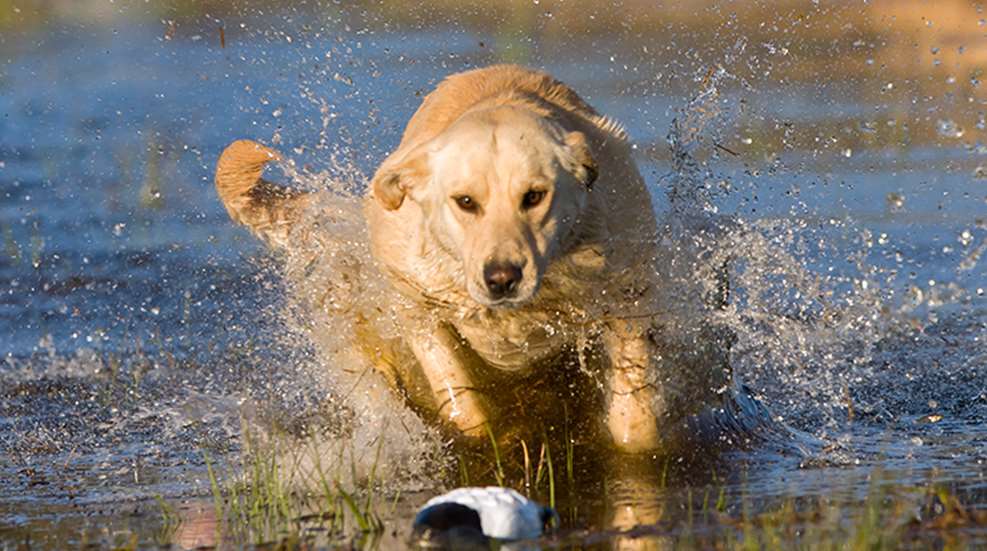
The Lab walked obediently into his blind and sat watching as a half-dozen hunters set out a few dozen full-bodied decoys. He remained in it as they called, as flock after flock circled and passed, wings whistling. He stayed as guns fired and ducks thumped to land. He didn’t even whine. And then he ran to fetch when commanded.
“Fantastic control,” I complimented the dog handler. “How old is he, 4 or 5?”
“No, just 18 months.”
Yikes. That was insane composure and performance for such a young dog, and it showed in his demeanor. He appeared to be one of the unhappiest dogs I’d ever seen hunt. He was the adjective “robotic” personified.
I don’t pretend to be an expert on what makes one dog a whirling ball of hyperactive enthusiasm and another an automaton going through the motions, but like most hunters, I’d prefer a balance of both. I think you get that through patience mixed with long and thorough positive reinforcement training.
Most of us know dogs need to mature before they can handle serious learning. As pro-trainer and senior manager at Nestlé Purina PetCare, Karl Gunzer has seen hundreds, probably thousands, of dogs in various stages of training. They have taught him much about patience, and how and when to properly apply it.
“Physically and mentally dogs must mature, just as people must,” he said to introduce this idea of applying patience in training. “And patience is related to time. But it’s more a mind-set than ticks on a clock. You can wait two minutes and you’ve waited too long to repeat something—or you can wait two weeks and be too hasty.”
Knowing which is which takes patience of its own. Be patient with yourself. Take the time to study situations, research dog behavior and uncover training options before proceeding. That’s only fair to you and your four-legged student.
Gunzer referenced the dictionary description of patience to put things in perspective: being able to accept or tolerate delays, problems or suffering without becoming annoyed or anxious.
“The more I thought about this, the more I realized being annoyed or anxious are two pretty poor qualities for a teacher,” he noted.
That leads to Gunzer’s main point about patience in training: it’s mostly a mind-set, an attitude. Adopt the mindset that you aren’t going to rush things, aren’t going to lose your cool and aren’t going to set back your student’s training by becoming anxious.
“With that mind-set,” the dog man explained, “you’re ready to motivate your dog. Any student learns faster and better if motivated, and what motivates a dog is success and praise, in that order.”
And that brings us to the well-known basis for most successful dog training. You build a learning foundation by rewarding Dog for things he already does and by overlaying commands while doing so. Dog sits, you say “sit” and then reinforce with praise or a treat. At some point the command “sit” initiates a Pavlovian response, and reward cements it. Move on to the next command, but repeatedly and regularly return to “sit.” As Gunzer pointed out, “repetition of success prevents impatience.”
Pretty soon you’re adding “stay,” “here,” “down” and are ready to move on to “fetch.” Most trainers start their sessions with commands Dog knows well. Dog succeeds, gets rewarded and is enthusiastic to continue learning. You get rewarded, too, making it that much easier to be patient. You build on success but regularly reinforce that foundation.
Patience can be tested when Dog refuses to catch on to a new task. The key here is discovering the motivator. Gunzer once faced this with a pup that wouldn’t fetch a bumper. She’d run to it but then ignore it. After three tosses, she wouldn’t even run toward it. After weeks of trying (and plenty of frustration, I’m guessing) Gunzer tossed a wing-clipped pigeon instead of that boring bumper. The pup not only grabbed the bird, but brought it back to Gunzer. Game on! “Two more tosses and she was a retrieving demon,” Gunzer said. Instead of leaning on the pup and forcing the issue, he’d kept his patience until he found the right motivator.
Another way to reinforce your patience is to strive for good rather than perfect. “Train for improvement and learning, not perfection,” Gunzer advised. “If your goal is improvement, you constantly succeed. If your goal is perfection, you’ll always fail.” With enough improvement, you might realize one day you’re pretty darn close to perfection.
When assessing any dog’s learning speed, take into account not only its age and previous successes, but also its genetics. Some breeds are slower at learning than others, and this usually correlates with their rate of maturation. Give the slower maturing/learning breeds more time. Don’t expect your 6-month-old golden to match your buddy’s 6-month-old Labrador.
At some point we all face a recalcitrant dog that just won’t do what it is commanded to do. At these times it’s critical to distinguish mistakes from willful disobedience. A charge that’s been retrieving eagerly and repeatedly but then suddenly doesn’t is more likely to be guilty of disobedience. It might be testing who’s boss. But a new retriever might just be confused about a new route, new bumper or unusual distractions. As teacher it’s your job to read and interpret before applying correction. Even then, go back to easy commands first to get Dog in the spirit for cooperation.
Corrections are sometimes necessary, but don’t rush to judgment. Strive to find a motivator you can combine with positive reinforcement to get the teaching done. Use patience to get Dog wanting to learn and succeed. I’ve rarely met a dog that didn’t love to hunt, sniff, search, run, chase and fetch. Our jobs are to direct them into the best ways for doing these things that increase their successes—and ours—in the field.
Perhaps Gunzer’s best advice for exercising patience goes back once again to attitude: “We should think of ourselves as dog teachers more than trainers,” he noted. Be quick to praise, slow to anger. “As a mentor told me years ago,” Gunzer said, “‘I can tell a lot about a man by how quick he is to anger.’” So can our dogs.