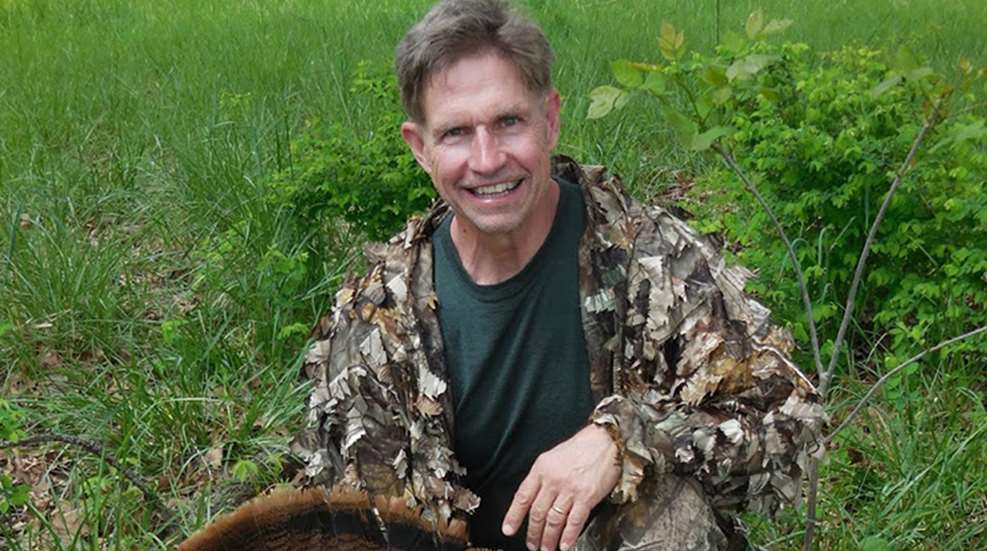
By Dennis Rackers, Crown Point, Ind.
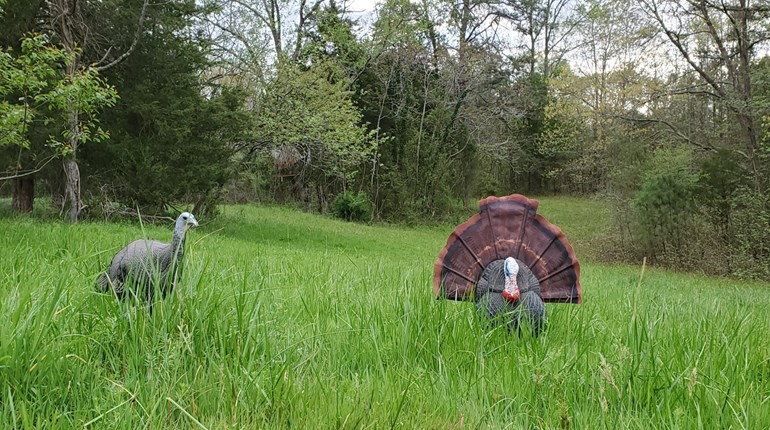
I was scouting for turkey the Sunday evening before opening day and, as luck would have it, I saw a gobbler fly up to his roost. The next morning, though, I failed to get up early enough to place a hen decoy without spooking him. Abandoning the idea, I crept in and slouched down in front of a big tree just before 6 a.m. with my shotgun pointed in his direction. He soon started gobbling about every 30 seconds, but I heard only one hen return his call from some distance away in the woods to my left. About 25 minutes later, he decided to drop down to his launching spot from the prior evening. Not wanting to give him time to see me or get twitchy, I dropped him at about 50 yards with 2 ounces of No. 5 shot, only moments after he landed and as his wings settled back to his sides.
 Wednesday morning I intentionally slept in because it was raining. It was 7:10 when I left my truck with my vest packed with tricks. I crossed the barn lot to climb over the gate into the pasture, and before I’d gone five steps from the gate post I saw a tom strutting about 200 yards away on a ridge through the thin, new green screen of tree limbs at the head of a draw between he and I. This was the same turkey that had eluded my buddy Bill and me for the last three days. I froze and then slowly backed up to the gate post with my binocular trained on him. In the couple of minutes that I watched, a pair of hens departed his company and walked to the left and away over the rise as the tom sauntered to my right behind a denser screen of foliage.
At that point the gobbler was within shotgun range of the edge of the woods, so I decided to back away and use the trees and ground to hide my approach before dropping the hammer on him. I knew not to call because of our experience over the last few mornings. But when I got to the edge of the pasture, I couldn’t find him. I slowly crept into the pasture, scanning the horizon with my binocular. The rascal had moved about 200 yards to the right and farther into the open, close-cropped pasture. I dropped back into the draw and popped up and out of the wood line again to find him. Once again, I had to move out into the open to see him, and as I did, he seemed to be moving slowly to my side of the pasture. I returned to the edge of the woods where I crouched down behind the stump of an uprooted tree and waited. In a few minutes I saw his fan, followed by his head as he slowly moved into view. I could have shot then, but I expected him to keep coming, which would make my shot more certain. Instead, he slowly sidled away from me farther into the pasture.
I’d had enough! I took off my vest and my binocular so I could crawl on my belly under a barbed-wire fence and then up the slight grade to the ridgeline for a face-off. I slouched about 15 yards up to the fence and then slithered under, going commando on my belly after this bird. I skirted the fresh cow pies and ignored the old ones. After another 15 yards, I was seeing his tail fan again, but his head was too low to assure a killing shot through the clumps of cow-cut fescue grass. I looked through the aperture sight on my Mossberg 500 at least five times, and each time I was never satisfied. As I inched forward to get a bit more of his neck in view, he poked his head to my right and gobbled. That was the only time I heard him that entire morning.
Finally, I knew it was time. Any farther and he’d see me, show me his heels and putt over the hill, safe for another morning. In a heartbeat, his head and neck were perched atop the front post of my barrel, the safety went off, the trigger broke and the shotgun barked. I jumped up immediately to see the tom collapsed on the ground.
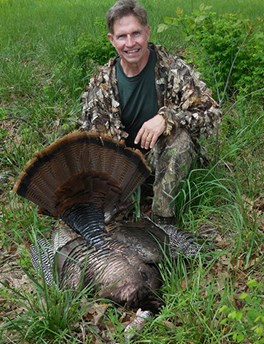
My watch said 8:05 a.m. For a turkey nut like me, it just doesn’t get much better than sleeping in and then killing my second tom of the season after a heart-pounding 55-minute stalk!
Do you have an exciting, unusual or humorous hunting experience to share?
Send your story (800 words or less) to [email protected] or to American Hunter, Dept. MH, 11250 Waples Mill Road, Fairfax, VA. 22030-9400. Please include your NRA ID number. Good quality photos are welcome. Make sure you have permission to use the material. Authors will not be paid, and manuscripts and photos will not be returned. All material becomes the property of NRA.