It’s no secret that many, if not most, hunting optics are made in Asia these days, whether the entire product, or parts for binoculars or scopes assembled elsewhere. One small but increasing trend, made possible by the Internet, is companies ordering exactly the products they want from Asian manufacturers, then selling them directly to their customers. This bypasses the traditional multi-layered system of distributors, sales representatives and retail stores, each requiring a cut of the profit, making it possible for companies to headquarter in smaller towns where property, housing and wages aren’t as high. In the end customers get more for their money.
One example is the Maven Outdoor Equipment Co. in Lander, Wyo., a small town on the east side of the Wind River Mountains. Lander’s in the middle of some of the best hunting in the Lower 48, and among other products, Maven sells binoculars that are not only good buys but can be customized with features you want.
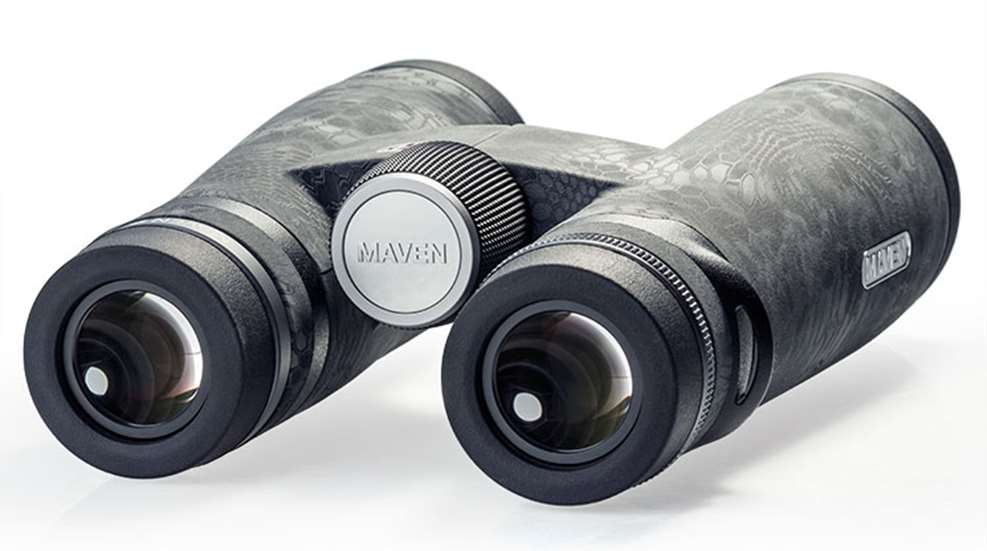
 The test binocular was built on Maven’s B.2 “Full Size Enhanced” roof-prism frame. The company allowed me to pick a bunch of options (easily done on Maven’s website), including camouflage pattern and the color of components such as the focus wheel, strap rings, diopter adjustment and tripod cap. For the body armor I chose (at an extra $100) the Kryptek Typhon pattern, an interesting black-gray combination. I picked black, gray and silver for the other details, with a hint of red on the label. Maven indicated the binocular would show up in four to six weeks, but it arrived much sooner, perhaps because it wasn’t the middle of hunting season.
The B.2 isn’t a lightweight bino, but many open-country hunters (including me) don’t mind some weight, because it helps steady the view across high-plains coulees and mountain canyons. Without the neck strap or lens covers the 9x45mm weighed 33 ounces on an accurate electronic scale, and had a little bit of “muzzle heaviness” when I held it in both hands with my right forefinger on the focus wheel, which also helped to steady the view.
There weren’t any other nine-powers in my collection of high-end binoculars for an optical comparison, but with some fiddling an 8/12x42mm Leica Duovid could be set on 9X. I then stacked the Maven on top of the Leica so the views could be instantly compared. The Leica had a slight edge in color richness, but in the low-light test the Maven was slightly brighter, perhaps due to the extra lenses required in the Leica for magnification changing. The view through the Maven did have slightly more edge-fuzz, which contrary to popular belief occurs even in the very best binoculars. In the B.2 the fuzz certainly wasn’t enough to cause any eyestrain even during extended glassing sessions.
Mechanically the Maven 9x45mm was very solid, with no slop in any of the adjustments, including the diopter on the right eyepiece and the focus ring. The single hinge between the barrels was tight enough to remain in place, but not so tight the angle couldn’t be easily adjusted. Interpupillary distance ranged from about 56mm to 77mm, with the top end slightly wider than Maven’s listed specifications. This is enough to accommodate almost any adult man, but the minimum would be a little too wide for a few women. The rubber-armored eyepieces had three firm twist-clicks for adjusting eye relief. The listed eye relief of 17.3mm was on the generous side, something easily noticed by this lifelong eyeglass wearer.
Offering considerable value for the price, the Maven B.2 is an excellent binocular both mechanically and optically. The finish options provide far more allowance for individual tastes and needs than most binoculars, and Maven also offers lighter-weight B.1 and B.3 models with the same range of consumer choices.
Technical Specifications:
• Type: roof-prism binocular
• Magnification: 9X (tested), 11X
• Objective Lens Diameter: 45mm
• Focusing Range: 4.9'-infinity
• Eye Relief: 17.3mm
• Exit Pupil: 5mm
• Field of View @ 1,000 Yds: 377'
• Coatings: scratch- and oil-resistant, fully multi-coated lenses; phase-corrected prisms
• Dimensions: length 7.1"; width 5.7"; weight 33.25 ozs.
• Construction: magnesium frame w/rubber armor; ED glass lenses; Abbe-Koenig prisms; nitrogen filled; waterproof
• Accessories: neck strap, lens covers, microfiber carry bag
• MSRP: $1,000 (base price), $1,160 (as tested)