In 1977 Ruger bucked the trend in a hunting market dominated by pump and semi-auto shotguns, introducing a new American-made over/under, the Red Label. The Red Label became a cult favorite among shotgunners until it faded from the Ruger line a few years ago. I owned and sold three over the years, but not before I shot plenty of pheasants with them at home in Iowa.
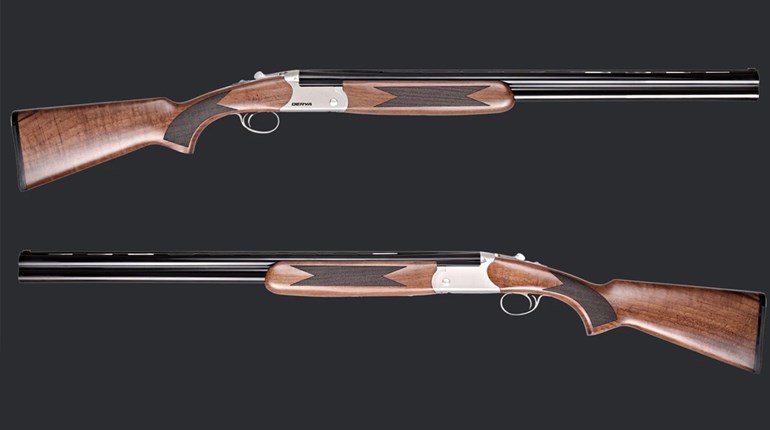
Last year, Ruger bucked the trend again. As other manufacturers cut costs by cheapening products or importing Turkish guns, Ruger announced the Red Label’s return. And it’s not just any Red Label. It’s better now, it’s still made in the United States and it sells for less than it used to. That sounds too good to be true, but true it is. Ruger was already shipping the 12-gauge to dealers last October when the gun was rolled out. The Red Label is back, and it’s sure to find a warm reception from hunters who want a great value in a proven design that’s made in America.
The gun has the same distinctive, low-profile stainless steel receiver but with slightly updated lines. You will notice right away, though, that while the old side ribs between the barrels were removable, they are now gone in the name of weight reduction. The opening lever is stainless, no longer blued, and the hard red rubber buttpad has been replaced by a black Pachmayr Decelerator. There is no square, blued barrel lug projecting through the bottom of the receiver as there was on the old Red Label.
Other changes to the gun are harder to see but even more important. The barrels are struck thinner for better handling. They are overbored and have lengthened forcing cones in an effort to improve patterns and reduce recoil. Although the Red Label has always been a heavy gun, the new version is noticeably livelier thanks to the lighter barrels. My test gun weighed 7 pounds, 14 ounces with 28-inch barrels.
Ruger overhauled the receiver to make it simpler and less expensive to manufacture. Some parts were redesigned, others eliminated. The old Red Label receiver was cast in two pieces and welded together, but the receiver is now made from a single casting, cutting production costs.
The barrels still fall open when you push the lever. Detractors often point to that as “sloppy,” but in fact, the gun was designed to open easily. Isn’t that better than having to open your new O/U over one knee until it breaks in? Lockup remains solid by means of two lugs projecting from the monobloc at mid-breech level.
The new Red Label retains the mechanical trigger of the original. My test gun’s trigger breaks at a pull weight of 7 pounds for the first barrel, 9 pounds for the second. The barrel-selector/safety switch still pivots right or left to select barrels. It’s an automatic safety, going back on each time the gun is opened, although Ruger will make it a manual safety for a nominal fee.
Drop on the straight-grain, satin-finish walnut stock measures 11/2 inches at the comb and 25/8 inches at the heel, with a length of pull just over 141/2 inches. Wood-to-metal fit has always been a cosmetic weak point of the Red Label and apparently still is. My test gun and the other new Red Labels I’ve seen all have wood that is proud at some points and low at others, and shows some small gaps around the bottom tang.
I received my review Red Label last fall and took it straight to the field. It picked up where my old Red Labels left off, dropping a pair of roosters during that first outing. On the skeet field it moved well to the target, and recoil was quite manageable (not always the case with its predecessor) thanks to the gun’s weight and the soft Pachmayr pad.
I patterned the gun for point of impact and found both barrels shot to point of aim and quite close to one another. Since the gun came with skeet choke tubes installed, I patterned target loads at 25 yards. Both barrels produced excellent, even, target-breaking, dove-dropping patterns with 1 ounce of No. 8's.
I saved the best part for last: At $1,399, the new Red Label costs a full $400 less than the old version did and well below the price of an entry-level Browning Citori or Beretta O/U. No question this gun is an improvement over the old one, too. It still has flaws: heavy weight and poor wood-to-metal fit primarily. The difference is the Red Label now sells for a price so low that we can overlook its flaws and celebrate its many strengths.
Technical Specifications:
Type: over/under shotgun
Gauge/Chamber: 1 2/3"
Barrels: 26", 28" (tested), 30"; free-floating vent rib, interchangeable choke tubes
Trigger: single-selective, mechanical; 7-lb. pull first barrel, 9-lb. pull second barrel
Sights: brass front bead
Safety: tang-mounted automatic w/barrel selector
Stock: satin-finish walnut; LOP 14 1/2", drop at heel 25/8", drop at comb 1 1/2"
Metal Finish: blued barrels, stainless receiver
Overall Length: 45 1/2"
Weight: 7 lbs., 14 ozs.
Accessories: takedown case, five Briley choke tubes (SK, SK, IC, M, F), wrench
MSRP: $1,399