Determining Deer Age

by
posted on March 10, 2014
** When you buy products through the links on our site, we may earn a commission that supports NRA's mission to protect, preserve and defend the Second Amendment. **
qa_ah2015_fs.jpg (5)

Q: I would like to learn how to age whitetail deer. How can it be done by examining the teeth?

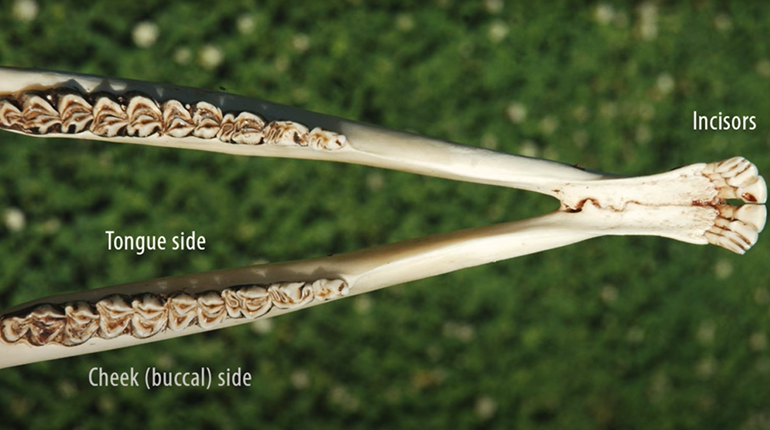
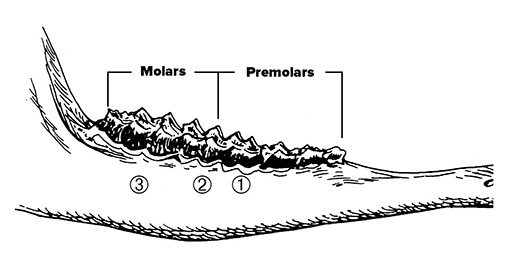
A: By the time a whitetail is 2 years old it should have grown its full complement of permanent teeth. On each lower jawbone this includes the four small teeth at the front of the mouth and six much larger teeth—premolars and molars—at the rear.The premolars and molars give best evidence of age. Up to six or seven months, yearlings will have only one molar; after seven months another will erupt, and the third will appear at about 13 months. At 18 to 19 months, the first set of temporary premolars is replaced by permanent ones. If the premolars are relatively stain-free and worn less than adjacent molars, the deer is likely in the 1½-year-old range. If staining is comparable, wear on the crests of the third molar reveals a 2½- year-old or older animal.As deer reach 3½ and beyond, the teeth's sharp, distinct cusps get ground down, first becoming rounded, then smooth. Also, as a tooth's enamel wears, more and more of the brown inner material, the dentine, is exposed, especially on the inside toward the tongue. The more dentine exposure, the older the deer.  On a 3½-year-old, dentine showing on the first molar (1) only will be equal or greater the amount of remaining enamel.  At 4½, both the first and the second molars (1) and (2 ) will reveal dentine equal or greater than the enamel, but the last molar (3) still shows as much or more enamel. All three molars on a 5½-year-old exhibit well-worn enamel, and if the center of the first (1) is worn smooth and virtually enamel-free, the deer is 6½ or even older.

It should be noted, however, that the foregoing are general guidelines. Tooth wear will vary by individual, and judging age by this method takes considerable practice and experience. Even then it is not an exact science.
Determining deer age

Latest

Remington 700 Clone Chassis Rifle

The 4 Classic Hunting Platforms

Andi Bogard takes a look at the classic actions and platforms that laid the foundation for today’s hunting rifles.

Conservation Partners Launch Novel Turkey Nesting Research

Predator populations—nest raiders and full-feathered turkey killers alike—are growing across the United States. To determine if their increasing numbers are a leading cause of wild turkey population declines, Turkeys For Tomorrow (TFT) has announced a groundbreaking study on predator impacts on nesting and poult-rearing success.

Muleys The Old Way: Traditional Muzzleloading

Aram von Benedikt and his son took part in one of the oldest American traditions there is: muzzleloading for deer with a traditional smokepole. Read on for more about their adventure.

MSU Deer Lab Celebrates 50 Years

For 50 years the Mississippi State University (MSU) Deer Lab—a partnership between the university’s Forest and Wildlife Research Center (FWRC) and MSU Extension Service in Starkville, Miss.—has delivered nationally recognized research on deer biology, habitat management and land stewardship.

#SundayGunday: Our Top 5 in 2025

Sitting on your couch in an eggnog stupor, wrapping paper still draped off every chair in sight? Still procrastinating getting up, cleaning, up or any sort of behavior that could be remotely described as productive? Here's something to keep you further occupied in your sedentary state. Read on, to check out our Top 5 #SundayGundays of 2025, as selected by you, our audience.

How to Make Woodstove Jerky

Homemade jerky is a staple with a lot of hunters. Deer, antelope, moose and elk all make excellent jerky. Surprisingly, geese do too. In fact, most any game animal will make palatable jerky. Here's how to make it with nothing but a woodstove, a knife and maybe some shears.

Interests


Get the best of American Hunter delivered to your inbox.