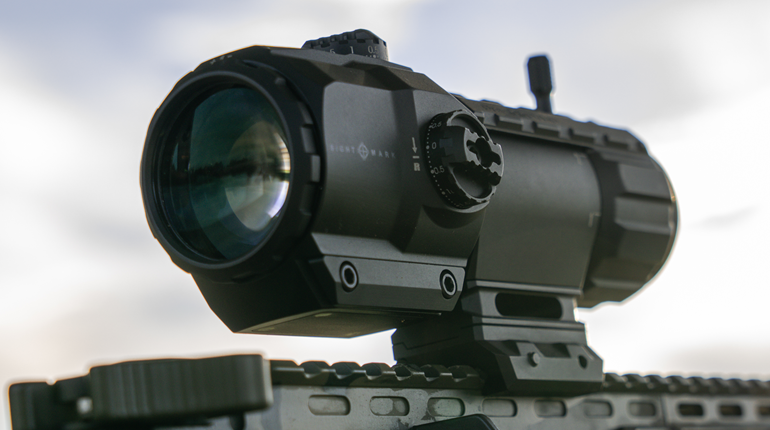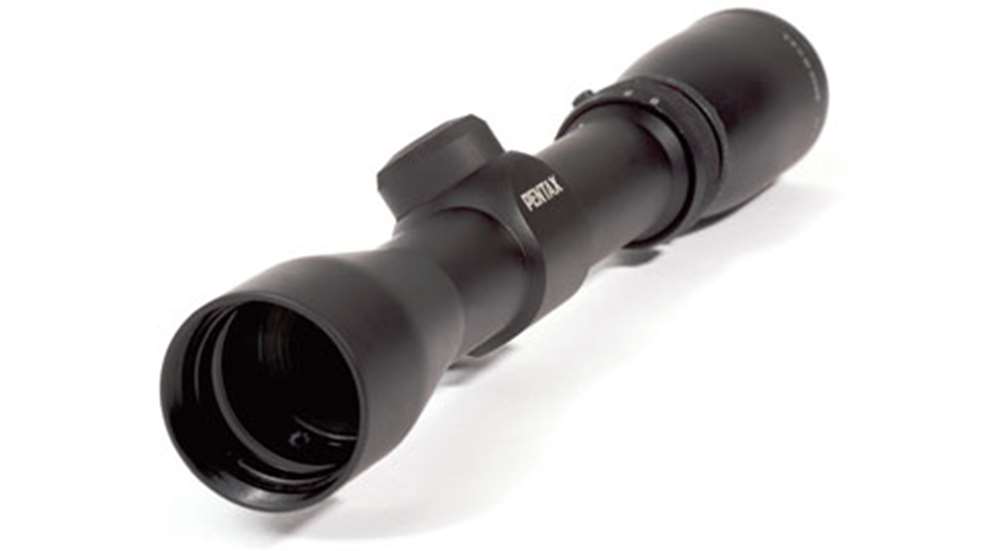
One of the more versatile scopes—perhaps the most versatile—from Pentax is the Lightseeker SL 3x-9x-32mm, a 10.5-inch-long, 13-ounce generalist that’s equally effective in dense timber and open plains for everything from leaping whitetails to peeking prairie dogs. A fine crosshair at 9x is sufficient to target prairie dogs out to 350 yards, and to shoot deer and elk at distances few have a right to try.
Why haul the weight and bulk of a 4.5x-14x varmint scope when still-hunting woodland whitetails? This little telescope won’t unbalance any rifle and is the perfect match for light mountain rifles.
The Lightseeker line represents Pentax’s highest quality, 1-inch-tube scopes. They’re advertised as being fully multi-coated for maximum light transmission. The reflections I saw of a ceiling light (seen in both objective and eyepiece lenses held about 18 inches away) were all green, indicating surfaces were indeed multi-coated. I didn’t dismantle this scope to check, but the company advertises it as a double 0-ring-sealed, single-piece, aircraft-grade aluminum main tube that is fogproof and waterproof. Immersing it in water after it was chilled in the freezer revealed no bubbles, no leaks and no fogging.
Lightseeker scopes are supposed to have thicker-than-average walls, 40 percent larger-than-average internal erector lenses and a reticle three times stronger than the industry standard. The proof of those claims is in the performance, and performance has been nearly flawless.
The only glitch I detected during range testing atop a Ruger M77 shooting Winchester Supreme .17 HMR ammunition was slight inaccuracy in windage adjustment. A paper sticker inside a turret cap indicated ¼-inch movement for each click, but when I adjusted windage 12 clicks right, groups centered 2 inches right instead of 3 inches, as they should have. The clicks were neither crisp nor loud and there were two for each hash mark on the turret dial, so I may have miscounted one or two. Vertical adjustments matched the advertised ¼-click, both up and down. Adjustments were consistent, however, coming back to original center when I shot the square. A 16-click adjustment to the left centered the group exactly 3 inches left. I can live with reticle adjustments that don’t match advertised specifications in a hunting scope as long as they’re consistent. Once the instrument is sighted in, adjustments are essentially over unless you change loads.
Contrast control was good even when looking toward the low sun with targets in shadow, but the shooter’s eye had to remain close to the center of the optical axis to prevent a white glare at 9x.
Another selling point for this scope is its long, 4-inch eye relief consistent across the power range. This should prevent “scope brow” even with the heaviest-recoiling rifles.
Several reticle styles are offered. The test scope came with a Ballistic Plex featuring the familiar double-thickness crosshairs with the addition of three short horizontal bars running down the lower, vertical wire. These can be used as long-range aiming points at user-selected distances. Combined with the main crosshairs and the junction of the thick and thin vertical posts, this provides five different aiming/range reticles.