While the debate among bowhunters persists over what type of broadhead is better—fixed or mechanical—the introduction of Rage mechanical broadheads a few years ago can be credited with bringing a good number of nonbelievers over to the mechanical camp. Before that time mechanicals were largely seen as finicky and undependable, not always deploying as designed and difficult to keep closed in the quiver or prior to draw. Rage’s rear-deploying blades and slip-cam design made mechanicals more reliable—both prior to launch and throughout impact—and with this improved reliability, a legion of hunters now swears by the heads. Five or six years ago, it seemed like nearly everyone in the camps I hunted was using them.
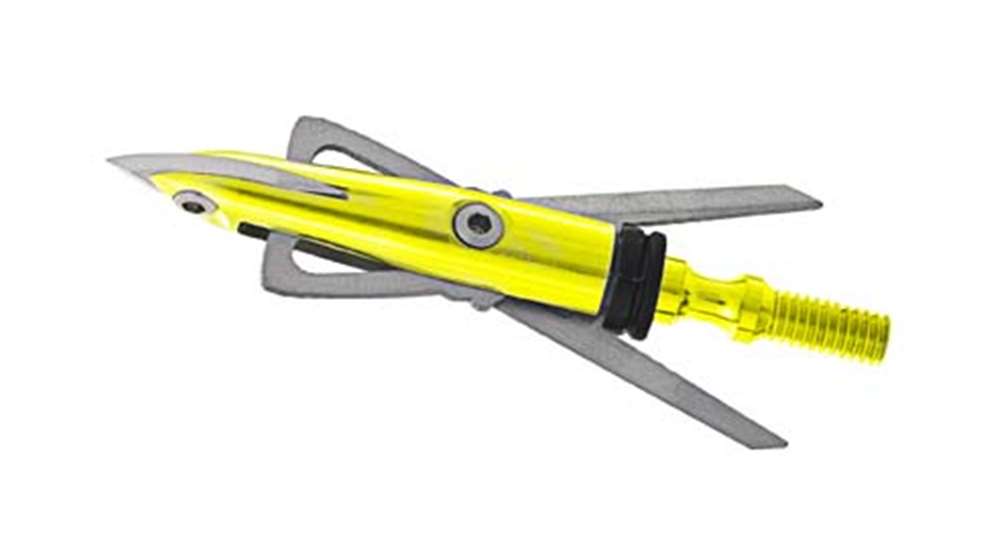
For 2012, Rage introduced its largest cutting mechanical yet with the creation of its X-Treme, a twin-blade mechanical head built to deliver a nasty 2.3-inch cutting diameter. To see if the X-Treme lives up to the hype that continues to surround the company’s offerings we put the broadhead through a battery of tests.
The Test Setup
Rage X-Tremes are designed to be shot from bows with draw weights in excess of 60 pounds. For the test, I used a Gander Mountain TecHunter compound bow set at 70 pounds and shot size 340 Easton Axis N-Fused Carbon arrows at a distance of 20 yards from each target. Target materials included a standard Block foam target, plastic milk jugs filled with water, a frozen chunk of meat and a half-inch sheet of plywood.
Target Test
To start out, the X-Treme was shot into a standard Block foam target to see if it would fly with field point-like accuracy, how well it deployed and if the dense foam would hinder or damage the broadhead in any way. Repeated shots through the 14-inch thick target resulted in 100 percent complete deployment of the double blades with an average of 2.75 inches more penetration than the field points shot as a control group. Shooting three-shot groups with the field points resulted in average groups of 2 inches. I was able to repeat that level of accuracy with the X-Treme without fail. These heads do indeed fly with field point-like accuracy, deliver great penetration and open to their full-advertised width upon impact.
Jug Test
Next, I shot the broadheads through milk jugs filled with water to compare entry and exit hole diameter on both sides of the containers. The X-Treme flies with a 7/8-inch cut prior to impact and upon striking the target begins to immediately deploy. In fact, the average entry cuts on the jugs actually measured nearly 1¼ inches, indicating a super rapid opening of the blades. However, the density and resistance provided by the water and thin milk jug plastic combination were not enough to sufficiently slow the arrow and it punched through the container so quickly, the exit holes were nearly the same size. A thicker plastic container was used to see if would yield different results, but the massive leading edge blade tip merely punched through both sides of the plastic like a bullet, knocking out a ¾-inch size hole upon exit, and not providing any clues as to the position of the blades during the pass-through. Other than providing a great visual to how quickly liquid will pour from a hole made from the broadhead, this test yielded no solid insight on the full deployment capabilities of the X-Treme other than to prove that even when they aren’t able to open completely, they still create a nasty—and lethal—gash.
Meat Test
The X-Treme was then shot into a frozen piece of meat. The arrow/broadhead combo failed to generate a complete pass-through due to the frozen meat’s density, but it did strike it solidly and bury itself three inches into the target, striking with sufficient force to open the blades as far as two inches upon impact. Had it been able to pass all the way through, I can only assume it would have deployed to its full 2.3-inch width, the meat being much denser than water.
Wood Test
Lastly, a piece of half-inch plywood was shot to simulate how the mechanical might work when slammed into something hard like bone. The Rage website has a slow-motion video of both the two-bladed and three-bladed broadheads being shot through particle board (as well as shooting gel, mesh and concrete block). In the video, the blades exit the wood intact. That wasn’t quite my experience, though the impact with the wood was nonetheless impressive and revealing. The X-Treme passed easily through the wood, but as it did, it sheered off approximately an 11/16 inch from each blade, basically where the ends of the blade extend beyond the rear edge blade support, potentially reducing the overall cutting diameter by nearly an inch and a third. Only one blade of several broadheads survived the pass-through and on that one, the threaded stem of the ferrule actually bent from the impact. These results might induce some fixed-blade purists to shout “A-Ha,” however, the bladed tip, ferrule and remainder of the opening blades still deployed and still penetrated without any other deformation, leaving a virtual .30-caliber-sized hole in the wood and allowing the arrow to pass completely through the target. Marks on the wood from the opening blades averaged 2.5 inches with the longest measuring a whopping 3.25 inches—the full opening spread of the blades before they set into their swept back full-open position. Despite the sheering of the blade ends, I’d still call this performance darn impressive and the cut upon impact simply ridiculous. The arrow and head still did their job.
Final Impression
While both mechanical diehards and defenders of the fixed broadhead will find results in these tests to prove their points, the bottom line is the Rage X-Treme is one straight flying, consistently deploying and structurally sound broadhead that promises to wreak a lot of havoc and rapidly depressurize the circulatory system of any big-game animal, leading to rapid bleed-out and quick death. I can’t wait to twist a few onto the end of my Eastons this fall and fill a few tags from my deer license. If you’re a mechanical fan, you’ll love them, and if you’re not, you might want to try them out.
Technical Specifications
Type of Broadhead: Mechanical
Weight: 100 grs.
Number of Blades: 2 deploying blades and a single front edge cutting blade point
Blade Width: .035” stainless steel blades
Maximum Cutting Diameter: 2.3” (closed diameter is 7/8”)
Additional Features: cut-on-impact HexFlat point, Shock Collar blade containment, solid yellow aluminum ferrule
Cost: $50/3-pack