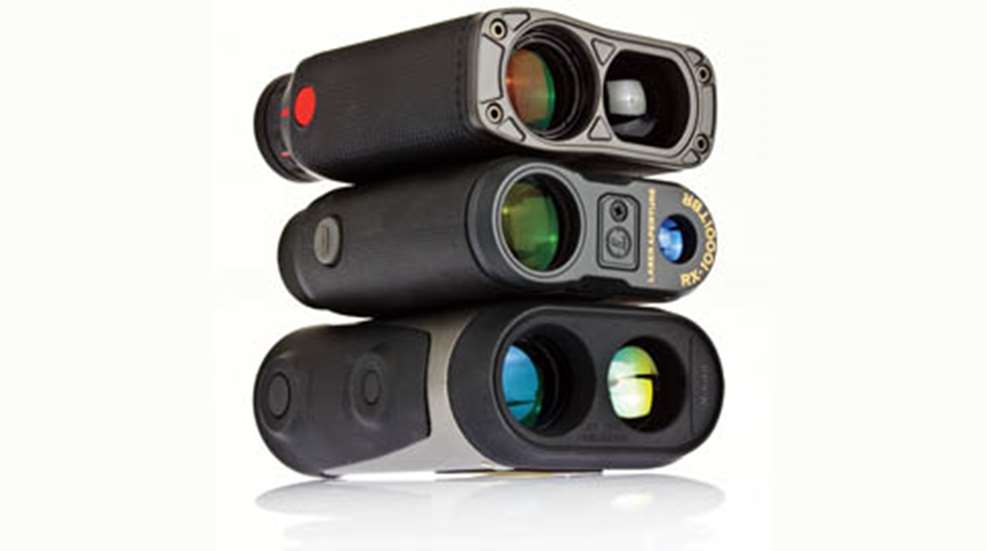
Recently I set three new rangefinders on a shooting bench in front of a group of well-traveled, middle-aged men at my gun club and asked what they thought. They put down their rifles and, without a 12-year-old to help them, soon ranged targets with the sophisticated electronics—proving once again that if there is a man-friendly electronic gadget, surely it’s the rangefinder. The Nikon Riflehunter 1000, Leupold RX-1000i TBR with DNA and Bushnell G-Force 1300 ARC are all user-friendly, but what came next answered why this test had teeth: Each hunter said he’d missed big game because he’d failed to get the correct range even though he had a rangefinder with him. Rangefinders are tremendous tools only if hunters keep one handy and know how to use it properly.
How to Use a Rangefinder
First of all, some of the shooters admitted they simply hadn’t practiced enough with their rangefinder. When a buck stepped out they blew the opportunity by forgetting which pocket held their unit. They fumbled about or finally just guessed the range. This illustrates that, though telling someone how to use a rangefinder might seem as necessary as having airline stewardesses show us how to buckle a seatbelt, most big-game hunters need practice with a rangefinder in a hunting situation.
The best way to do that is to include it during realistic practice sessions. When plinking with a .22, walk to various ranges, pull the rangefinder from where you’ll keep it while hunting, place it to your eye without taking your eye off the target, take the range and shoot just as you would in the field.
Some keep it in a pocket, while others hang it from a lanyard. Bushnell developed the Magnetic Attachment System that clips a rangefinder to a belt, backpack strap or binocular harness. A magnet holds it in place and a bungee cord keeps it tethered.
Why Rangefinders Fail
Some hunters missed because they used rangefinders that wouldn’t range. One said, “The rangefinder was giving readings to grass clumps that were 200 yards closer to me than the antelope.” He missed. He could have used a mode that gives readings either to the closest or farthest object in the viewfinder. The Nikon and the Bushnell models mentioned here do that. Many range just the closest object hit by the laser beam.
Rangefinders emit laser beams and then pick up pieces of the laser reflected from an object. Because the speed of light is a known variable, it’s a simple calculation for the rangefinder to determine distance. To do this they don’t just shoot a single beam. They actually send a pulse. This is how a good rangefinder can range an object partially obscured by grass or leaves.
Of course, the laser is affected by sunlight, fog and other variables. Moisture in the air, low-pressure pockets and even heat waves refract the laser and can thereby make it difficult to get readings. “Beam divergence,” when the laser spreads out over distance, making readings from small objects difficult at long range, is also as issue. This is why higher-end rangefinders that have better electronics are often more reliable.
Also realize that the reflectivity of the target determines how far a rangefinder can get a reading. Reflective targets, such as a cliff or a building, can be measured at greater distances than soft surfaces like deer. If you can’t quickly get a reading on game, look for nearby rocks or trees and try for a reading on them.
Use the Right Unit
Different rangefinders have designs that help avoid pitfalls. One of the hunters in my impromptu field test said, “I took a low-end rangefinder on an elk hunt. Its eyepiece only had 1x magnification. Back here in the East I tried it out and thought it didn’t matter. But when I was hunting I repeatedly couldn’t find elk in the rangefinder.”
Also, consider the readout screen. The Nikon automatically changes color from orange to black depending on available light. The Leupold screen is bright red. Bushnell’s is red and allows you to alter brightness.
All three rangefinders here have 6x magnification and multi-coated optics. They all performed well out to 1,000 yards on a clear day. All three are waterproof.
The last hunter to relay his tale of missed opportunity said he misjudged the distance due to a steep angle, and shot high. All three units here can compensate for angles. Learning the modes that do this is simple, but you do have to read the directions and spend time practicing to familiarize yourself with different features. Some, like the Leupold, even allow you to change reticles—and it uses a “True Ballistic Range” to give the number of inches to hold over or under the aim point.