Forget everything you’ve learned about binoculars and dig for the lowest common denominator: What is their purpose? Answer: to improve your ability to see game. Now ask: What would be the most convenient, effective way to enhance your eyesight? Magnified glasses set in a traditional frame? Contact lenses? Magnified lenses surgically implanted into your own eyes?
Obviously none of that is going to happen with current technology, so what’s the next best option? Seems to me it would be the smallest, lightest “traditional” binocular possible with sufficient optical performance to enable you to employ it regularly during the hours you hunt.
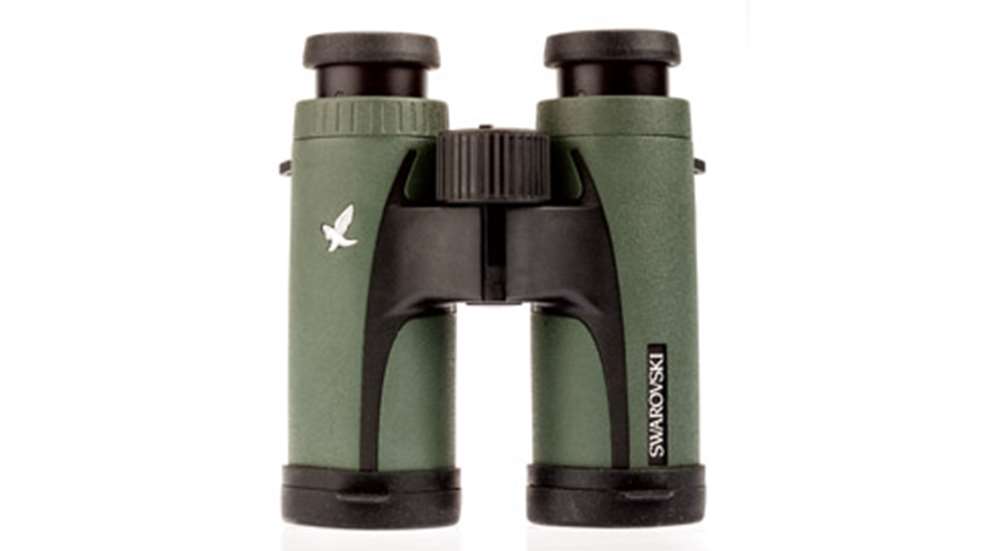
Swarovski’s new CL 8x30 isn’t small enough to strap to your face like eyeglasses, but at 4.75 inches long, 4.5 inches wide, 1.8 inches deep and 21 ounces (with strap and lens covers, 17.6 ounces naked) it could be the tiniest, lightest 8x30 hunting binocular on the market and quite likely the brightest and sharpest. I’ve seen none to beat it.
Swarovski calls this CL the Companion, and while that doesn’t invoke images of snow-capped peaks and dusty African plains, it does imply the truth: This binocular is so handy and so useful that it could become your steady companion, a two-barreled glass “best friend” that follows you everywhere—and often leads.
This means more than most folks think. It means the CL Companion is going to lead you to more game and help you to see more of nature’s wonders because you’re going to have it with you. This is a reality most hunters never consider. In our pursuit for the brightest, most powerful binocular, we overlook the pain in the neck a heavy binocular can be. Sure, a big 10x50mm transmits a spectacular view, but its 2.2 pounds of mass exert a subtle but persistent psychological pull against your resolve. This inspires you to leave it in the truck or, at best, in your pack. So be honest: Are you going to spot more game with an 8x30mm around your neck or a brighter, more powerful 10x50 in storage?
I’ll take the 8x30, thank you. And if it’s this CL, I won’t be giving up much in the bargain. The optical quality of this sprite is shocking. In a head-to-head comparison with its more expensive EL 8x32 cousin and another world-class 8x32, the CL scored so close that I award it the top spot based on its lighter weight and lower cost.
At sunset while looking at wood grain patterns under a house eve in deep shadow with the sun in the same view, I saw no more flare in the CL than the pricier binoculars. There may have been the slightest decrease in contrast. I tried hard to see it, but honestly couldn’t swear to it. Regardless which binocular I peered through, I couldn’t honestly say any was better than another. Roughly 45 minutes later, 15 minutes beyond legal hunting hours in most states, I could just barely make out half-inch black lettering on a cardboard box 20 yards away through each of these binoculars. When the letters were no longer identifiable through the CL, they were equally muddled through the other units. Looking into the shadowed side of a boulder covered with lichens similarly showed almost no contrast or color saturation differences among the three binoculars. A professionally trained, sharper-eyed optical engineer might see optical flaws in the CL that I couldn’t, but he’d have a devil of a time convincing me. This is an impressive optical instrument I’d be happy to take hunting any day.
An hour in the home freezer did nothing to slow down the CL. It still focused smoothly. After submersion in a sink of tap water, it emerged showing no internal fogging, a rare thing in my optical testing. Even after turning the focus wheel and twisting the eyecups up and down, the binocular took on no water that I could detect through careful observation inside the barrels with a flashlight.
The big question, then, is how can Swarovksi build this optical quality in a binocular for half the cost of their flagship 8x32 EL (MSRP $1,032 vs. $2,143)? The answer appears to be by minimizing parts, simplifying construction and skipping just a few of the more expensive pieces. For instance, the +/- diopter on the CL is changed via an old-fashioned friction ring on the right eyepiece. The EL diopter is on the focus wheel and locks by pushing down the cap. I actually prefer the friction ring because it’s less likely to get bumped out of position.
The CL connects its two rubber-armored, polycarbonate/aluminum barrels with a single, slim central hinge-bridge. The EL uses two hinges, suggesting it should be more durable. Both units include thumb indents under each barrel. The CL runs through its focus range with just more than one complete turn of the central focus wheel. The EL needs just more than 1.5 turns. But the EL focuses down to 6.2 feet. The CL stops at 9.8 feet—no great disadvantage unless you’re hunting butterflies. Field of view through the EL is 423 feet at 1,000 yards. The CL is 372 feet at the same distance. The newest EL features field-flattening lenses for precise focus across the field of view. Edge focus with the CL falls off slightly.
The lenses within the CL are fully multi-coated with SWAROTOP anti-reflection coatings, but there are no flouride HD lenses. Light throughput is rated at 91 percent, better than the 90 percent for the EL, probably because there are fewer lenses in the CL. Exterior lens surfaces are coated with protective SWARODUR to resist scratching, but not the SWAROCLEAN applied to the EL. The CL’s roof prisms are phase-coated, just like the EL’s, and they have the same SWAROBRIGHT dielectric mirror coatings for maximum light reflection.
Swarovski wisely didn’t cut corners by returning to the infamous cracking rubber, roll-down eyepieces of yesteryear. Locking, twist up/down eyecups nicely accommodate us eyeglass wearers.
I suspect the CL will wear under hard use a bit faster than the EL, but with a modicum of caution and care, it could last a hunting lifetime.
Technical Specifications:
Type: roof-prism binocular
Magnification: 8X
Objective Lens Diameter: 30mm
Focusing Range: 9.8'–infinity
Eye Relief: 15mm
Exit Pupil: 3.75mm
Twilight Factor: 15.5
Field of View @ 1,000 yds: 372'
Coatings: fully multi-coated lenses, phase-coated prisms, SWAROBRIGHT, SWARODUR, SWAROTOP coatings
Dimensions: length 4.75"; width 4.5"; depth 1.8"; weight 17.6 ozs. (w/o accessories)
Construction: polycarbonate/aluminum chassis, rubber armor cover, nitrogen-purged
Accessories: nylon field bag, neoprene neck strap, objective lens caps, eyepiece cover
MSRP: $1,032
Most Popular