Today hunters demand much more from riflescopes. They expect one to help them shoot at long range and the reticle to be visible in low light. They want the scope to turn dusk into noon and they demand the scope be rugged enough to use as a club on a marauding grizzly and still hold zero. Today, all these things are doable, but they come at a price.
Nightforce scopes are engineered to survive 24 hours of submersion in water 100 feet deep. They are built to withstand a temperature swing of 240 degrees over a one-hour period. Impact testing occurs at 1,250 G’s. Okay, maybe that’s not the same as beating a grizzly over the head. Actually it’s probably tougher.
But a riflescope is an optical device, not a club, and it’s made for looking through and sighting targets. All Nightforce scope lenses are coated with proprietary chemicals to enhance color rendition and light transmission, and to provide abrasion protection that meets military standards. All lenses—riflescopes have more than two—are matched through a process called optical indexing and are aligned by hand. Nightforce calls this precision; most optics manufacturers would say it’s too time-consuming. However, when you look through the scope you’ll be glad someone took the time to do it. You’ll also notice it in its cost.
But back to beating bruins. Nightforce’s scope tubes are machined from a solid bar of 6061 T6 aluminum. How good is this alloy? So good that important things like airplane wings and firearm sound suppressors are made from it. In short, it’s tough enough, and since Nightforce scope tubes are thicker than those from most other manufacturers, they are tougher than enough.
Most hunters would rather shoot a bruin than club one, and to hit what you shoot at your riflescope has to maintain zero, even after you have beaten a bear over the head with it. One small element that lets a riflescope maintain zero is the spring that pushes against the erector tube to hold it in place. Nightforce polishes those springs for two weeks in a tumbler to assure there are no rough spots to interfere with smooth operation. This titanium spring can be repeatedly compressed and held in place without fatigue. Titanium is not cheap.
But maintaining zero is not just about a spring. Nightforce machines the screw that controls reticle adjustment to 110 threads per inch, and this engineering marvel is then hand-fit to the riflescope. Yeah, that takes time too.
What else? Lenses are bedded in the tube in a proprietary material so there is no glass-to-metal contact. This protects against lens breakage that might result from impact. Then, each lens is secured with an O-ring and a metal lock ring on both sides. If you’re trying to make as many scopes as fast as you can, this would be considered unsatisfactory. If you want to ensure the scope is rugged enough for clumsy hunters or soldiers on the battlefield, this is insurance.
No, the scopes of today, at least those from Nightforce, are not made like the scopes of 50 years ago. But unlike those scopes, Nightforce expects theirs to last 50 years or longer, which is why they come with a lifetime warranty. But do they perform?
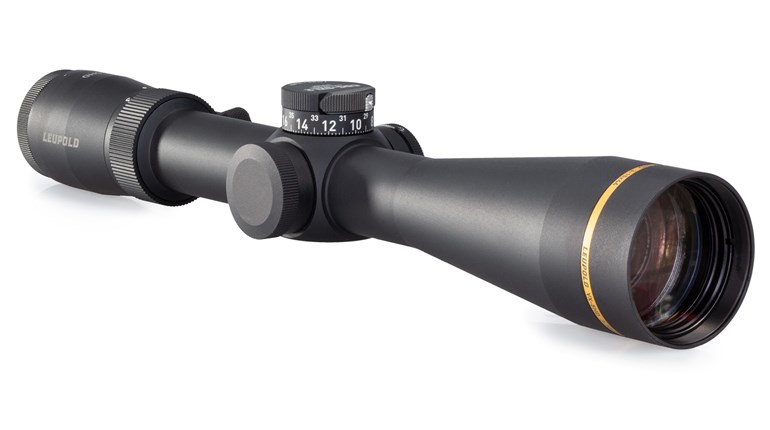
The great thing about being a gunwriter is I get to take expensive stuff I did not pay for and treat it like I didn’t pay for it. I asked Nightforce to send me the best big-game hunting riflescope they make. It sent its 2.5X-10X-32mm NXS Compact scope, which has an illuminated mil-dot reticle, 1⁄₁₀th milliradian adjustment target-style turrets and an optional Power Throw Lever.
With Talley detachable steel rings, I mounted it to my Forbes Rifle in .35 Whelen. I picked this good-shooting rifle because I knew it was rugged enough to handle what I was preparing to do to this scope, and because it weighs 5.5 pounds and kicks like a mule with a toothache. If the scope could survive me and the Whelen, it just might be worth it.
Test one: adjustments. They were perfect no matter which direction or how many times I turned them. Test two: clarity and sharpness. How do you compare something this subjective? I’ll just say it was as good as, if not better, than any scope I’ve looked through. Test three: illuminated reticle. I wish I had a dollar for those I’ve broken. It survived the shooting and weeks of periodic and aggravated dial twisting. Test four: heat and cold. Twenty minutes in the hot tub and 20 in the fridge had no effect. Test five: drop test. I dropped the rifle—scope down—onto my gravel driveway. Three times! There was no point of impact shift or damage. Credit to the mounts and rifle here as well. I could not find a bear to beat with the Nightforce and, in all honesty I figured that was lucky for the bear.
Not long after testing I told Kyle Brown at Nightforce I just might have to buy this scope. He said, “Not so fast. We’ve just released an updated version.”
I said, “You’re kidding! You made a scope better than this?” I guess I’ll find out; it’s headed my way. I told you, riflescopes continue to get even better.
Nightforce 2.5X-10X-32mm NXS Compact
Type: variable-magnification, illuminated-reticle riflescope
Magnification: 2.5X-10X
Objective Lens Diameter: 32 mm
Eye Relief: 3.7"
Exit Pupil Diameter: 13.3 mm @ 2.5X, 3.3 mm @ 10X
Field of View @ 100 yds: 44' @ 2.5 X, 11' @ 10X
Coatings: fully multi-coated
Dimensions: weight 19 ozs.; length 12"; mounting space 5.7"
Construction: 30 mm T6 aluminum main tube; click value .25 MOA (.1 mil); internal adjustment range 98" @ 100 yds.; 9 intensity settings; 4 reticles available
Accessories: rubber lens caps, Power Throw Lever
MSRP: $1,744