By Dr. Stephen H. Corwin, Waco, Texas
Having just finished reading your excellent article "Handgun Hunting 101" in the June 2014 issue, I was reenergized to share my personal experience of a New Mexico elk-hunting trip a few years ago. I have often been successful on elk with equipment ranging from bows and Kentucky long guns, to several calibers of rifles. However, since I love to stalk and still-hunt on game's natural turf, this time I chose to hunt with a handgun.
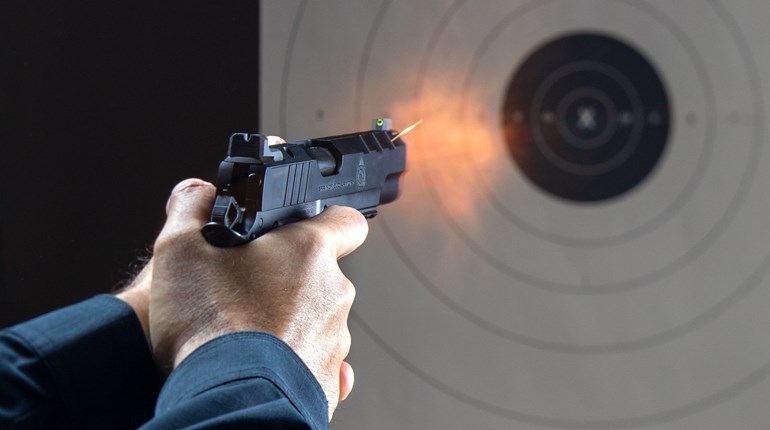
The referenced article by Max Prasac is totally on target about choosing the right platform, barrel length, caliber, sights and bullet weight for your anticipated game. But most important, and also emphasized by Mr. Prasac, is practice. Practice from the various positions you will potentially use, even if you are a veteran hunter.
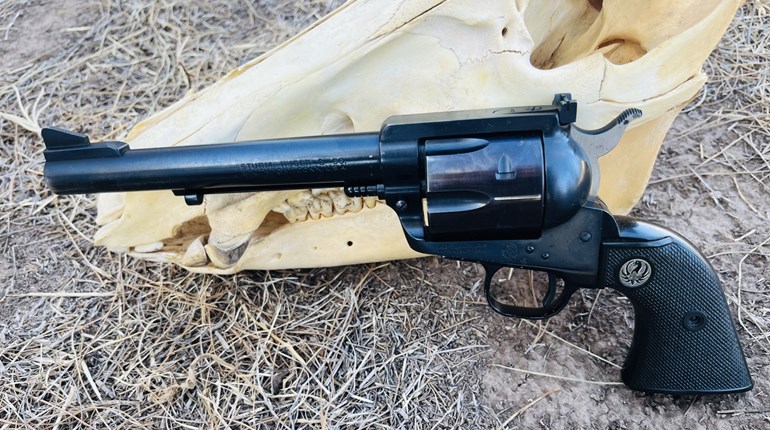
I had hunted the area previously and was well aware of the variety of extremes in both distance and vertical changes that might be present throughout the experience. Not having a handgun sufficiently large enough for elk, I did a little research and ultimately selected a Freedom Arms Premier Grade .454 Casull with a honed action, hardwood grips and a 7½-inch octagonal barrel. I decided not to port the barrel, but at the last minute and with a little amateur gunsmithing, I did add a matching silver 2.5X-8X Leupold pistol scope with a single-piece, two-ring base.
Then the work started. Not only did I increase the intensity of my daily summer conditioning with emphasis on endurance, but I also practiced incessantly with 260-grain jacketed flat points. I never took the scope off 2.5X and set the zero at about 3 inches high from the bench. Thereafter, I practiced repeatedly freehand from 25 to 50 yards. I will confess to launching a few rounds at 100 yards, though not with a great deal of sincerity. I felt like if I could consistently hit an 8-inch paper plate freehand at that distance, it would suffice. Admittedly, ammunition was somewhat less expensive then.
Fall arrived, and my good friend and frequent guide and I headed out to our hunting area in northern New Mexico. In the predawn darkness, though slightly later than planned, we bumped along the two-track through the grassy plain in his old F-150. Accompanying us and crammed into the center of the bench seat was my youngest son, more a photographer than a hunter. While my rifle was in the cab and "controlled" by my son—yes, I was guilty of having some second thoughts—I made it eminently clear that I was not to be permitted to use it, and that I was specifically after a "tail-scratcher." The pursuit was everything. Whether I scored was immaterial to the hunt.
Dawn was breaking, shedding some tangential light through the tall pines. We were bouncing along perhaps a quarter of a mile from our planned destination—a forested "park" hidden snugly against some small mountains with an adjacent stream–when we spotted two bulls off to the east. They were picking up their pace toward the dark timber a few hundred yards beyond us.
Squinting into the sunrise, both appeared about the same size, and gauging from their swords, they looked to be mature 6x6s with good mass and good length. Before my guide could stop the truck, I had my left hand on the rifle barrel. All I can vaguely recall was his comment that the rifle was not why I had come to hunt. My instant reply was probably not polite but something to the effect that the elk were not only almost in the timber, but also in another zip code. There was no time to debate the issue.
Leaving the truck with the .454 firmly grasped in my right hand and choosing the trailing bull, I covered about 30 yards running to my left across the front of the truck. I took a stance that felt familiar, put the crosshairs at about shoulder height tracking to my right and sent a 260-grain jacketed slug down the barrel. It's what happened next that really impressed me. The bull literally collapsed like a wet sack of flour sliding nose-first into second base. A one-shot kill. As I closed the gap to ensure the bull wasn't leaving, my son eased up behind me and said it was about a 149-yard shot.
After surviving the backslapping, some pics and few moments of levity, we winched the 850- to 900-pound animal into the bed of the pickup and headed for some breakfast. The bull green-scored about 345, the biggest elk I have taken. That gun and ammunition was, and is, a serious combination of firepower.