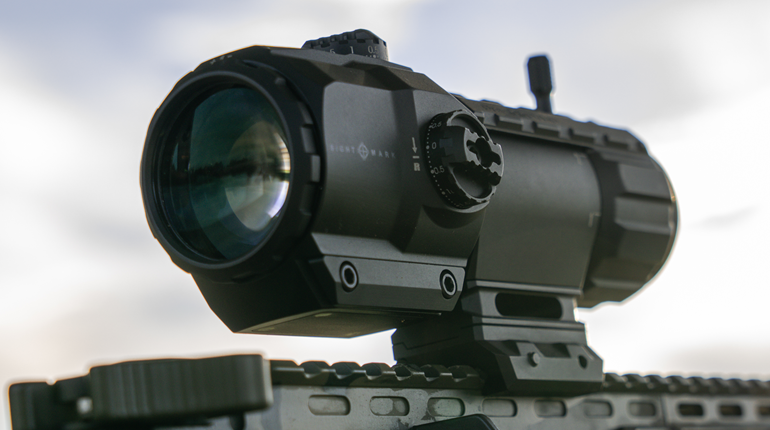
In several ways a 3X Leupold scope is the optical equivalent of the pre-’64 Winchester Model 70 rifle. Fans of the scope and rifle consider each perfectly designed for its purpose: the Model 70 for hunting big game and the 3X Leupold for hunting dangerous game, especially in Africa.
What? You’ve never heard of the 3X Leupold? Unlike the Model 70, it was essentially a special-purpose item, especially after variable scopes started taking over the market half a century ago. Leupold kept making more fixed-magnification scopes than any other manufacturer, but dropped the 3X in the 1980s.
A devoted minority of hunters kept seeking them out, just as some hunters search for pre-’64s, though apparently not enough 3X Leupolds were made. Any hunter who really liked pre-’64 Model 70s could buy several, but not everybody who liked the 3X Leupold could find one.
What was so special about such a simple scope? The 3X Leupold possessed the perfect compromise of just enough magnification and a tube long enough to span bolt-actions long enough for cartridges such as the .375 H&H, .416 Rigby and .458 Lott. Additionally, the scope only weighed a little over 8 ounces, had almost 4 inches of eye relief, and was really recoil-resistant. (Yeah, we’ve all heard that modern variables are just as tough as fixed-powers. Tell that to hunters who’ve had variables croak in the field on .375s, .416s and .458s.)
Leupold continued to make a 2.5X scope, which was also very recoil-resistant and weighed only 6.5 ounces, but with a really short tube. While it wasn’t impossible to mount the 2.5X on dangerous-game rifles, the scope’s position in the rings—therefore eye relief—was severely limited. The longer 3X could be mounted to perfectly suit any hunter’s shooting stance.
Eventually prices for a 3X in good shape matched or even exceeded those of new 2.5X and 4X Leupolds—when they could be found. The 3X’s fans (including more than one hunting writer, and the head of an Internet optics retail store) hounded Leupold for a new 3X. The demand increased after Leupold upgraded all its fixed-power scopes with click adjustments (rather than the friction adjustments they’d used for years) and multi-coated lenses.
Unfortunately, the tooling for the old 3X had long ago disappeared, and the company was too busy making other scopes (especially variables) to develop a specialized fixed-power for a limited market. But in 2007 Tim O’Connor, Leupold’s new-product development manager, started fooling with parts being made for other scopes, and came up with a couple of gloss-finish prototype 3xs with Multi-Coat 4 lenses and quarter-inch click adjustments.
O’Connor kept one and shipped the other to me. For the next year I used it primarily as a test-scope on various rifles from .300 H&H to .416 Rigby. It never failed.Eventually, Leupold decided to offer the new 3X through its custom shop and SWFA Outdoors, the company continually asking for the scope. I ordered one from Leupold’s custom shop with a matte finish and the Heavy Duplex reticle, mounting it on a CZ .416 Rigby for an upcoming safari in Tanzania. The adjustments proved to be as trustworthy as on the prototype, and the scope worked perfectly on a Cape buffalo at 30 yards.
Four bulls were hiding from the midday sun in thick bush along a dry creek, the shade so dark the herd looked more like shadows themselves. The multi-coated glass and thick reticle made aiming at the biggest bull’s black shoulder relatively easy.
The new 3X Leupold has slightly more magnification and eye relief than the old scope, reducing the field of view at 100 yards from around 40 feet to 30. This still proved plenty wide for aiming at close-range buffalo. Personally, I find field of view one of the most overrated aspects of hunting scopes.
Another good feature is the price: SWFA offers either gloss or matte models at just more than $300. Some hunters firmly believe a dangerous-game scope needs to cost a lot more, but that was never true with the old Leupold 3X, and still isn’t with the new and improved model.
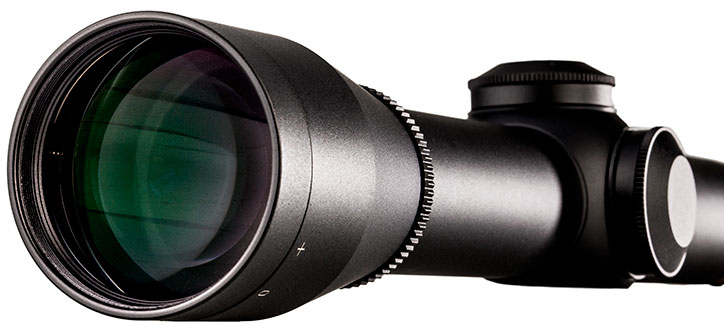
Technical Specifications:
Type: fixed-power riflescope
Magnification: 3X
Objective Lens Diameter: 20mm
Focusing Range: 10 yds. to infinity
Eye Relief: 3.9"
Exit Pupil: 6.7mm
Field of View @ 100 yds: 30'
Coatings: fully multi-coated with Multi-Coat 4
Dimensions: 1" tube; 10.3" long
Weight: 8.7 ozs.
Construction: anodized aluminum tube; gloss or matte black finish
MSRP: $304 (SWFA)