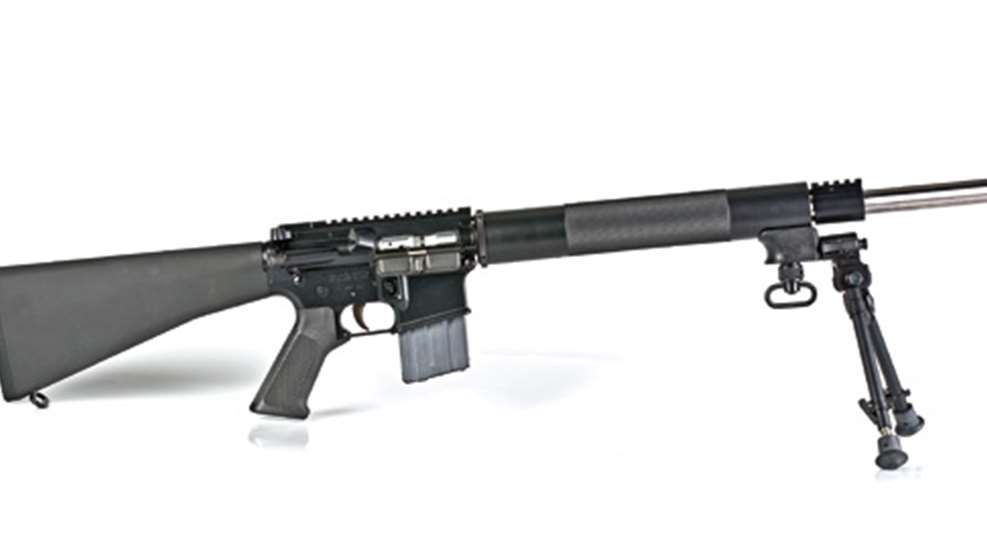
Most shooters know Les Baer Custom (LBC) as a maker of some of the best M1911 pistols on the market. But for a decade now, the company has also built a reputation as a maker of some of the best AR-15s on the market. The LBC Ultimate AR .223 Super Varmint is the flagship of the company’s AR line, and it makes an excellent rifle not only for varmint hunters but for benchrest shooters and police SWAT units as well.
Les Baer grew up in the 1960s in Pennsylvania, and, as any driver who came of age in that decade, he grew to love muscle cars. Becoming a machinist wasn’t a stretch for someone with a love of such performance, and he was working in the aircraft parts industry when he began shooting in pistol competitions. He attended an International Practical Shooting Confederation match in the early 1980s, and he realized he could switch gears. “ I looked at the guns guys were shooting [1911s] and I thought, ‘Heck, I can do that.’”
So he did. In 1988, Springfield Armory hired him to start up their custom shop in Illinois. Two years later, Baer moved his operation to Le Claire, Iowa, its current home. Today, LBC produces hundreds of guns a month, and a separate machine shop on site produces all manner of parts for other industries.
In the late 1990s, when Baer began to tinker with the ARs, he wanted to produce half-minute guns.
“Back then, everybody was saying you couldn’t make an AR and get it to group the way I wanted,” says Baer. “I said, ‘Baloney—it can be done.’ We worked for two years until we did. And now every AR we make drills one ragged hole.”
A bold claim? Sure, but it’s backed up by performance. The Ultimate AR Super Varmint is not cheap at $2,290. But it’s significantly less than other custom ARs on the market. Still, one wonders what he gets for such a price.
For starters, you get a rifle crafted by expert gunsmiths. Fit and finish are excellent, and accuracy is outstanding. This is not a “kit” gun made with vendor-supplied components, as is common and not in itself a sin. LBC makes everything on the rifle except the butt stock and other plastic parts, the magazines, the springs and the trigger. After forging and machining everything from the free-float aluminum handguards to the receivers to the barrel, it takes about 10 hours just to assemble each rifle. Delivery time is usually about 16 weeks, but often only 10, Baer says.
The upper and lower receivers are forged and machined from 7075 aluminum alloy (with or without a forward-assist, per customer preference). Atop the flattop upper resides a machined Picatinny rail ready to accept the riflescope of choice. Dupont S, a black rust-resistant finish, is baked onto both receivers and all small parts.
The LBC Ultimate Match carrier, with a chromed bolt and extractor, was patented sometime ago by Baer. Its hallmark? The ribs visible on the side of the carrier, which enable uniform cycling every time. “The carrier is about a half an ounce heavier than standard,” Baer says, necessary to provide the reliability expected at this price point.
But the extra weight means nothing when one considers the barrel. It’s an LBC Bench Rest unit, free-floated and made from 416R stainless steel. It’s left in the white, but it may be coated with Dupont S at customer request. The rifle I ordered for evaluation came with a 20-inch barrel (18, 22 or 24 inches may be requested). The rifling is created with a tool—basically a mini-broach—which cuts one groove at a time. The process takes more than an hour, painstakingly slow but worth the effort, says Baer.
“The heart of the gun is the way we make the barrel,” he says. “Single-point barrels take a long time to make, but if you want the most accurate barrel that’s the way to do it. There’s absolutely no stress in it.”
Machined atop the aluminum gas block is a Picatinny rail, so an A-2-style front sight can easily be mounted. Honestly, I can’t imagine why one would do so. This gun was made for long range.
That was evident the first time I squeezed the trigger, a two-stage unit made by Geissele. It takes 2 1/2 pounds of pressure to take up the first stage, then only 14 ounces to trip the second. My most memorable experiences with the AR platform involved M-4 semi-auto carbines or the M16s I carried in the Marine Corps. Any trigger on such a gun is built for practicality; long-range accuracy isn’t part of the equation. But the trigger on the Super Varmint begs to be squeezed slowly, deliberately, as if you know its release will unleash a beautiful group downrange. And it does.
After several range sessions (and one ragged-hole group!), I appreciated the LBC Custom grip. The beauty of it lies in its ergonomics; you don’t really notice anything, you just feel something special.
Accessories include a 20-round magazine, a factory-installed Versa-Pod bipod and a soft case. Upon taking delivery, customers need only buy high-mount rings (or order them from LBC) to mount the optic of their choice, load the magazine and start shooting.
Which is the way Les Baer likes it. This gun is guaranteed to produce half-minute groups out of the box like a turnkey street machine produces sub-10-second quarter-mile runs.
“You don’t need to add anything except a scope,” he says. “And you shouldn’t take off anything, either; don’t switch out the hand guards or the trigger or anything. If you eliminate any of those features accuracy starts to fall apart. Just take it out and shoot it, and enjoy it.”
Specs:
563-289-2126, www.lesbaer.com
Type: semi-auto, centerfire rifle
Caliber: .223 Rem.
Barrel: 20"; stainless steel; single-point rifling; 1:9" twist
Trigger: Geissele 2-stage
Magazine: detachable, 20-rd. capacity
Sights: none; integral Picatinny rail
Overall Length: 38.375"
Weight: 9.3 lbs.
Metal Finish: Dupont S black matte
Accessories: 20-rd. magazine; Versa-Pod; soft case
MSRP: $2,290