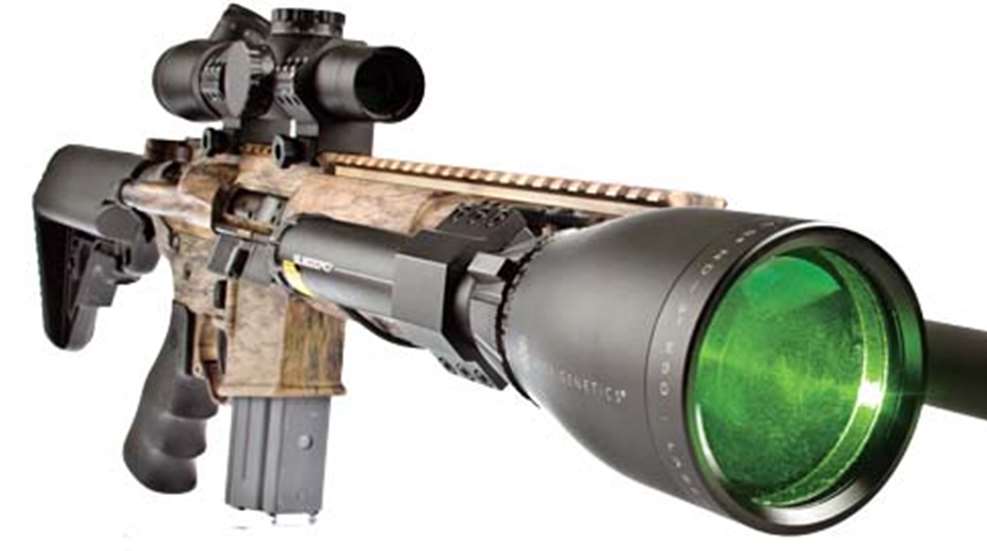
When the flashlight-looking apparatus landed on my desk I rolled my eyes. Who needs a pound of flashlight attached to a rifle? But then I pushed the switch on the end cap and my eyes widened. I didn’t even know what a “laser designator” was, but I quickly realized I’d never seen anything like the powerful tool I was holding. The Laser Genetics ND-3 was definitely more than just another flashlight.
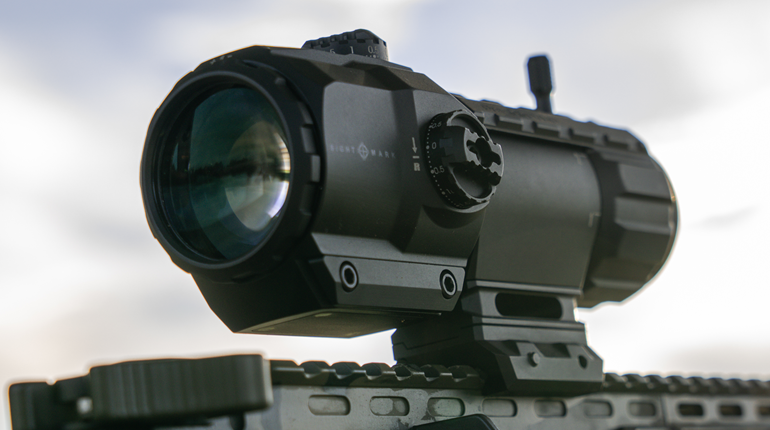
Then I turned the “rotary optical collimator.” It’s a bezel ring that functions similarly to a Mag Light’s beam adjustment system—though with nine fully multi-coated rings it’s more complex. The amplified laser beam it emitted went from a 28-inch-diameter green spot on my wall to an intensely concentrated, 2-inch shaft of dazzling light as I maxed the collimater. When I stepped into the hallway and shined the beam 30 yards to the far wall it remained crisp (3.5 inches in diameter) with very little dispersion of light, or flooding, as with flashlights. So, I did what anyone would do: I grabbed an AR-15 and attached the machined-aluminum ND-3 to the gun’s Picatinny rail and installed the pressure switch. When I shouldered the rifle, my scope’s crosshairs were obvious in the green light. Then I rotated the collimator until the beam’s diameter corresponded to the scope’s field of view. Then I understood what I had: a long-range night vision device for use with any riflescope.
Turns out I had more than that. A few weeks later I hunted coyotes and hogs at night. The last time I did this, I used a common electric spotlight (in my state you can varmint hunt at night as long as you let the warden know beforehand). But spotlights have disadvantages. First, 100 yards is about their max range. Secondly, everybody and everything can not only see the spot of light where the beam strikes, but the beam itself. Conventional, tungsten bulb-based lights spook animals and drain huge amounts of power—so much that most need to be wired to a car battery—and they can get as hot as a frying pan while in use.
The ND-3 runs up to seven hours (three in freezing conditions thanks to modified circuitry) on two CR123A batteries; its lens remains cool; its green beam doesn’t unduly spook animals; and with it you can see your target and the reticle of your scope clearly at 500 yards. Plus, its beam reflects eyes. (The warnings stickers on all Class 2 lasers advise that they can be harmful to vision if misused, so use good judgment.) I attached the ND-3 x 50 to my rifle via a hand-tightened Picatinny clamp, so I could remove it, turn the collimator to its widest setting and use it as a flashlight while walking. Company reps claim its beam can be seen for up to 3 miles at night, so it makes a great distress beacon. I think it would be handy on a boat. Laser Genetics has an entire line of laser designators in various sizes and prices, and now all my coworkers want one.