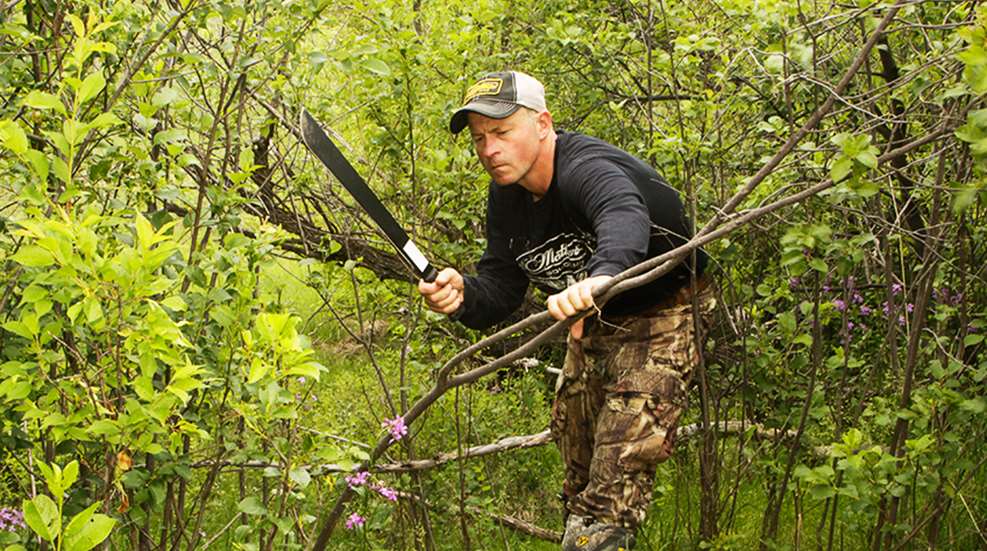
My lightbulb rarely glows above the dim setting, but it flickered as I watched not one, but two adolescent bucks detour on a trail I had machete-hacked days earlier. They walked right past my stand at less than 20 yards. Was an even better buck to follow through the can’t-miss zone? It did two weeks later. That lesson played out more than two decades ago. Since then, a machete, saw or pruner has accompanied me during stand setup, and throughout hunting season, for more than the obvious shooting-lane maintenance.
My trailblazing passion began while hunting dense river bottoms. I needed easy access through tangled willow thickets to reach treestands stashed in lofty cottonwoods. It was that simple. Whitetails could use the existing tunnel trails, but it was pointless for me to try to walk upright in the thatched environment. After whacking my own trails so I wouldn’t have to bend and crouch on my way to stands, watching deer veer into my hand-cut paths was a surprise benefit.
Avoiding back pain is just one reason for my machete work. As a scent-control fanatic I try to avoid brushing against any vegetation while slipping toward a stand, particularly when crossing shooting lanes. I clear as much foliage as possible from foot to shoulder level to prevent leaving any hint of my passage. Combine clear-cutting with the customary dousing of scent-eliminating sprays, and your presence disappears.
There is a third reason I chose to cut trails: My devotion to decoys means packing the hollow, noisy shells from stand to stand. Every limb or branch that smacks my plastic pal sends an echoing alarm throughout tranquil woods. Hack a roomier route and problem solved.
If scent and decoy management don’t rank high on your importance list, the unintended consequence of prompting additional whitetail traffic at close range should be reason enough for becoming a recreational landscaper. Whitetails, like most animals (including you) prefer to follow the path of least resistance. By chopping a wider, easier and more visible path through heavy cover, you advertise a better way to whitetails. Many discontinue using traditional trails for the new throughway in nearly impenetrable settings.
I’ve experienced great results with my exploits in river bottoms, but field edges are where they really shine. Like many whitetail hunters, I set up just inside the timber with a shot to the field edge. To avoid the possibility of leaving scent in an edge’s shooting zone, I’ll backdoor into the timber on a trail widened by my efforts. Bucks, particularly mature ones, routinely use my pioneer paths for a hidden and downwind advantage to scent-check openings from cover. That puts them within easy shooting range. When chasing ensues, does take the new off ramp for evasive action and bucks follow into the trap.
Wielding a machete, saw or pruner is work. It may remind you of yard chores at home, but the extra labor could put a buck right in your lap this season.