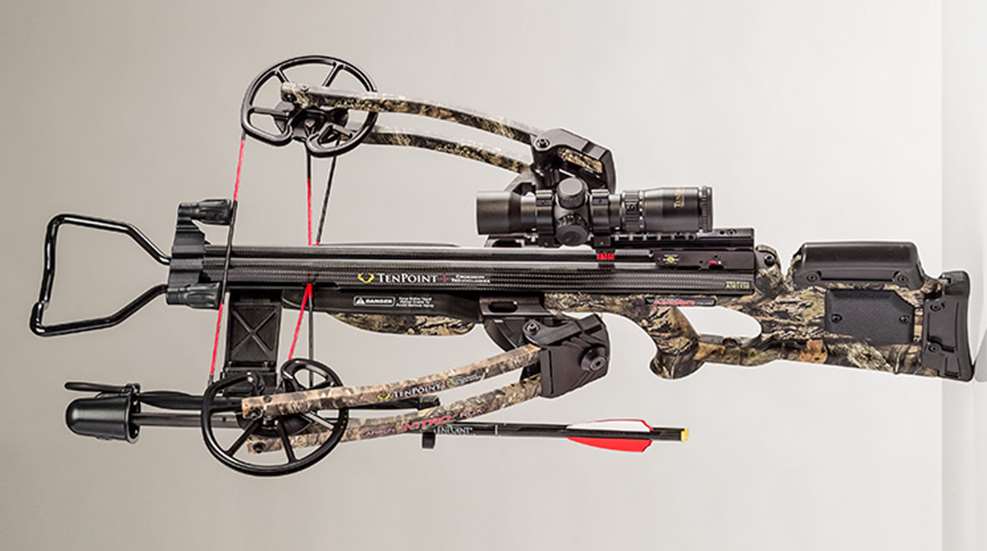
TenPoint has a reputation for manufacturing high-end crossbows with high-end price tags. But at $1,800, the new Carbon Nitro RDX is pricey even for TenPoint. What hunters get is a crossbow that promises to be more powerful than any other model in the company’s lineup. It’s rated as being quieter, lighter and more compact than many competing ’bows. Even so, is it worth the steep price? That’s ultimately for each hunter to decide, but what became certain during testing is the Carbon Nitro RDX is very compact and darned accurate.
For centuries crossbows have been designed with rearward-curving limbs mounted toward the front of the stock. The Carbon Nitro RDX, though, is a reverse-draw crossbow: The limbs attach to a riser that sits well back on the frame and curve toward the front. The draw stroke is the reverse of a traditional setup; rather than the string increasingly moving away from the limbs and riser during cocking, it starts in front of the limbs and riser, moves toward and passes them before anchoring behind them. The advantage of the reverse-draw design is it allows for a more compact crossbow with plenty of power.
Uncocked the Carbon Nitro RDX is 20.5 inches wide from outer cam edge to outer cam edge, and about 15 inches wide when cocked. When you consider many conventional crossbows are 5 or more inches wider, the Carbon Nitro RDX is darned near svelte and will be easier to maneuver in a treestand or blind. Despite that compactness, TenPoint says the Carbon Nitro RDX produces a velocity of 385 fps with a 370-grain arrow. This is the fastest crossbow in the company’s line even though its draw weight is one of the lowest at just 165 pounds. The reverse-draw design permits a longer power stroke that, coupled with large cams, transfers more energy to the arrow.
A tradeoff with reverse-draw crossbows is they typically require larger and heavier risers and cams. To offset that gain, the Carbon Nitro RDX is built on TenPoint’s C3 stock, which Brian Flaherty, the company’s marketing project manager, says cut .4 pound from the crossbow’s weight.
“The stock material is a specialty PolyOne material made specifically for
TenPoint,” Flaherty explains. “The base material, polypropylene, a mixture of 20 percent long carbon fiber and other proprietary components, allows a lighter, stronger stock that still maintains a supple feel when you shoot the Nitro RDX.”
As you might expect, the high-tech stock isn’t cheap—materials and manufacturing make it cost about double the price of a glass-injected stock, says Flaherty. But the C3 stock isn’t the only lightweight, technologically advanced (and expensive) component. The Carbon Nitro RDX barrel is a carbon-and-glass composite and starts as a blank that’s hand-wrapped around a mandrel before CNC machines cut the critical features.
“The barrel is made more similarly to a carbon bike frame than it is to a traditional injection-molded part,” says Flaherty. “It is almost four times the cost of a CNC-machined aluminum barrel.”
While the barrel and stock provide strength without much weight, the reverse-draw design also shifts the weight of the riser, limbs and cams toward the rear. Result: a crossbow that feels lighter than its 7.8-pound weight suggests and that balances comfortably when shouldered.
The Carbon Nitro RDX I received to test came with TenPoint’s RangeMaster Pro 1.5X-5X-30mm scope. Three crosshairs and five illuminated dots provide aiming points for 20, 30, 40, 50 and 60 yards. Turning the magnification ring, which is marked with arrow speeds from 275-425 fps, changes the subtensions between the dots and calibrates the scope for the velocity and drop of a given arrow. I set the scope for 385 fps and found it to be pretty much dead-on from 20-50 yards with a 370-grain TenPoint Pro Elite arrow sporting a 100-grain field point.
Results from my first firing sequence with the Carbon Nitro RDX—one shot apiece at 20- to 50-yard targets—were impressive. Firing from a rest, I laid the arrow right next to the bullseye at 20 yards and 30 yards. My 40-yard shot hit wide by a good 4 inches. I blamed it on my newness with the bow, a point which was confirmed when I took my time and put my first 50-yard shot within 2 inches of the bullseye. Even at that range, the Carbon Nitro RDX drove the arrow into the backstop right up to the vanes. After more practice, my three-arrow, 30-yard groups averaged 1.75 inches. At 40 yards my groups jumped to 2.75 inches, but with more time I bet I could shrink that closer to 2 inches.
I don’t know what to say about the trigger except that I wish some rifles had one with a pull this clean and light. The safety was positive, engaged automatically when the string was fully cocked and was easy to reach.
You have your choice of two cocking devices with the Carbon Nitro RDX: TenPoint’s patented ACUdraw, a gear-assisted mechanism that ratchets back the string into the firing position; or the Dedd Sled 50, essentially a rope with rubberized handles at both ends that loops around the back of the crossbow’s frame for leverage and grasps onto the string via a hard plastic “sled.” The crank cockers I have used work fine—but hand-pull mechanisms cock a crossbow considerably faster and I prefer them. Plus, ordering the Carbon Nitro RDX with the Dedd Sled saves $200. The Dedd Sled 50 reduces the force needed to cock the crossbow by 50 percent, but you’ll still need muscle. A hunter with any sort of upper-body disability would want to use the ACUdraw.
All in all, this is an accurate and extremely functional crossbow. With TenPoint’s limited lifetime warranty, the Carbon Nitro RDX should be a hunter’s go-to crossbow for years to come.
Technical Specifications
• Type: reverse-draw crossbow
• Draw Weight: 165 lbs.
• Velocity (w/ 370-gr. arrow): 385 fps
• Barrel: carbon-and-glass composite
• Riser: CNC-machined aluminum
• Stock: polypropylene-and-carbon composite thumbhole; Mossy Oak Break-Up Country finish; LOP adjustable 13.63"-13.88”
• Trigger: single stage; 3.5-lb. pull weight
• Safety: two-position toggle, automatic
• Dimensions: length 34.25"; axle-to-axle width15.5" uncocked, 10" cocked; power stroke 16.5"
• Weight: 7.8 lbs.
• Accessories: ACUdraw or Dedd Sled 50 cocking device, RangeMaster Pro 1.5X-5X-30mm scope, RDX String Stop System, 3-arrow quiver, 6 Pro Elite carbon arrows w/100-gr. field points
• MSRP: $1,619 w/Dedd Sled 50 (tested); $1,819 w/ACUdraw