The buck wasn’t a fighter. Perhaps it had outgrown that in its youth. Or, given its size compared to other bucks we’d seen, maybe it preferred intimidation to full-on violence. What I can say for certain is the buck came to my friend Michael’s rattling sequence on that cold afternoon in Alberta, investigated for a moment then quickly circled back to tend its does. Minutes passed, my stomach in knots all the while, before it reemerged. It fed on prairie grasses amidst loose pines as I took aim. My shotgun cracked. Had I seen the deer fall? I couldn’t be sure. The shot didn’t feel great, which I confessed to Michael.
“Well, I think you’re going to be happy,” he said, interrupting our search for blood.
Antlers stood tall over the grass, just 10 yards from where the deer had been shot. Federal Premium’s new Trophy Copper Slug had caught the buck behind the shoulder and, I later discovered, mushroomed nicely and driven bone fragments through its lungs. We pulled the slug from the off-side hide.
That wasn’t the first time the innovative sabot caused me to smile. My initial test of the new ammo was with 12-gauge, 300-grain slugs and a Benelli Super Black Eagle II with a 1:28-inch rifled barrel. My intent was merely to sight-in the gun (formal accuracy testing would be performed another day), and yet the results literally caused me to say “wow.” My first three-shot group at 100 yards was 1.8 inches. Just to make sure it wasn’t a fluke, I shot another group, a veritable cloverleaf by slug standards at 1.7 inches. I’ve tested centerfire rifles that shot looser groups than that. Given the modern fine-tuning of sabot slugs and rifled shotgun barrels, the “200-yard shotgun” has replaced “hitting a pie plate at 100 yards” as the gold standard. However, the Benelli/Federal Trophy Copper Slug setup is the first that’s truly given me the confidence to consider shooting a whitetail at that distance.
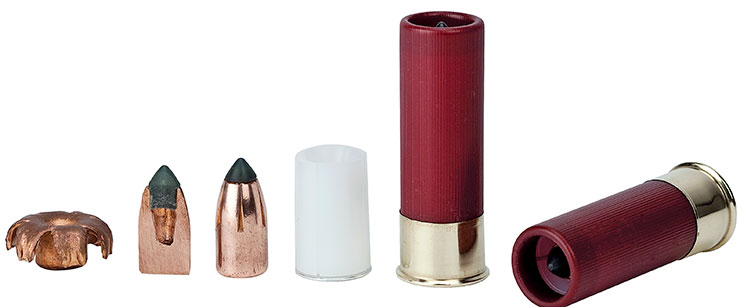
Arguably the most unique aspect of Federal’s new design is the aluminum plate that sits at the rear of the sabot. According to Federal, the plate helps the sabot to engage the rifling in a more stable and consistent fashion. Upon exiting the muzzle, the plate falls free from the sabot. Through some effort and a lot of luck, I was able to recover one of the plates after firing. Its roughed edges indicated to me that it had indeed engaged the rifling as the sabot rotated down the barrel. It’s an innovative design, but not surprising considering that Federal’s engineers are ever-tinkering. After all, its parent company, ATK, produces everything from fighter jet missiles to rocket propulsion systems.
The slug itself features a polymer tip that increases its ballistic coefficient over a normal hollow-point copper solid. According to factory numbers, the load I tested, a 12-gauge, 23/4-inch shell firing a 300-grain slug 1900 fps at the muzzle, flies quite flat for the first hundred yards, then drops 11 inches in the subsequent hundred yards. With a 150-yard zero, drop is estimated at just less than 8 inches at 200 yards.
Other aspects of the slug’s design include a large internal cavity designed to foster penetration as the slug’s petals peel back around it. Speaking of which, the Trophy Copper Slug is pre-skived to initiate expansion. Federal says the skiving also results in consistent bullet upset (mushrooming) across a range of distances and energy levels. In addition to my Alberta buck, which was shot at about 125 yards, a hunter sharing camp shot one with the Trophy Copper Slug at just more than 150 yards. The slug displayed a nice uniform mushroom and retained all petals. I also shot a coyote in Alberta at a distance of 125 yards. As you may have guessed, the coyote proved no match for a heavy shotgun slug, but I include this as further testament to the slug’s accuracy. Interestingly, the slug’s copper construction proved hard enough that the entry/exit wounds weren’t as substantial as you may suspect. The 50-pound male coyote made a nice rug.
Based on my initial, very positive experience, I was excited to more thoroughly evaluate the accuracy of the Trophy Copper Slug load. The Benelli shotgun I borrowed for my Alberta hunt was no longer available, so I borrowed another Super Black Eagle II to keep things consistent. Unfortunately, the load underperformed compared to my previous results. I shot five three-shot groups, which averaged 2.42 inches. Hey, that’s pretty good for a slug at 100 yards. Probably well above average, in fact, and I would’ve been happy if not for my prior results. For both tests, I used a 12-gauge Benelli Super Black Eagle II with a 1:28-twist rifled slug barrel and 23/4-inch shells with 300-grain slugs. The ammo was the same. The shooter was the same. And the test seems simply to reaffirm that guns, even of the same model, don’t always shoot alike.
However, my overall impression of the Federal Trophy Copper Slug remains a strong one. In the right gun, it achieves dramatic accuracy results. And I’m equally impressed by its performance on game.
Type: all-copper sabot shotgun slug
Gauge: 12, 20
Length: 2 3/4" or 3"
Weight: 275 grs. (20); 300 grs. (12)
Advertised Muzzle Velocity: 2000 fps (12-ga. 3"); 1900 fps (12-ga. 23/4" and 20-ga. 3"); 1700 fps (20-ga. 2¾")
MSRP: 23/4" $15; 3" $18