Some ideas are just too good to die, and the same can be said about cartridges. The .300 H&H Magnum has been around since Coolidge occupied the White House and has been pronounced dead by “experts” since the 1960s. The years have brought us shorter, faster and even shorter .300 magnums, yet the original lives on. Some modern riflemen despise the .300 H&H for its length, belt, tapered case design and obtuse neck, yet it is precisely these qualities that have kept the round alive for decades. And now ammo companies have breathed new life into this classic cartridge.
It all began in 1925 when the British firm Holland and Holland necked down another classic, its .375 H&H. Original factory cordite loads pushed bullets of 150, 180 and 200 grains at 3000, 2700 and 2350 fps, respectively. The cartridge eventually became the standard by which medium-bore magnums were compared. It’s versatility suited the cartridge for everything from long-range target shooting to hunting big game in Africa to Alaska.
Over the years factory loads got milder and more scarce, and like many classics, the benefits of the cartridge were lost to all but handloaders. (Manuals list maximum loads for a 165-grain bullet at 3150 fps, which is on the heels of the .300 Weatherby.) Perhaps the .300 H&H’s biggest threat, however, was a lack of factory rifles chambered for it. Though custom makers see a steady demand for the .300 H&H, major manufacturers steered clear, opting for newer, faster, home-grown chamberings.
But over the last few years ammo companies have applied new technology to older loads. By loading the .300 H&H with cutting-edge powders and bullets, it displays ballistics in line with modern .300 mags while maintaining its silky smooth feeding and extraction thanks to it’s gently taperered contours. Currently at least 10 loads from major manufacturers are available—all of which exceed original velocities.
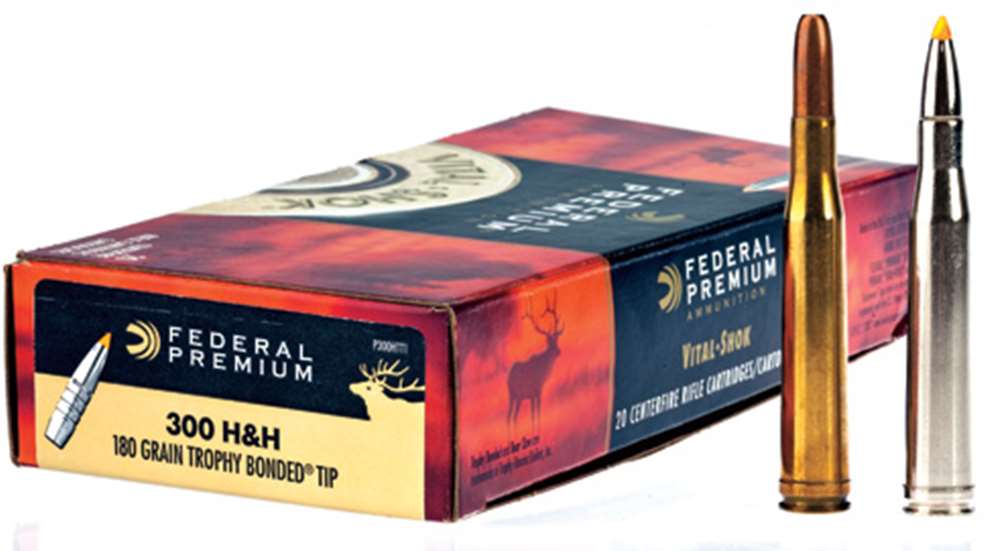
Federal Premium alone has seen .300 H&H ammo demand double over the past three years.The company now offers it with an ultra-modern Trophy Bonded Tipped bullet, shown above. This premium, controlled-expansion bullet has a very high B.C. of .500. While it starts out at the same muzzle velocity of 2880 fps as Federal’s other loads, by 200 yards it begins to pull away from other bullets in energy and velocity due to its high B.C.
Ruger has responded to new demand by chambering the .300 H&H in its single-shot No.1-S. The .300 H&H really shines with a 26-inch barrel, and the Ruger provides it with an overall length of only 42.25 inches. The mere sight of this classically styled rifle with its long, tapered cartridge evokes images of faraway places and exotic beasts. That kind of nostalgia, combined with the round’s enhanced performance with modern bullets, is why this “obsolete” cartridge won’t quit.