Image Courtesy John Seerey-Lester
We Americans are so accustomed to safety in outdoor activity that when an animal such as a wolf attacks someone, it makes national news. But in many parts of the world, animals not only attack but also kill people fairly often.
Some of the most terrifying sprees of human killing by animals occurred a hundred years ago in the jungle villages at the foothills of the Himalayas, in a region called Kumaon, in northern India. Bengal tigers and leopards killed—and ate—hundreds of men, women and children. One Bengal tiger became so dependent on human flesh that it killed 436 people. (It remains the worst man-eating record for a single animal.)
The British colonial government that ruled India was at wit’s end as government-authorized bounty hunters returned empty-handed. Even armed soldiers sent in to vanquish the monsters managed only to push them deeper into the jungle, allowing the tigers to reappear elsewhere. The mighty power of the British Empire was no match for the man-eating tigers and leopards.
The turnaround came when a railroad cargo supervisor and hunter named Jim Corbett entered the picture. In 1907 he did the seemingly impossible—bagging the tiger that had taken 436 lives, known as the Champawat Tiger. And he declined the bounties offered. Over the next three decades, as he donated his spare time by diligently tracking and dutifully eliminating a dozen man-eaters, he was lionized in India by grateful villagers and colonial officials alike (no small honor in a colonial country that resented the whites living there).
But it was his book describing his hunts for the Champawat Tiger and other man-eaters that made him a world-famous hunter. The book, Man-Eaters of Kumaon, was published in 1944, right in the middle of World War II—yet it became an international bestseller. It has since been re-published in countless editions. He wrote several other books, but this became a classic of hunting narrative.
So, in 2014, as we mark the 70th anniversary of this masterpiece, it behooves every hunter who has not read Man-Eaters of Kumaon to do so. This recommendation is particularly apropos today, as many hunters seem to think sophisticated gadgets can substitute for skill and persistence. Today’s addiction to scopes, laser rangefinders, scent-control clothing and more would make Corbett turn in his grave.
How was Corbett so successful where so many others failed? Simply put, he was a hunter with unique observational abilities. He could read nature’s signs with the ease most of us read billboards on the highway. In short, he was the Sherlock Holmes of the jungle.
Largely self-taught in jungle biology, he was an expert in deciphering animal footprints (pug marks, as he called them). He wrote that a tiger’s “pug marks can provide one with quite a lot of useful information, as for instance the direction and speed at which the animal was traveling, its sex and age, whether all four limbs are sound, and, if not sound, which particular limb is defective.”
It was this jungle savvy, rather than mere gunmanship, that distinguished Corbett as the world’s foremost hunter of predators. He lived before the advent of motion-sensing trail cameras, but he could infer almost as much about an animal from its footprints as we today see from a trail-camera photo.
Hunting in tiger country, he wanted to kill the man-eaters—not every tiger in sight. So, he would carefully interview witnesses before the hunt. For instance, in tracking one tiger, he describes how he reached his preliminary conclusions:
•••••
The villagers gave me one very interesting item of news in connection with the tiger. They said they always knew when it had come into the village by the low moaning sound it made. On questioning them closely I learnt that at times the sound was continuous as the tiger passed between the houses, while at other times the sound stopped for sometimes short and other times long periods.
From this information I concluded (a) that the tiger was suffering from a wound, (b) that the wound was of such a nature that the tiger only felt it when in motion, and that therefore (c) the wound was in one of its legs.
•••••
Surely enough, after tracking and killing the tiger, he found a festering wound in its left front leg, with some 30 porcupine quills embedded. A fight with a porcupine had rendered the tiger incapable of capturing its natural prey, thus becoming a man-eater. In fact, in his writings, Corbett painstakingly emphasized that tigers only resort to man-eating if they have serious wounds or other defects.
His exploits often involved terrifying, death-defying moments. For instance, in 1930 he was tracking a man-eating tigress that had killed 64 people. He had some bird eggs (which he had grabbed for his personal collection) in his left hand, and as he went around a massive rock, he came face-to-face with the tigress—sitting only 8 feet from him. Any false move and the tiger’s teeth would be on his neck. What he did next—while still holding the eggs in his left hand—illustrates his masterful self-composure.
•••••
The rifle was in my right hand held diagonally across my chest, with the safety-catch off, and in order to get it to bear on the tigress the muzzle would have to be swung round three-quarters of a circle.
The movement of swinging round the rifle, with one hand, was begun very slowly, and hardly perceptibly, and when a quarter of a circle had been made, the stock came in contact with my right side. It was now necessary to extend my arm, and as the stock cleared my side, the swing was very slowly continued. My arm was now at full stretch and the weight of the rifle was beginning to tell. Only a little further now for the muzzle to go, and the tigress—who had not once taken her eyes off mine—was still looking up at me …
How long it took the rifle to make the three-quarter circle, I am not in a position to say. To me, looking into the tigress’s eyes and unable therefore to follow the movement of the barrel, it appeared that my arm was paralyzed, and that the swing would never be completed. However, the movement was completed at last, and as soon as the rifle was pointing at the tiger’s body, I pressed the trigger …
For a perceptible fraction of time the tigress remained perfectly still, and then, very slowly, her head sank on to her outstretched paws, while at the same time a jet of blood issued from the bullet-hole. The bullet had injured her spine and shattered the upper portion of her heart.
•••••
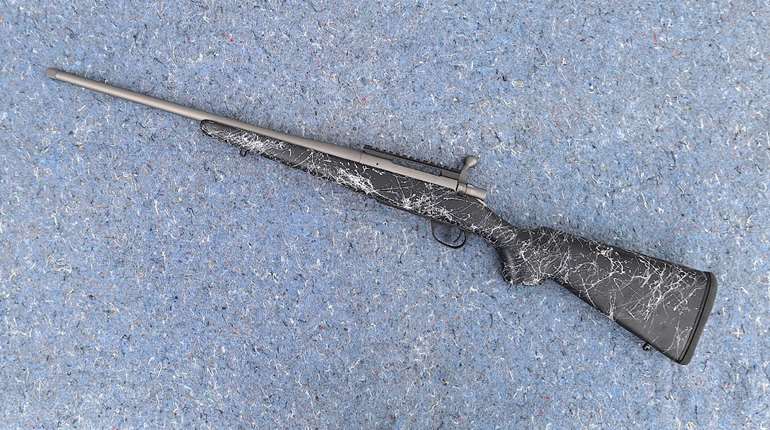
Corbett usually hunted with one or more of three rifle calibers: a .275 (7mm Mauser), a .450/400, and a .500. Alongside his man-eater hunts, he sometimes pursued trophy game. He once bagged a (non-man-eating) Bengal tiger dubbed the Bachelor of Powalgarh—it measured a staggering 10 feet, 7 inches long.
In all, the man-eating tigers and leopards he shot had killed at least 1,200 people. Without his fearless feats, hundreds or perhaps thousands of more people would have died. Yet he remained a rather humble man—“modest and unassuming,” as his contemporaries often described him. He went to the eternal Happy Hunting Ground in 1955, at age 79.
There is a valuable moral lesson from his life. That is, a skilled outdoorsman can tackle nature’s threats better than an entire government can. The fact that he lived in a faraway country does not make that moral lesson irrelevant to us Americans. In fact, it is a timeless warning to us, as we see many of our political leaders disparage self-reliance and promote the misguided notion that the government can protect people from every danger.