As we Americans celebrate the semiquincentennial—250th anniversary—of our great country, understand there are, of course, various interpretations of what made our country great. But no one can deny the role of frontiersmen in our history—and they depended on hunting for their survival. (Unfortunately, in some circles there are those who reject the very idea of America being a great country, but such perfidy is not worth our time, for life is too short to waste it on negative nincompoops.) At 250, our country has lived longer than any of us ever will, so let’s celebrate this unique moment with unabashed patriotism.
There are few recreational activities where patriotism runs deeper than in hunting. In a deep sense, we hunters are traditionalists—we go get our meat from the land, just as the frontiersmen did when the country was founded. Our equipment is more sophisticated than theirs, but fundamentally the activity is the same. When the country expanded in the founding era, it was largely thanks to frontiersmen who braved forth and charted uncharted land. Of course, there were no grocery stores in the wilderness—you ate what you brought with you, and when it ran out you hunted your dinner. You cleared the land for farming, but you still depended on meat from the land until your crops were ready.
Therefore, at this time of grateful celebration, we American hunters cannot be faulted if we also indulge in filiopietism—the enthusiastic reverence of traditions and ancestors. In fact, filiopietism should be a very appropriate part of our celebration. After all, hunting made possible the existence of the frontiersmen, and frontiersmen made possible the expansion and thus the continued existence of the country, and therefore hunting is inseparably connected to America’s greatness.
Over the last 250 years, millions of Americans maintained the tradition of hunting by actively engaging in it. We will never know all their names—but we can commemorate those whose names we do know well. Even the latter list would be inordinately long, so we are therefore compelled to pick and choose some names over others, which is a subjective exercise after all. Nevertheless, the American hunters we celebrate here are worthy of being on anyone’s list.
George Washington (1732-1799)
The father of our country was not only a great commander in chief but he was also an avid hunter. In the 1750s, his military service in the Virginia provincial forces during the French and Indian War took him to what was then the wilderness of western Pennsylvania, long journeys that taught him wilderness survival, among other things.
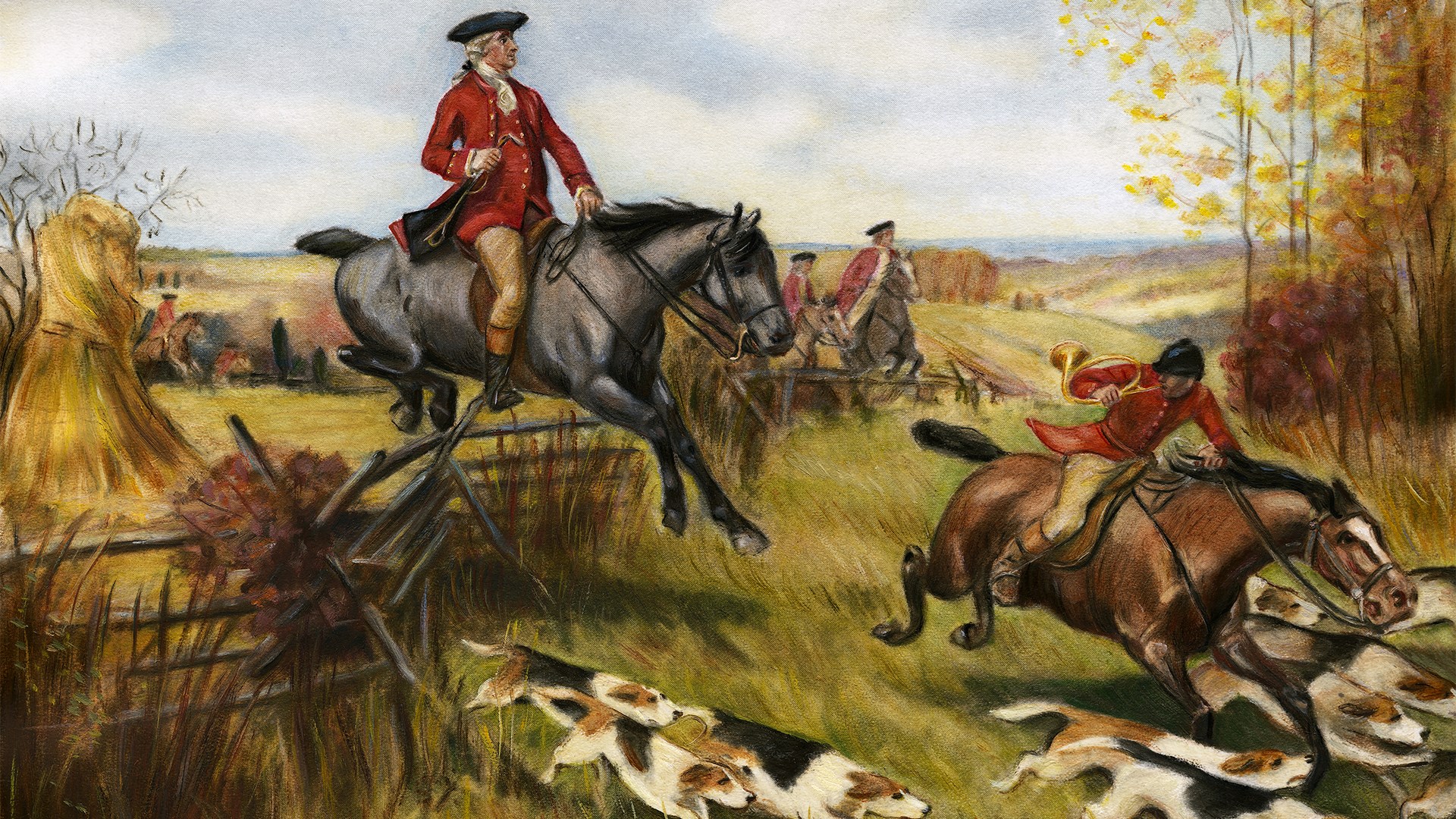
In the 1760s, when he made his living as a planter, growing tobacco and other crops, much of his free time, especially in winter, was spent on fox hunts on his 3,000-acre Mount Vernon plantation and the surrounding woods. His step-grandson recounted that Washington’s fox hunting outfit was “in true sporting costume, of blue coat, scarlet waistcoat, buckskin breeches, top [high] boots, velvet cap, and whip with long thong … .” He hunted with hounds and “rode in the chase a horse called Blueskin, of a dark iron-gray color, approaching to blue … .”
Furthermore, “The habit was to hunt three times a week, weather permitting; breakfast was served, on these mornings, at candle-light.” His breakfast was an Indian-corn cake and a bowl of milk, and he would set off before daybreak.
In fact, Washington’s own diary is the best witness to his hunting passion. (Since his diary was not intended for the public, his wording is casual and choppy, but his passion is clear and fluent.)
For instance, on Jan. 26, 1768, he diarized, “Cloudy & cold, with Spits of Snow. Went out with the Hounds but started no Fox. Some of the Hounds run of upon a Deer.”
The next day, Jan. 27, he wrote, “Went out again—started a Fox abt. 10. Run him till 3 and lost him.” Notice that’s a five-hour fox chase, from 10 a.m. to 3 p.m!
Despite the cold weather, he tried again on Feb. 3 and 6: “Started but catchd nothing.”
He was undeterred, and on Feb. 9: “Went out Hunting again. Started a fox. Run him four hours & then lost him.”
But on Feb. 12: “Fox hunting with [a company of friends]. Catchd two foxes.”
More luck the next day, Feb. 13: “Hunting in the same Company. Catchd 2 More foxes.”
Then on Feb. 18 he did a duck hunt: “Went a ducking between breakfast & dinner.”
Back to fox hunting on Feb. 20: “Fox hunting with [a friend]. Catchd a Fox.”
And again on Feb. 23: “Fox hunting with [a friend]. Catchd a Fox we suppose, but being dark coud not find it.” You see, the hunter’s bane of running out of daylight is nothing new.
The next day, Feb. 24, he reverted to duck hunting and got lucky: “Went a ducking between breakfast & dinner & killd 2 Mallards & 5 bald faces [i.e., American wigeon].”
And again on Feb. 25: “I went to the Creek but not cross it. Killd 2 Ducks—viz. a sprig tail and Teal.” He was most certainly referring to Little Hunting Creek, which still exists at Mount Vernon.
His relentless pursuit of a quarry is epitomized in this diary entry for March 2, 1768: “Hunting again, & catchd a fox with a bobd Tail & cut Ears, after 7 hours chase in wch. most of the Dogs were worsted [i.e., exhausted].” Yes, he said it—a fox chase that lasted seven hours.
Well, who knew the father of our country pursued foxes as doggedly as he would pursue the British army years later? Given his diary entries, it is not hyperbolic for us to conclude that his fox hunting probably taught him much about persistence that would later serve him well as he led the Revolutionary War.
Most Americans today don’t realize it, but the Revolutionary War lasted at least six years, from 1775 in Massachusetts to 1781 in Virginia, until Washington conclusively defeated the British at Yorktown. The American Continental Army was essentially a ragtag army of men who were ill-fed, ill-clothed and ill-equipped. They needed persistence if they were to defeat the mighty king’s army. Fortunately for them—and for America itself—their commander was a man who knew a lot about persistence.
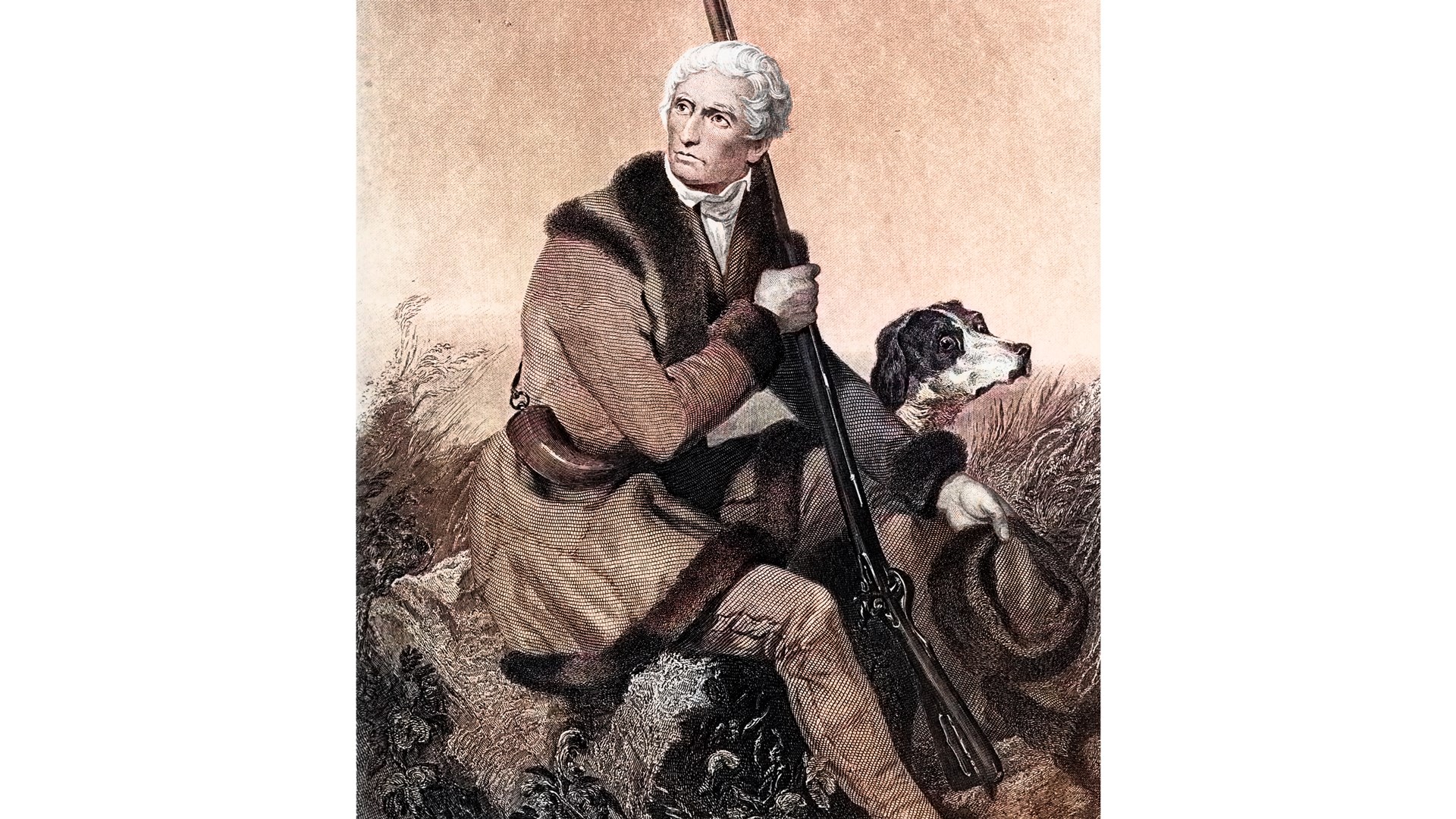
Daniel Boone (1734-1820)
If not for Washington, Daniel Boone would top any list of historic American hunters.
Born and raised in Pennsylvania, Boone began hunting when very young. Later, he frequently engaged in what was called a “long hunt,” where the hunter stayed in the woods for weeks or months at a time until he gathered sufficient meat for food and skins for sale. That activity, combined with a wanderlust that lasted all his life, took him far and wide. His travels—by foot, on horseback and by boat—spanned a vast region that today includes Michigan in the north and stretches as far south as Alabama and Florida, and then across the Mississippi River to Missouri and beyond.
But of course it was Kentucky that made him famous; in particular, his founding and defense of the fortified village named after him: Boonesborough. However, Boone was not the first American in Kentucky; in fact, he heard about Kentucky from others who had been there. But he was the most respected enthusiast for Kentucky. As an accomplished woodsman, he exuded a confidence that inspired his contemporaries to follow him. He was also honest and forthright; people did not wonder if they were hitching their wagon to a charlatan. His crossings of the Appalachian Mountains made the Cumberland Gap the most famous mountain pass in America, and thousands of Americans seeking fertile land and fine game followed his footsteps and moved into Kentucky and beyond, into the region historians call the Trans-Appalachian West.

Early American Long Rifle
A commercial hunter and trapper, he often took 200 to 500 deer in a season, selling the skins for a profit. Deerskins were in demand for clothing. He likely used a Pennsylvania long rifle for these hunts. One morning, hunting in eastern Kentucky, he killed 11 bears before noon. Bear meat was savored by many Americans and its fat was used as oil. In trapping, taking 100 to 200 beaver skins a season was not unusual for him. He also dug up and sold ginseng roots, which American traders shipped to China.
In his time, game was plentiful, and we should view his actions in that context, not by our modern hunting ethics. However, Indians frowned on white hunters (including Boone) who often took only the skin and let the animal’s carcass rot, and such resentment often led to confrontations. Nevertheless, Boone understood the indispensability of game as a food source even for white settlers. In 1775, at the founding of Boonesborough, he enacted restrictions against indiscriminate hunting. It was probably the first conservationist action in Trans-Appalachian history.
Boone said that a man needs only three things to be happy: a good gun, a good horse and a good wife. He evidently had all three.
In some ways, Boone was an improbable trailblazer. He was a man of few words, and soft-spoken. Physically, he was not very big. Though robustly built with broad shoulders and muscular limbs, he was only 5-foot-8 and weighed about 175 pounds. Yet it is a testament to his character that, two centuries after his death, he still personifies the quintessential American frontier hero. No one else comes even close.
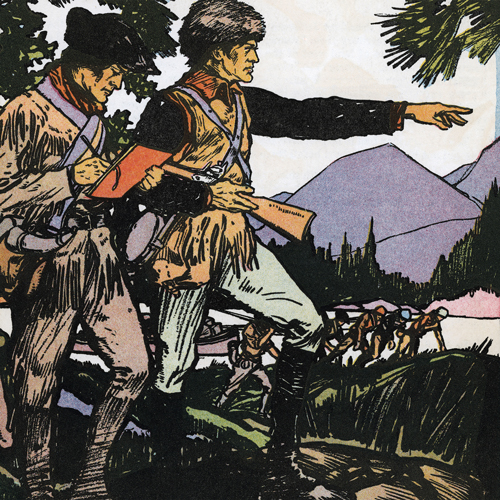
Lewis and Clark Expedition (1804-06)
No other event in American history exemplified wilderness survival—and the essential role that hunting plays in it—better than this expedition did.
The 250th anniversary we are celebrating this year is for the Declaration of Independence, our founding document from 1776, which was authored by Thomas Jefferson. Jefferson was a man with boundless curiosity, so when he became president in 1801 he began promoting exploration and expansion. With the Louisiana Purchase in 1803, he nearly doubled the size of the country, so he arranged for captains Meriwether Lewis and William Clark to explore the new land and possibly seek an interior water route to the Pacific. Hence the Lewis and Clark Expedition—a river voyage that operated as an independent unit of the U.S. Army, comprising non-commissioned officers, privates and civilians—about 30 in all, besides the two captains.
Going upriver, moving the expedition’s heavily loaded, 55-foot-long keelboat and pirogues against the current was exhausting work, and the men ended up with ravenous appetites, each man often consuming some 5 to 10 pounds of meat a day. Though they sometimes caught fish, only red meat could satisfy such frenzied feeding, and red meat came from the land—by hunting.
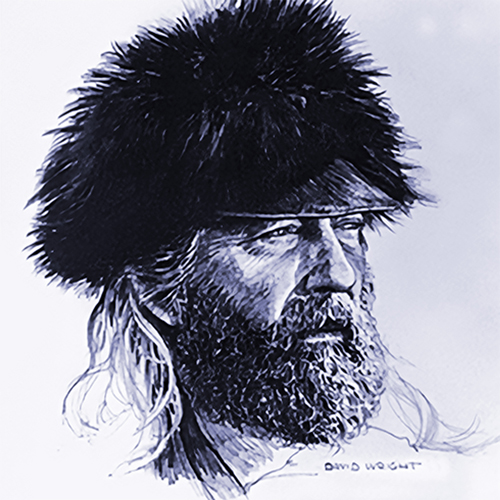
And one of the best hunters on the crew was a young man named John Colter. For instance, in September 1804, near today’s Yankton, S.D., Colter was sent to find a crew member who had been missing for days. While looking for him for a week, Colter downed a jaw-dropping buffet of Midwestern game to help feed the crew: a bison, an elk, three deer, a wolf, five turkeys, a goose and a beaver—all this while the missing crew member, despite having a gun while being lost and hungry for days, had killed only a single rabbit.
By the time the expedition reached the Pacific Ocean in November 1805—a year and half after leaving St. Louis—the two captains had developed a profound admiration for Colter’s rugged skills. That admiration led them to a unique decision on the return journey. In August 1806, in North Dakota, the returning expedition met two trappers going up the Missouri River in search of beaver. Colter wanted to join them, and the two captains, not wanting to disappoint him, gave him permission.
The “official” rifles of the Lewis and Clark Expedition were 15 special-order guns. It was previously thought these 15 rifles were Model 1803. Today it is believed they were 1792 Contract rifles (i.e., .49-caliber flintlocks made under government contract in 1792-94), but specially modified, perhaps to .54 caliber, with the barrel 42 inches or shorter (short barrels being desirable in cramped quarters such as the expedition’s keelboat). Given Colter’s outstanding skills, the captains almost certainly let him use one of these rifles. And it is possible he carried that gun when he left the expedition to pursue trapping.
 Girandoni Air Rifle
So, Colter headed back upriver with his two new companions, towards the Yellowstone River, and eventually to its tributaries, where beavers were aplenty. The next year, he began working for a fur trader and, hoping to promote trade with Indian tribes, undertook a solitary trailblazing trek of several hundred miles across southern Montana and northwestern Wyoming, and became the first white man to see the amazing geysers and the timeless scenery of what is now the Yellowstone National Park. During this months-long trek in the Rocky Mountains, he subsisted on local game, trapped, and fended for himself—thus becoming America’s first mountain man.
Other famous mountain men such as Jim Bridger, Kit Carson and Jedediah Smith were tough men in their own right, but Colter was the first.
Though Lewis and Clark did not find a continuous inland water route to the Pacific, their exploration had a direct role in the settlement of the Midwest and the West. Their steps were followed by mountain men, who in turn were followed by thousands of settlers. Without hunting, neither Lewis and Clark nor mountain men nor settlers would have lasted long.
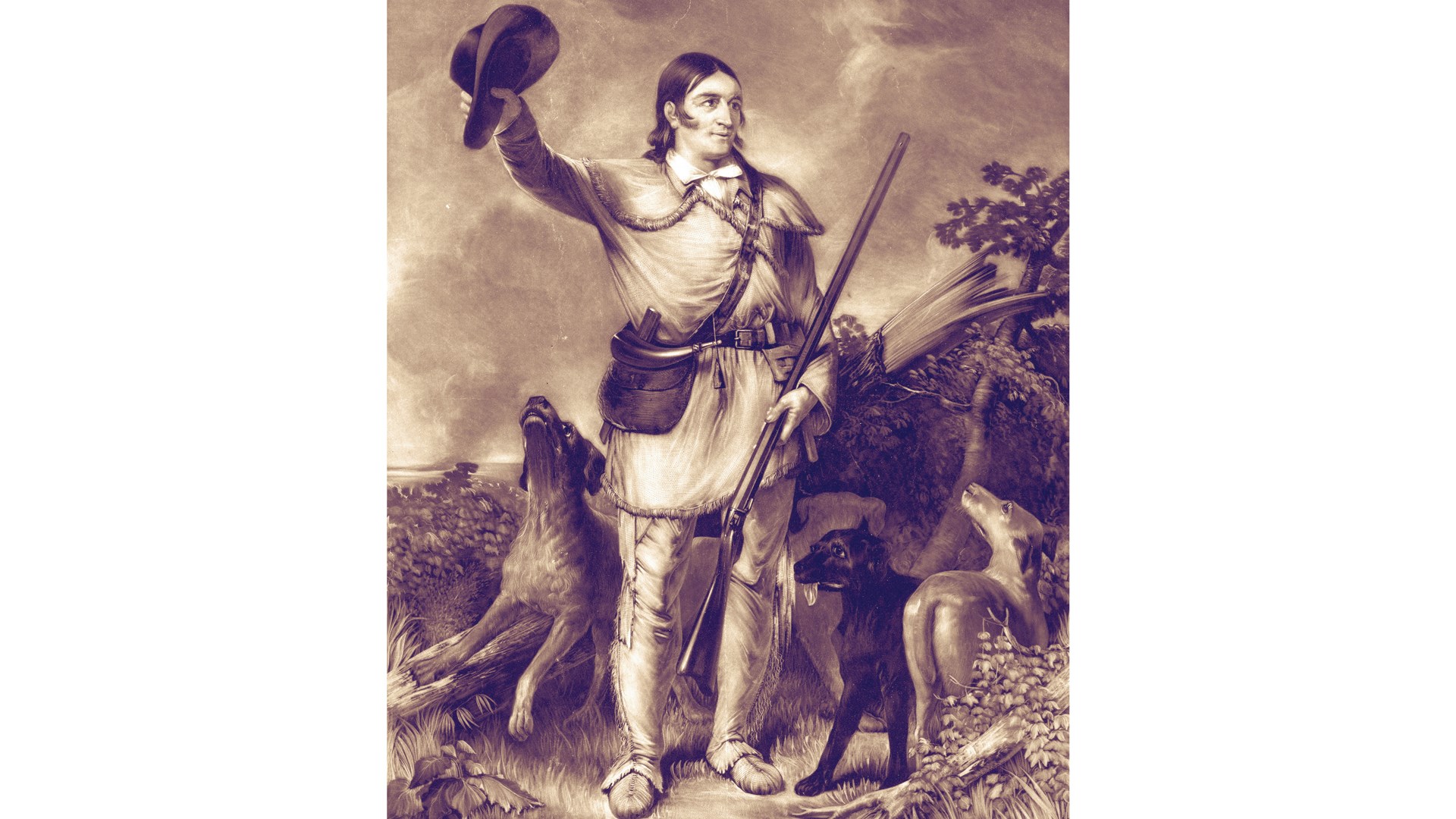
David Crockett (1786-1836)
Many Americans today remember David Crockett as a Texas hero who died at the Alamo. But Crockett was not a Texan. He had been in Texas less than three months when he was killed at the Alamo at age 49. Instead, Crockett was from Tennessee—and was a Tennessean born and raised.
He took to hunting at an early age as did many boys living in what was then the American frontier—and soon everyone noticed his precocious skills in marksmanship. So it was no surprise that during the War of 1812-1815 Crockett enlisted as a Tennessee volunteer in the army headed by Andrew Jackson. (Jackson’s victory in that war would later propel him to the presidency.)
As an enlistee in his 20s, Crockett was almost more valuable as a hunter than as a soldier, for Jackson’s army had meager rations and often had to find food on the march. Crockett said, “As the army marched, I hunted every day, and would kill every hawk, bird, and squirrel that I could find.”
Even after the war, Crockett traveled and hunted all sorts of game, from turkeys to deer, feral hogs and elk. But what he loved to hunt most was bear. One such hunt occurred in the winter of 1822-1823, in icy weather, in thick bushes along the South Fork of the Obion River, in northwestern Tennessee. He and his dogs happened upon a big black bear. The dogs drove the bear up an oak tree, and Crockett crawled to within 80 yards of the tree, until the big bear’s breast was in Crockett’s clear line of sight. He described what happened next, using his trademark backwoods parlance and sense of humor.
“I put fresh priming in my gun, and fired at him. At this he raised one of his paws and snorted loudly. I loaded again as quick as I could, and fired as near the same place in his breast as possible. At the crack of my gun here he came tumbling down; and the moment he touched the ground, I heard one of my best dogs cry out. I took my tomahawk in one hand, and my big butcher-knife in the other, and run up within four or five paces of him, at which he let my dog go, and fixed his eyes on me. I got back in all sorts of a hurry, for I know’d if he got hold of me, he would hug me altogether too close for comfort. I went to my gun and hastily loaded her again, and shot him the third time, which killed him good.”
Having thus avoided a bear hug, Crockett went home and returned to his kill with two men and four horses. The bear was big. He estimated it weighed 600 pounds.
Today, the farthest we have to go for food is the nearest grocery store, and for clothing the nearest department store. But in Boone’s time at the frontier, the black bear provided not only coveted meat but its fat was used as oil in cooking, in lamps that lit homes and in various medicinal remedies. And its skin was used in clothing and bedding. Even its bladder was used as a waterproof pouch—they had no Ziploc bags back then.
Despite the vicissitudes of frontier life and very little education, Crockett pulled himself up by his bootstraps. He ran for office, winning elected office in the Tennessee legislature, and eventually even wining a seat in Congress and serving in Washington.
Crockett was already a folk hero even before his death at the Alamo. When he published his autobiography in 1834, he became what we today would call a media celebrity. Newspapers couldn’t publish enough Crockett interviews. But his death at the Alamo was what mainly immortalized him.
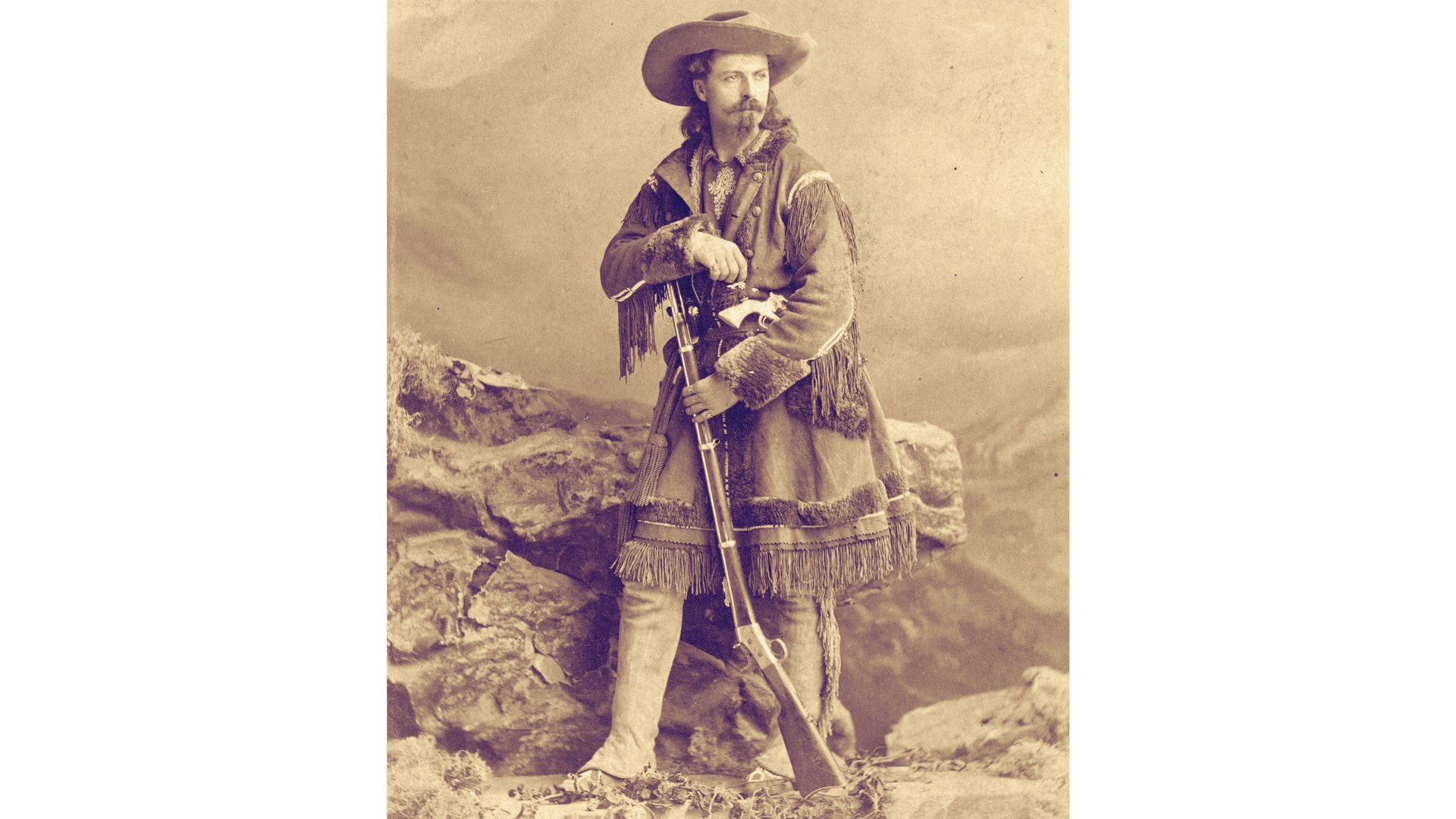
“Buffalo Bill” Cody (1846-1917)
Accustomed as we are to today’s hunting ethics, most of us have trouble imagining hunters engaging in wanton slaughter. But there was a time in American history when game was considered eternally plentiful and thus no restrictions were imposed. William Frederick Cody came of age at such a time. His reputation for hunting down bison eventually got him nicknamed “Buffalo Bill.”
Born in Iowa, he grew up mostly around Leavenworth, Kan. By the mid-1860s, he had served a stint in the Army’s 7th Kansas Cavalry and had developed scouting skills. One day in 1867, he was working as a ground preparation worker near Hays for the Union Pacific Railway when word came there was a herd of bison nearby. An experienced rider, he jumped on his horse named Brigham and sped towards the herd. At the same time a group of Army officers was also galloping towards the herd, intent on a kill.
But Cody’s horse beat them to the action. Cody said: “In a few jumps he brought me alongside the rear buffalo. Raising old ‘Lucretia Borgia [nickname for his .50-caliber Springfield rifle],’ I killed the animal with one shot. On went Brigham to the next buffalo, ten feet farther along, and another was disposed of. As fast as one animal would fall, Brigham would pass to the next, getting so close that I could almost touch it with my gun. In this fashion I killed eleven buffaloes with twelve shots.”
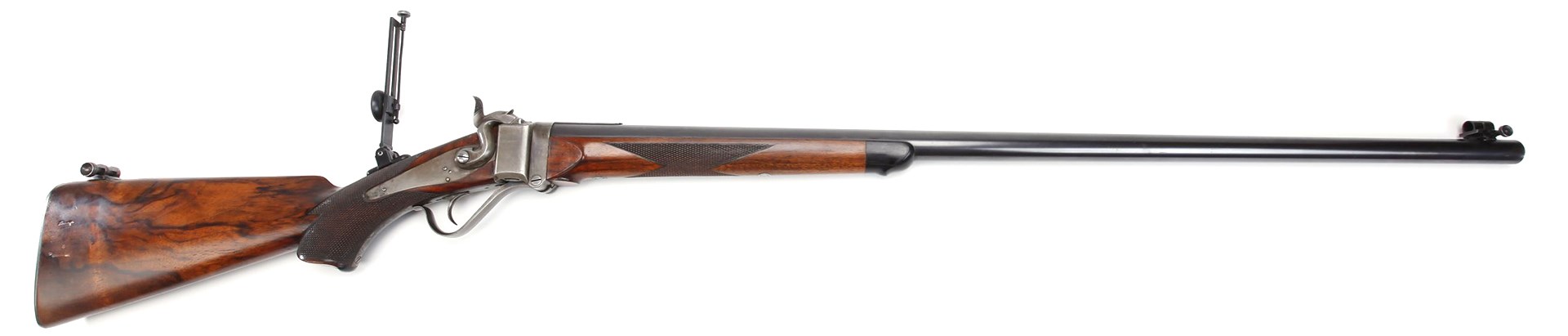 Sharps Rifle
That incident, with empty-handed officers as his jealous witnesses, brought him immediate local fame as a fearless shooter. Soon he landed a contract to supply fresh bison meat to the hungry railroad workers nearby. The contract terms were 12 bison a day—yes, per day—and he would be paid $500 a month (the equivalent of $11,000 a month today). The contract lasted eight months, and he basically turned the Kansas plains into an abattoir for bison. Assuming he hunted six days a week (since railroad workers typically worked six days), he must have killed at least 2,300 bison in that period. But in his autobiography he claimed he killed 4,280 bison in 18 months that included the eight-month contract period. If that is true (and some historians doubt that, as Cody sometimes exaggerated his exploits), then he was surely a relentless bison hunter. Even the conservative 2,300-count would place him among the most prolific hunters anywhere in the world. He is undoubtedly the best-known market hunter in American history.
In the 1870s, he began partaking in and promoting Wild West shows, entertaining audiences across the country and eventually across the Atlantic, with re-enactments of events in the American West, featuring cowboys, Indians and even female crack shots. Billed as “Buffalo Bill’s Wild West,” with these shows he single-handedly popularized the American West to foreign audiences many decades before there were any Hollywood Westerns.
We should not view his bison-hunting exploits through our prism, but should instead view his actions in the context of his time. Incidentally, unlike today’s Hollywood Western actors who are pretenders with guns and who would probably starve if vegan grocery stores went out of business, Cody at least had real-life, blood-and-guts experience with guns and hunting before he went for the stage lights.
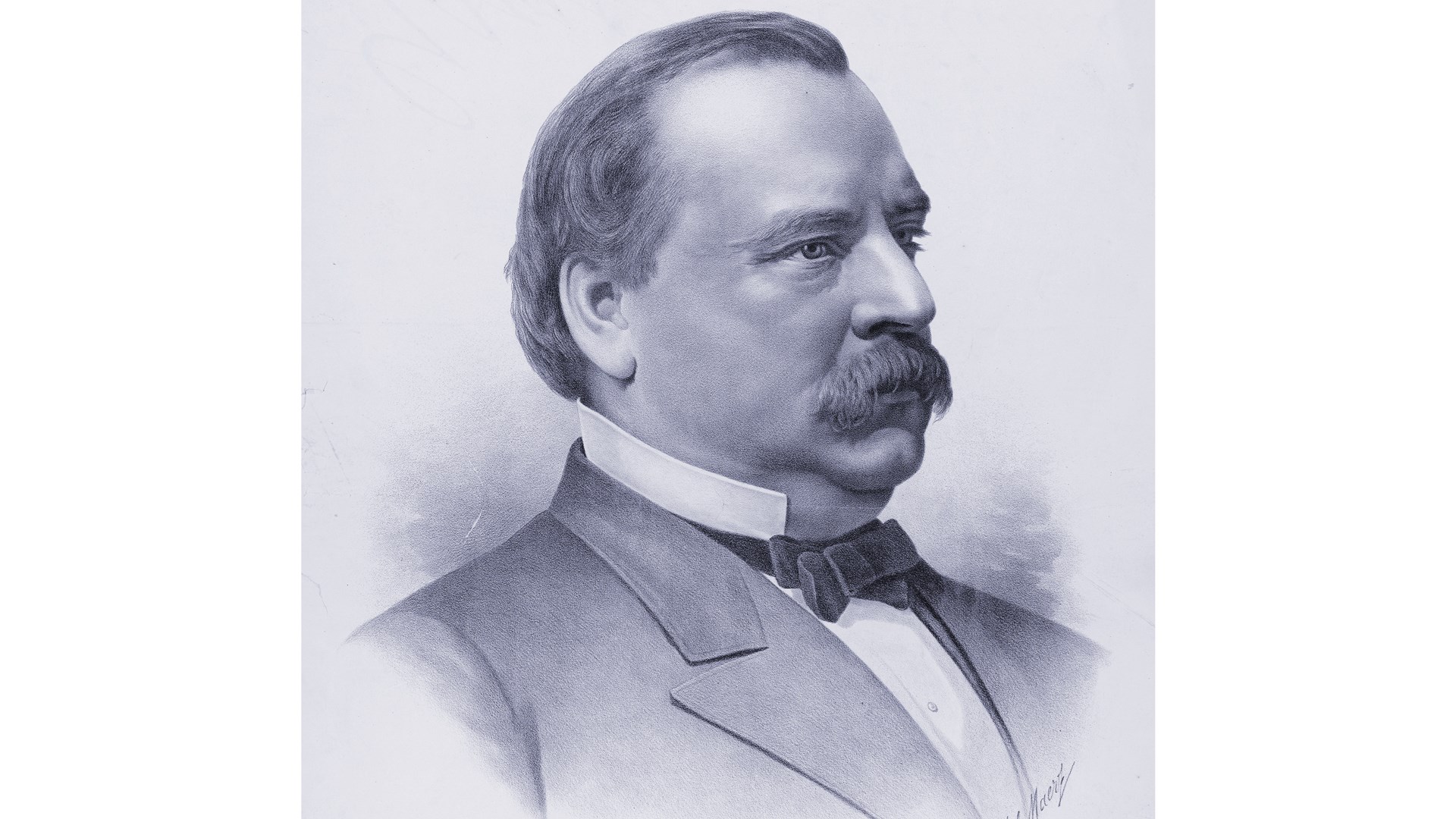
Grover Cleveland (1837-1908)
Until President Trump returned to office after winning the 2024 election, Grover Cleveland had been the only president in American history to hold two non-consecutive terms in office. He was first elected in 1884 then lost the 1888 election, but came back and won the 1892 election. Born in New Jersey and raised in New York, he was governor of New York before winning the presidency.
Cleveland was both a hunter and angler. An honest man, his constant fight against public corruption often led him to seek rest and relaxation in the outdoors. Thus, when not hunting, he went fishing.
Though in later life his waterfowl hunting became a favorite pastime, he had previously hunted both big and small game. Among small game, he relished rabbits. Dismissing the notion that rabbit hunting is not a real hunting challenge, he said, “I am not ashamed of their pursuit; and I count it by no means bad skill to force them by a successful shot to a topsy-turvy pause when at their best speed.” In other words, he liked shooting rabbits when they were running at full speed and watching them tumble.
 Winchester Model 12
So dedicated a hunter was Cleveland that right after he won the 1892 election he embarked on a 10-day hunting trip as president-elect, and enjoyed his Thanksgiving by hunting ducks and geese on Hog Island, a barrier island on the eastern shore of Virginia.
Cleveland understood the role hunters play in conservation, declaring, “I am convinced that there can be no better conservators of the sensible and provident protection of game and fish than those who are enthusiastic in their pursuit.” In 1893 he gave protection to some 5 million acres in Oregon by setting aside the land as forest reserves, using presidential proclamation authority under the Forest Reserve Act of 1891. (Most of this land was first called Cascade Range Forest Reserve, but has since been split into several national forests.) He also signed into law the Yellowstone Game Protection Act of 1894, which forbade hunting within Yellowstone National Park (poaching had been decimating the bison there).
Then, in 1897, just two weeks before he left office, as he reassessed unfinished actions, he set aside some 20 million acres as forest reserves to protect them from uncontrolled timbering and other abuses. Among these were areas that are now Mount Rainier and Olympic national parks, and hunting grounds such as Bitterroot National Forest (in Montana and Idaho) and Black Hills National Forest (in South Dakota and Wyoming). This action infuriated the timber industry and politicians from Western states, but he stuck to his guns. Up to that time, no American president had taken such daring action on land conservation.
If Teddy Roosevelt had not become president, then today it would probably be Cleveland that we would celebrate as the great conservationist-in-chief due to his prescient action on land conservation, a remarkable record considering that unlike Roosevelt, Cleveland had never traveled West and had not even seen the land he was conserving. Yet, thanks to Cleveland, millions of acres of Western forests were saved—which today provide good hunting grounds for many a hunter.
Cleveland summed up his hunting ethics with these timeless words: “It is better to go home with nothing killed than to feel the weight of a mean, unsportsmanlike act.”
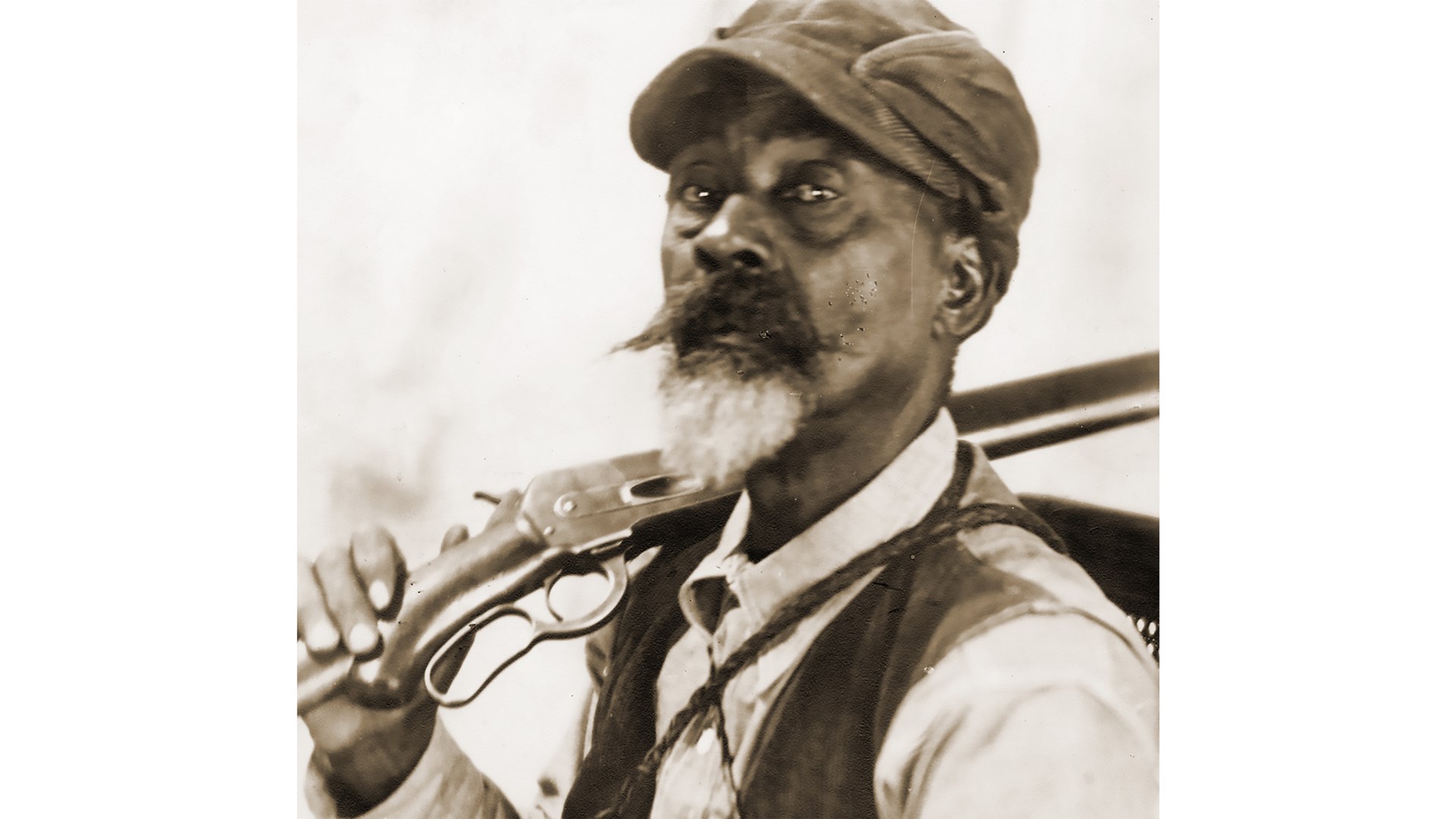
Holt Collier (1846-1936)
It was 1902. President Theodore Roosevelt was hunting bear in the swamps of Mississippi. He was being guided by a gutsy Southerner who was an experienced bear hunter. At first they had no luck, but the guide eventually tracked down a bear and held it in place by a most daring technique—by lassoing it and then tying it to a tree. When Roosevelt arrived on the scene, he felt sorry for the tethered bruin, and refused to shoot it.
This incident was immediately picked up by newspapers and publicized across the nation. (This was before radio or television, so people got their news from newspapers.) The public pretty soon was enamored of this story of a hapless bear being spared by Teddy Roosevelt. Young children became especially fond of this story. And it led to the creation of the toy known today as the Teddy bear.
Over the last hundred years, millions of parents, regardless whether they were hunters, have purchased Teddy bears for their children. Nevertheless, today hardly anyone knows the real story behind the toy. In fact, the real story goes beyond Roosevelt—and involves a remarkable man named Holt Collier. Collier was an American hunter whose life defied incredible odds.
In fact, he lived a life that defied history. Born a slave in Mississippi, Collier fought for the Confederacy during the Civil War. Yes, you read it correctly—he was a slave who fought for the Confederacy. At a time when slaves were forbidden from bearing anything that could become a weapon, let alone firearms, he bore arms and fought alongside white Southern soldiers. Even after the war, when thousands of former slaves migrated north for better opportunities, he proudly stayed back, preferring a livelihood by hunting, thus holding on to his Southern roots.
From the mid 1860s to 1870s, the South was under Reconstruction, the period when former Confederate states were re-admitted to the Union and the federal government in turn promoted massive re-building and infrastructure projects, which often involved timber-cutting and railroad-building, attracting thousands of workers. Collier realized he could make a decent living by supplying these industries with fresh meat via the one activity he had always relished: hunting. Thus began his career as a professional hunter. Deer and bear were his common quarries, but bear meat brought him a premium income. Hunting bear in the Mississippi swamps and in thick, interminable canebrakes was strenuous work, but it was Collier’s forte.
His typical method of hunting bear was with mixed-breed dogs. He would lead his pack of dogs that would tree a bear or corner it on the ground, whereupon he would shoot it or drive a knife into it. The latter method was particularly gutsy since it required the hunter to get right up to the bear (while the dogs kept it at bay) and stab it on the side opposite to where the hunter stood (so that as the bear turned its head toward the stabbed side, the hunter had a chance to get away), but many hunters including Collier never shied away from it. By 1890, he had killed more than 2,100 bears. By 1900, he was a regional legend.
Here was a man who was resented by many in his own race for fighting for the Confederacy, but he never strait-jacketed himself into a racial confine just because he was black. His supreme skills in pursuing wild game made him independent of anyone. In a way, he had emancipated himself by earning a living by hunting. And his skills were so respected that he was invited into the big leagues of hunting with the most powerful men of his time.
Much is made of Jackie Robinson breaking the color line in sports when he played Major League Baseball in 1947. But almost 50 years earlier, Collier demonstrated in a major way that there was no color line in the sport of hunting in the first place, by hunting with none other than the president of the United States.
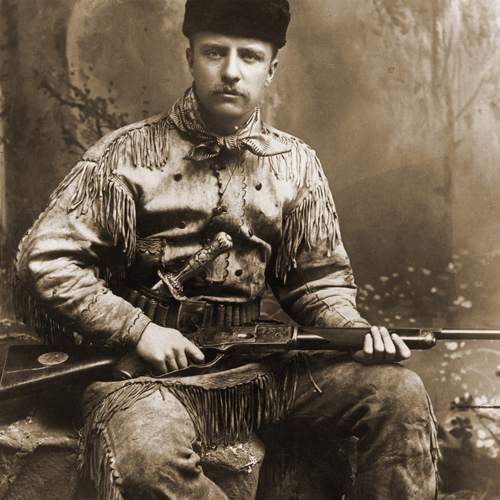
Theodore Roosevelt (1858-1919)
There is no need to explain Theodore Roosevelt, for he is as self-explanatory to hunters as “Babe” Ruth is to baseball fans. Nevertheless, if for nothing else other than honoring his supreme legacy again, we should celebrate his life and work.
He was the youngest person to become president, at age 42. It’s a record that still stands. (Despite popular belief, John Kennedy was not the youngest president. Kennedy was the youngest to win a presidential election, whereas Roosevelt actually became president at a younger age due to the assassination of William McKinley.)
Roosevelt’s Western hunting debut was a bison hunt in 1883 in North Dakota, where, after nearly 10 days of bad weather and no luck, he finally downed a trophy bison bull with his .45-caliber Sharps rifle. The base for many of his Western hunts was a ranch called the “Elkhorn,” situated on the banks of the Little Missouri, about 35 miles north of Medora, N.D. He hunted extensively in the West, from deer to grizzly bear. He also became a cattle rancher, owning several thousand head of cattle, and earnestly adopting the strenuous life of a cowboy. This ranching and hunting life transformed him from a New York dude into a rugged man. He always acknowledged that it was his time in the American West that was the most influential factor in preparing him for the presidency: “If it had not been for what I learned during those years that I spent here in North Dakota, I never in the world would have been president of the United States.”
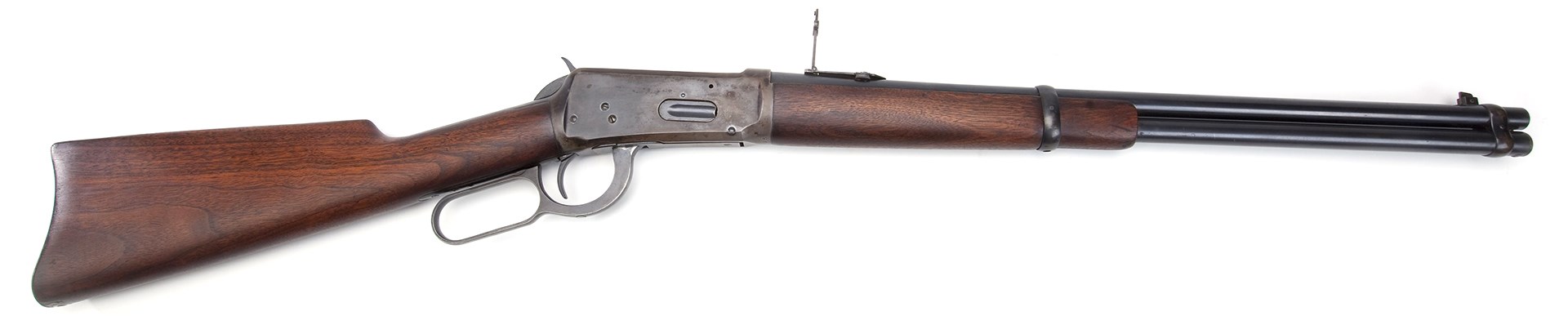 Winchester Model 94
The ranch site and 70,000 acres of the surrounding area now comprise the Theodore Roosevelt National Park, the only national park named after a president. It’s a fully deserved honor, considering he did more for conservation than any president before or since. During his presidency (1901-1909), he aggressively implemented conservation measures, ranging from protecting the Grand Canyon to establishing what became the National Wildlife Refuge system. In total, he put some 230 million acres of land under federal protection. He vociferously advocated for the right balance between hunting and conservation. Having lived in the wilderness, he knew firsthand the necessity of having to chase and shoot his dinner; hence the responsibility of making sure there was something left to chase and shoot.
Roosevelt was a Republican, but this is an inconvenient truth today, given our biased media and revisionist education system, and therefore is hardly mentioned. Thus, many Americans are unaware of the Republican Party’s legacy of conservation. Moreover, in recent decades many Republican office-holders have allowed themselves to be sidelined on conservation issues, thus facilitating the myth that Republicans don’t care about the environment.
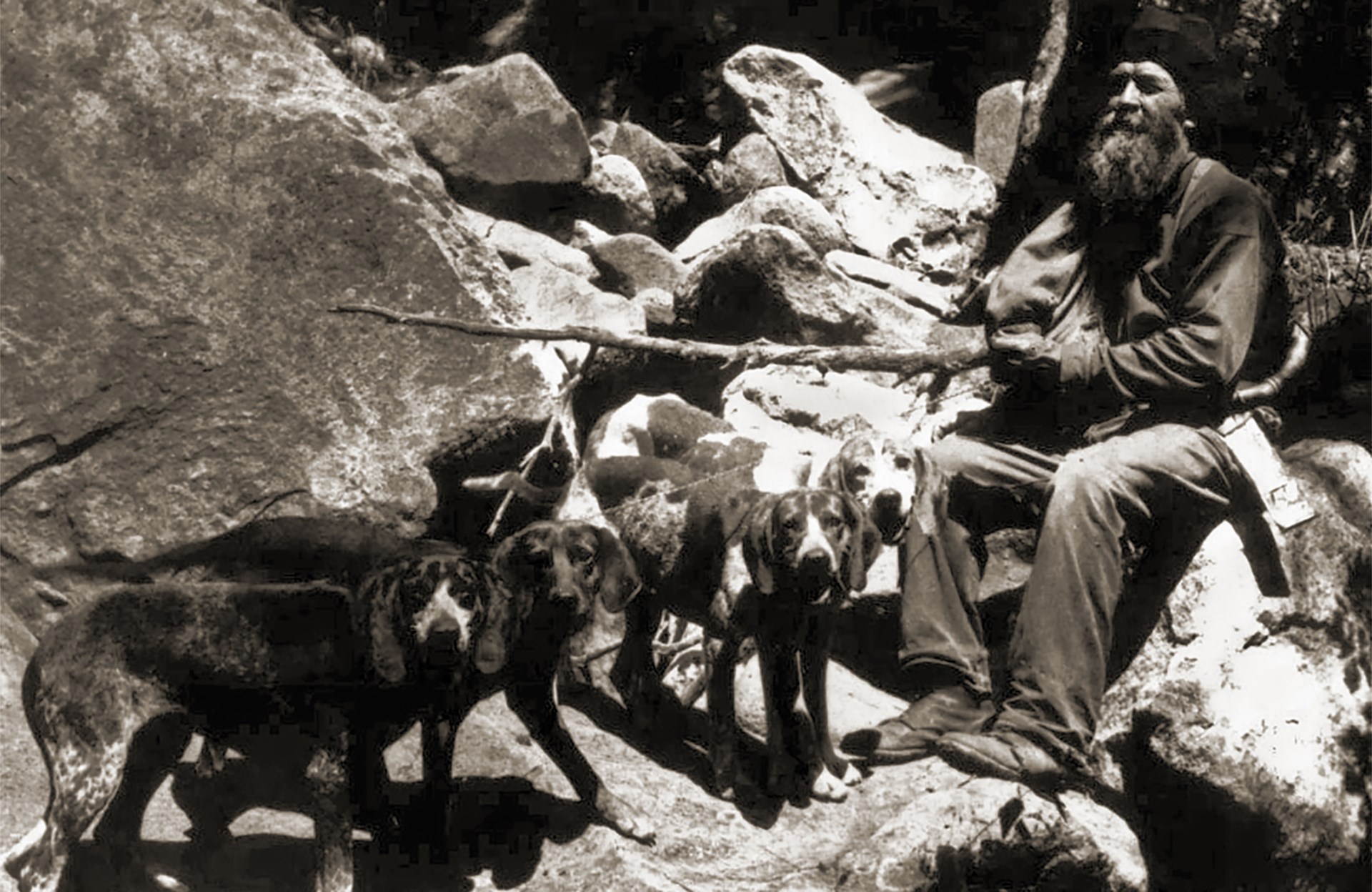
Ben Lilly (1856-1936)
Among famous hunters, Ben Lilly was perhaps the most enigmatic character. Born in Alabama, he ended up in the American Southwest due to his implacable appetite for hunting apex predators, where he vanquished grizzly bears, wolves and mountain lions. He was a devout Christian who never hunted on Sundays and a teetotaler who also didn’t smoke and apparently didn’t even drink coffee. Yet he had no problem plunging a knife into a mountain lion or a grizzly to finish it off, or even killing any one of his own dogs when it failed to perform as expected.
He joined President Roosevelt on a black bear hunt in Louisiana in 1907. Roosevelt’s impression of Lilly conveys his enigmatic and hardy nature better than any other account. Roosevelt said Lilly was “a spare, full-bearded man with … blue eyes and a frame of steel and whipcord. I never met any other man so indifferent to fatigue and hardship. … The morning he joined us in camp, he had come on foot through thick woods, followed by his two dogs, and had neither eaten nor drunk for twenty-four hours; for he did not like to drink the swamp water. It had rained hard throughout the night, and he had no shelter, no rubber coat, nothing but the clothes he was wearing, and the ground was too wet for him to lie on; so he perched in a crooked tree in the beating rain, much as if he had been a wild turkey. But he was not in the least tired when he struck camp; and, though he slept an hour after breakfast, it was chiefly because he had nothing else to do, inasmuch as it was Sunday, on which day he never hunted nor labored. He could run through the woods like a buck, was far more enduring and quite as indifferent to weather, though he was over fifty years old. He had trapped and hunted throughout almost all the half century of his life, and on trail of game he was as sure as his own hounds. His observations on wild creatures were singularly close and accurate. He was particularly fond of the chase of the bear, which he followed by himself with one or two dogs; often he would be on the trail of his quarry for days at a time, lying down to sleep wherever night overtook him; and he had killed over a hundred and twenty bears.”
For mountain lions Lilly reportedly used a .30-30 Winchester lever action rifle, and for bears a .33 Winchester lever action. He was often hired by the U.S. government to hunt predators in the Southwest, where ranchers often saw depredations on their cattle herds and sheep flocks. He and his dogs were the cavalry that saved the livelihoods of many ranchers. This activity provided him with an income for many years. It is said he killed several hundred mountain lions in his career, which is plausible given his relentless obsession with predators and his liking for mountain lion meat. He was especially familiar with the mountains of the Southwest, and when he died in 1936, likely with several hundred mountain lions under his belt, many observers believed he was the last true mountain man.
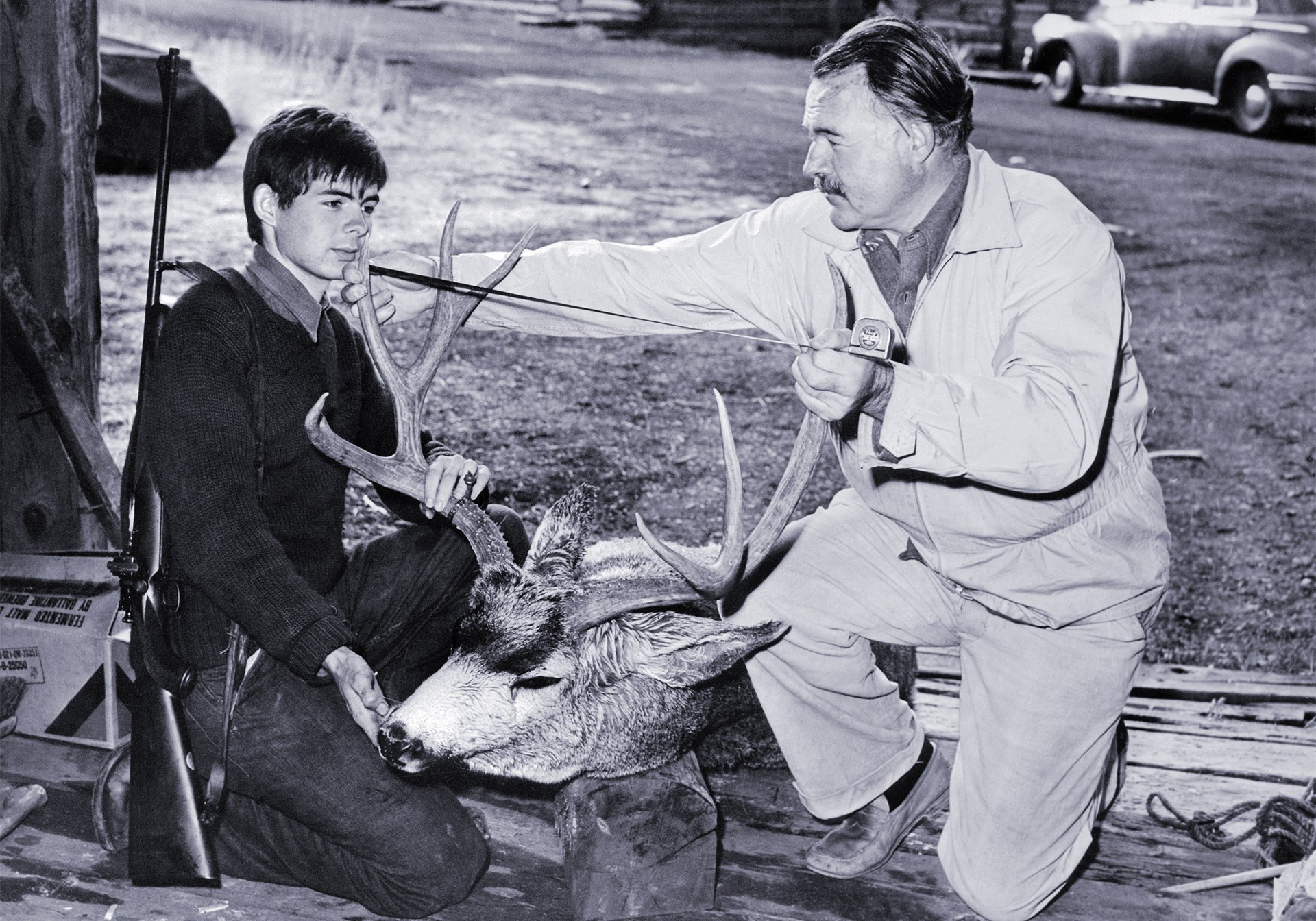 Writer Ernest Hemingway hunted throughout the American West. His favorite gun was probably the 1903 Springfield .30-06, a rifle his son, Patrick, left, shouldered in Idaho.
Ernest Hemingway (1899-1961)
If ever there was a man who truly excelled in woods as well as in words, it was Ernest Hemingway. He was a literary giant—nay, colossus—who infused his writing with hunting themes and was utterly unabashed about his hunting. In fact, he is the best example from the 20th century of a man who can be cited as the knockout counter-argument against many liberal critics who believe guns and hunting are for unschooled, unenlightened country bumpkins.
Hemingway’s African hunting and his books that ensued are well-known, but what is less-known is that he hunted extensively in the American West—especially Wyoming, Idaho and Montana—before and after his African safaris. In fact, his deer, elk and grizzly bear hunts in the West prepared him well for his African dangerous game hunts.
His lucid writing style often included tongue-in-cheek humor. In a now-forgotten article he wrote in 1951, he described a pronghorn hunt, where he gives what is clearly sardonic, tongue-in-cheek hunting advice:
“ …. Then there is the third way where you hunt them in high country on foot or on horseback and no antelope are guaranteed. The author of this article, after taking a long time to make up his mind, and admitting his guilt on all counts, believes that it is a sin to kill any non-dangerous game animal except for meat. Now, with low-temperature refrigeration, you can keep meat properly and the amount of hunters has greatly increased. It has increased to such a point that you are lucky if some character does not loose off at you or your horse at least once in any three days of shooting. There is only one answer when this starts. Loose off quick yourself, shooting low. Because antelope, deer, elk and moose never shoot back and the character who opens fire, however undeveloped he may be in a sporting way, understands this basic principle. And if you should hit the son of a bitch it is only a hunting accident anyway. Shoot back if they shoot at you.”
Due to increasing recognition of his writing, he was financially comfortable by the mid 1940s. Moreover, his 1954 Nobel Prize in literature alone brought him $36,000 (the equivalent of $430,000 today). Thus, his self-earned wealth meant he could afford to do a lot of hunting—which he did.
 Springfield 1903 NRA Sporter Bolt Action
But he had been hunting long before he became famous, and thus in his hunting career he acquired numerous guns. Among them: a 12-gauge Winchester Model 12 pump, 12-gauge Browning over/under, a 16-gauge Browning Auto-5, 20-gauge Winchester Model 21, a Griffin & Howe .30-06 Springfield, a 6.5x54mm Mannlicher-Schoenauer Model 1903, a Westley Richards .577-caliber Nitro Express and a .45-caliber Thompson submachine gun, which he used aboard his boat to shoot sharks that would otherwise devour marlin and tuna on his line, for fishing was another of his passions. However, it is said his favorite gun was the 1903 Springfield .30-06.
Hemingway’s books will remain literary classics for the ages. His hunting was a major factor in his life experiences that made his writing so appealing to wide audiences.
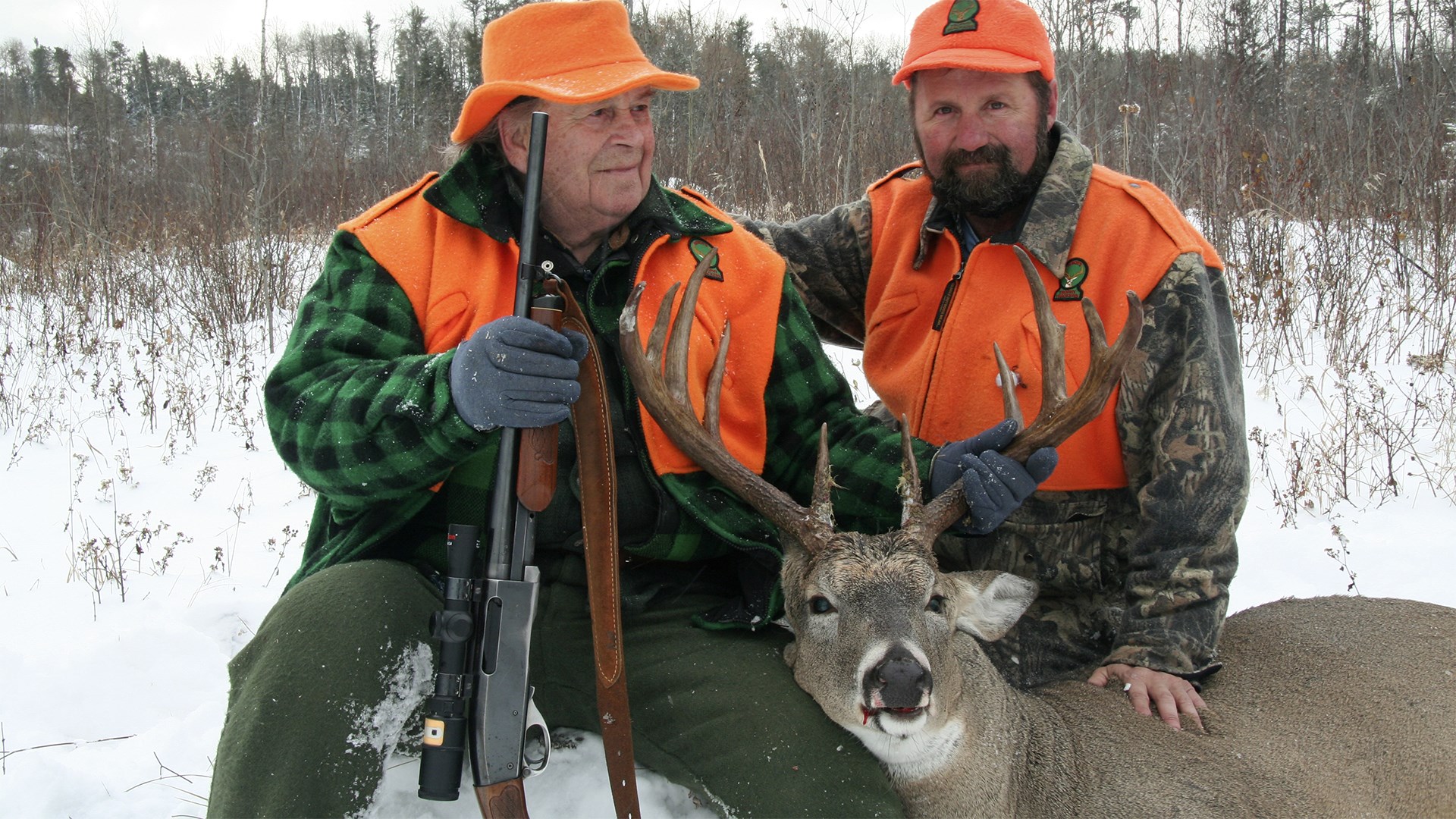 In the 1970s Vermonter Larry Benoit, left, beside his son, Shane, became regarded as a great deer tracker.
Larry Benoit (1924-2013)
There is no better example from the last 50 or so years of a common man making an uncommon mark on American hunting history than the example set by Vermont’s Larry Benoit.
Born to a poor Vermont family, Benoit was a child during the Great Depression, and hunting, especially deer hunting, became a means of survival for him and his family. He became such a keen deer-tracker that it was said he knew what the deer would do before even the deer knew. He relished tracking deer in the winter, often walking miles and miles in frigid weather, and when night fell, going home and returning early the next day to resume his tracking. He hunted for more than 70 years, eventually bagging more than 200 of the biggest deer in the Vermont woods and the surrounding region. Thus he became a deer-hunting legend in his own lifetime.
Perhaps the most admirable aspect of his prodigious hunting career was that he did it the old-fashioned way, without trail cameras, without scent-free clothing and without the other accessories that have turned many deer hunters into camouflaged automatons controlled by gadgets. And he used a no-frills, simple rifle, the Remington Model 7600 .30-06 pump action.
To Benoit, a big buck didn’t necessarily mean a big rack—he would rather shoot a buck with a bigger body than a buck with a bigger rack, a utilitarian lesson from his Great Depression childhood days when bigger-bodied bucks put more food on the table. Thus, most of the deer he shot reportedly grossed more than 200 pounds in dressed weight.
Benoit’s career conclusively demonstrated that it’s not your gadgets that get the deer—rather, it’s your skills and persistence. In that sense, he was probably the closest example we have of a frontiersman living in our own lifetime.
Notes on Quotations:
George Washington Parke Custis quotes come from Recollections and Private Memoirs of Washington (1860), and Washington’s diary in the National Archives, available at this and associated links, founders.archives.gov/documents/Washington/01-02-02-0003-0004-0009.
Crockett quotes are drawn from his autobiography, A Narrative of the Life of David Crockett of the State of Tennessee (1834).
Cleveland quotes come from his book Fishing and Shooting Sketches (1906).
Roosevelt’s impression of Lilly is gleaned from Roosevelt’s article “In the Louisiana Canebrakes,” Scribner’s magazine, January 1908.
Hemingway’s quote comes from his article “The Shot,” True magazine, April 1951.
Most Popular