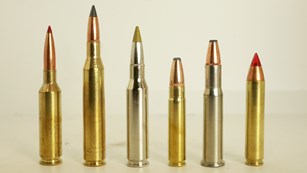
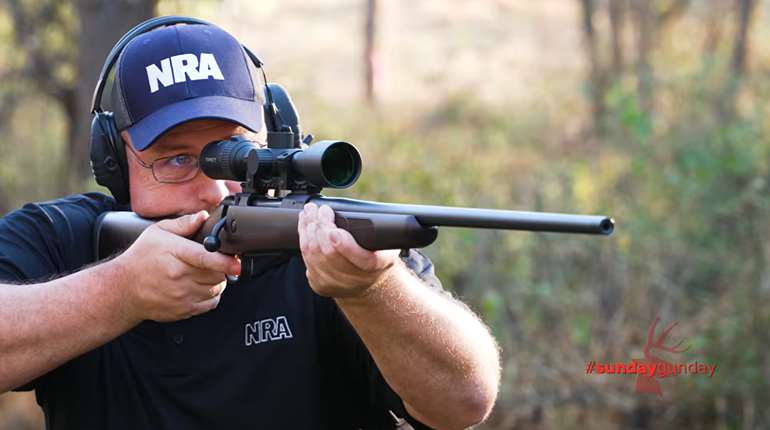
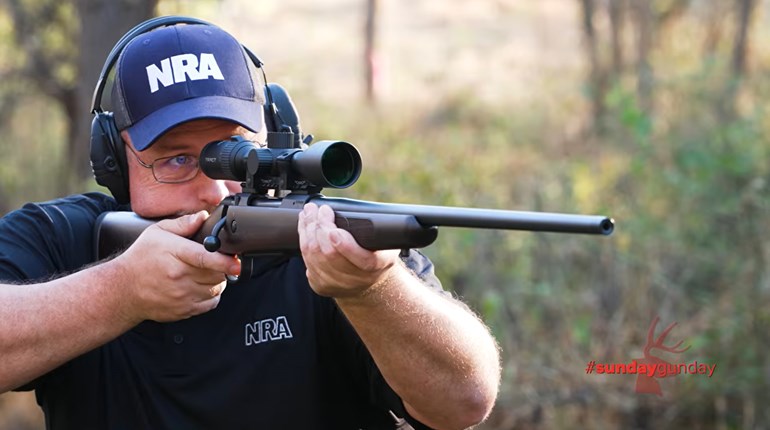
“High, left,” I communicated to my son, Cole, as he continued peering down the barrel of the 6.5 Creedmoor. He slowly settled back into the rifle with a slight change of aim as I watched at the distant focus of his concentration. No, it wasn’t a deer or pronghorn ready to dash away, although black-tail prairie dogs do dart with blurring speed when the lead flies. And why such a big caliber for such a diminutive target? This varmint hunt included two important objectives: varmint control for a local rancher, and a shooting tune-up for later hunting seasons. The larger caliber choice was definitely tuning for a future hunt.
Summer months may be lacking in big game to pursue, but almost anywhere across the nation you can put together a varmint hunt that offers plenty of practice for a fleeting encounter on fall antlered game. A prairie dog hunt in the West offers a medley of everything, including a limitless supply of rancher irritants, ever-changing distances and shifting winds that play havoc with your trajectory calculations. Prairie dogs may hold the title the “varmint king,” but you can find ample relatives of this pudgy rodent across the nation for a personalized tune-up.
In the East you can pursue cousins of Punxsutawney Phil. Northern varmint hunters can target the Richardson’s ground squirrel, and further west you can aim for the California ground squirrel. If you really want to up your varmint game, you can even jump species barriers and go all out with a hog hunt in the South. Other options are available depending on your creativity. Your goal is to reduce the number of varmints irritating a local landowner and bond with your rifles. Take along several shooting irons to ensure you understand all their intimate offerings.
Ditch the Rangefinder
An overlooked skill of yesteryear is distance estimation. Today distances are available with the tap of a button and a glance at a screen for an LCD readout with incredible accuracy. Unfortunately, mechanical devices fail, and some big-game encounters occur in seconds, leaving you without the time to raise a rangefinder.
To be effective you need to memorize the trajectory of your rifle caliber. A DOPE card (data on previous engagement) provides a cheat sheet you can secure to your buttstock for quick reference. You can then utilize a variety of methods to judge distance.
The military continues to teach the mil method utilizing a mil-dot reticle and knowing the size of the target. It’s effective, but unless you utilize it religiously, it’s easy to forget the mathematical calculations for a speedy computation.
A simpler method is to mentally compare a known distance to the landscape before you. For instance, both a football field and the Statue of Liberty tipped on end (pedestal included), extend approximately 100 yards. Using your imagination, you can compare these knowns to the unknown distance before you. Three Lady of Libertys laid out equals 300 yards and may require a slight holdover to hit your liberating mark.
Ride the Wind
Your morning shots might be in calm conditions, but as the earth heats it stirs up the wind. Those pesky crosswinds can toss a bullet around like a beer can hitching a ride in your truck bed. Having wind deflection information on your DOPE card is essential once you guesstimate a wind value. A wind gauge, like a Kestrel unit, can read wind at your location and you can estimate its value at the target through environmental observations.
There are also several ways to approximate the wind at distance without battery assistance. At best it’s a ballpark, but with some wind practice on the varmint of your choice you’ll soon be landing projectiles within the vital zone of a big-game animal, despite a miss on that grinning gopher.

Free online programs are available, like Hornady's 4DOF Ballistics Calculator, that enable you to develop a "DOPE" card for your rifle/caliber combination utilizing user-calculated or manufacturer-provided data.
Deflection of the bullet is based on wind, but the longer the bullet is in flight, velocity of the bullet, its weight and angle to the wind also play into the calculation. To make accurate deflection predictions you can start with wind values at your location for suspected values at distance. Remember though, terrain could alter winds drastically across distances. It could even be blowing from the complete opposite direction across a canyon or cornfield.
Begin your assessment with the wind around you, then move your observation to the target and look to vegetation. Winds up to 10 mph typically keep most grassy vegetation in a constant state of motion. A wind up to 15 mph will sway small trees. Gusts above 20 mph get large limbs and even stout trees to tango.
Another way to assess wind at distance is to read heatwave mirage through a scope. Most experts use a spotting scope and read the mirage halfway to three-quarters the distance to target where it has the greatest affect on bullet flight. With a wind blowing from behind or straight at the shooter, no mirage will be visible, or it will boil up in appearance requiring no aiming adjustment.
A mirage with waves left or right indicates a crosswind value and like ocean waves, the speed of the mirage wave increases with wind speed. Unfortunately, with wind speeds beyond 12 mph the mirage method becomes unreliable, but that’s when you can combine environmental observations for a trustworthy deduction. Practice makes perfect.
Sit Up, Stand Up and Shoot Straight
As a final tune-up, get off your belly and launch a few bullets from various shooting positions besides prone. You may be sitting with your back against an oak when a whitetail bounds into an opening. Or, you could be sneaking to a stand when a deer unsuspectingly walks across a trail 100 yards ahead of you for a shot from the standing position. Maybe you have time to drop to your knee before the shot. Would you be able to stabilize quickly from any of these positions?
Steadying off extended shooting sticks or using a rifle sling to wrap around your arm during a hasty, made-up shooting scenario delivers shooting-position insight. You won’t take every big-game shot from the comfort of a pre-set stand. Missing a chubby, wannabe Chuck E. Cheese mascot during a summer outing isn’t as heartbreaking as flubbing a shot on a once-in-a-lifetime buck. Tune-up with varmints this summer to avoid that misfortune later.