Scores of bowhunters have learned the hard way that gobblers aren’t easy targets. Besides being incredibly wary, the bird has an anatomy that is often misunderstood. Knowing when to draw and where to aim will greatly elevate your odds this spring.
How to Draw Undetected
The easiest way to kill a turkey with a bow is to use a ground blind. It mitigates the toughest obstacle: drawing without spooking the bird. For run-and-gun hunters, however, full-fledged ground blinds are impractical, so I prefer a portable one like the Collapsible Super Light Blind from Hunters Specialties. (You can make one, too.) Keep it in your vest until you’ve closed the distance, and then unfurl it in seconds. The blind’s camouflaged fabric screen allows you to draw undetected before rising slightly to shoot.
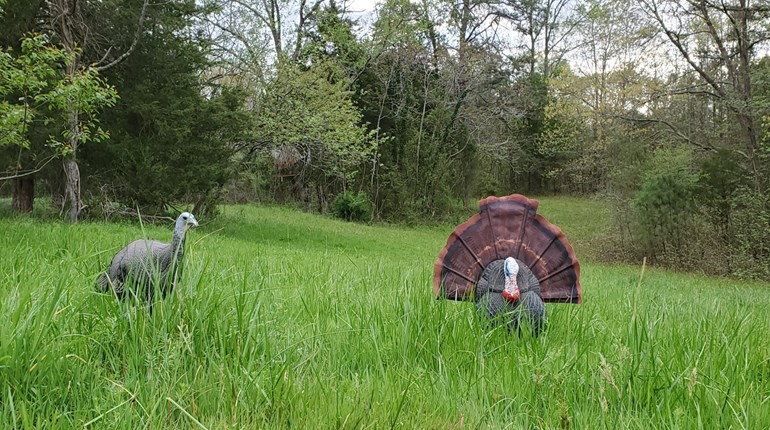
Without a blind I like to use a decoy, not only to attract a bird into bow range but also to distract him once he’s there. It’ll take the gobbler’s focus off you so you can draw. Set up the decoy to your left side (for right-handed shooters) so the bird will be less likely to approach from straight ahead. A shot to the left is also easier to execute (lefties will want to position the decoy to the right).
Without a deke, you have several options to draw and shoot. First, use available cover as a screen to draw. Anticipate when and where a walking bird will pass behind a tree during his approach. When his eye is shielded, draw without hesitation and shoot as soon as his vitals are exposed.
If the gobbler struts, chances are he will turn around, where his fan will shield his eyes from you. This is a perfect draw-and-shoot opportunity.
My favorite technique is to call a bird into range, and then shut up. After a minute or two he’ll assume the hen that was calling (you) has moved on, so he’ll either turn to leave or walk past you. As he quarters away, draw and shoot if you can. If he’s walking too fast, give a cluck. Odds are he’ll turn back around, and that’s when you deliver the news.
Where to Aim
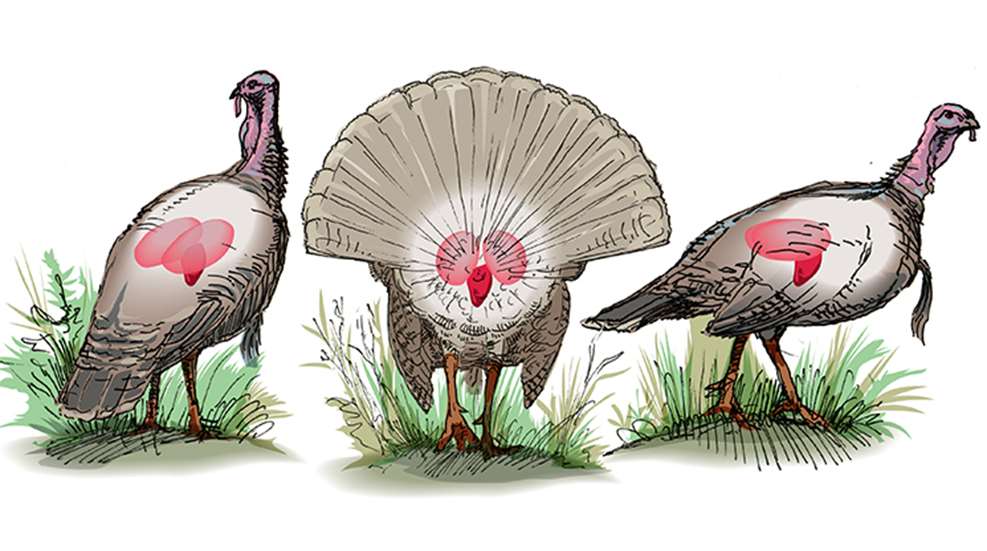
You’ve probably heard to shoot a broadside turkey in the wingbutt. This is wrong. I’ve seen arrows deflect off this hard, round bone without seriously injuring the bird. If you miss forward, you’ll hit the bird’s monstrous breast, which is just muscle. And even if you break the wing, a winged turkey can still run like Usain Bolt. Fact is, the vitals are farther back.
When a turkey is standing fully erect, its vitals are above its hips. Therefore the best place to aim is an inch above the hip, which on a gobbler is concealed by the wing. His heart is located there. If you hit high, you’ll hit lungs; if you hit low, you’ll hit hip, and a hip-shot turkey is dead. It can’t run, and it likely can’t fly either.
For quartering-away shots, aim for the offside breast, again just above the hip. If the bird is quartering toward you, aim for the top of the offside hip. If he’s facing you, aim between the neck and beard. And for facing-away shots, aim for the bullseye known as the cloaca.
Another technique altogether is the head/neck shot. While difficult because it’s a small target and because a turkey’s first reaction to surprise is to duck its head, I like this shot because generally it’s a quick-kill-or-clean-miss proposition.
Quick Tips
1. Mastering a mouth call that you can use while at full draw is a huge advantage.
2. Bows with short axle-to-axle lengths shine because you can shoot them while sitting on the ground without crouching or rising up.
3. Large-diameter, expandable broadheads are superior for turkeys because they increase the margin for error. Penetration usually isn’t an issue.