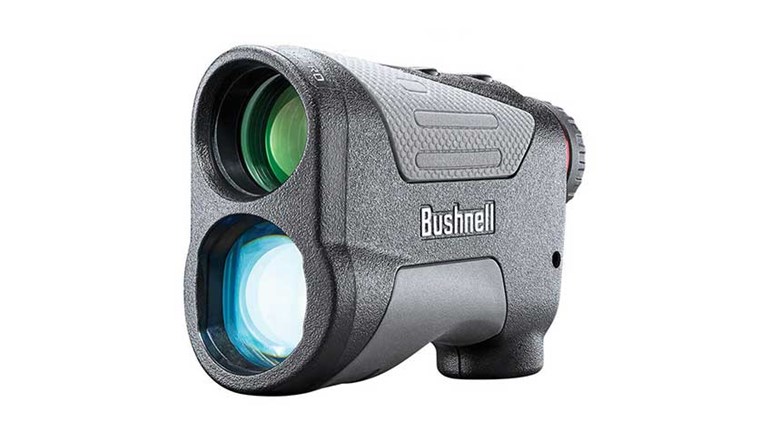
Within the last 15 years I’ve amended my “necessary hunting gear” list to include a laser rangefinder along with my knife, flashlight, binocular, and gun or bow. It absolutely helps me deliver more accurate shots, which helps me kill game cleanly. But if you’ve spent much time using one you know how difficult it can be to aim at long distances where you need it most. If its crosshairs are off your intended target by even a hair, the rangefinder can give you the distance to another object, causing you to miss by a country mile. And they’re toughest to use at the moment of truth when a gagger buck walks into the clearing and you’ve only got 10 seconds to make the shot. Because a rangefinder is so light and the image is magnified, any shaking of your hand results in a dancing crosshair that’s difficult to center on a now-blurry target.
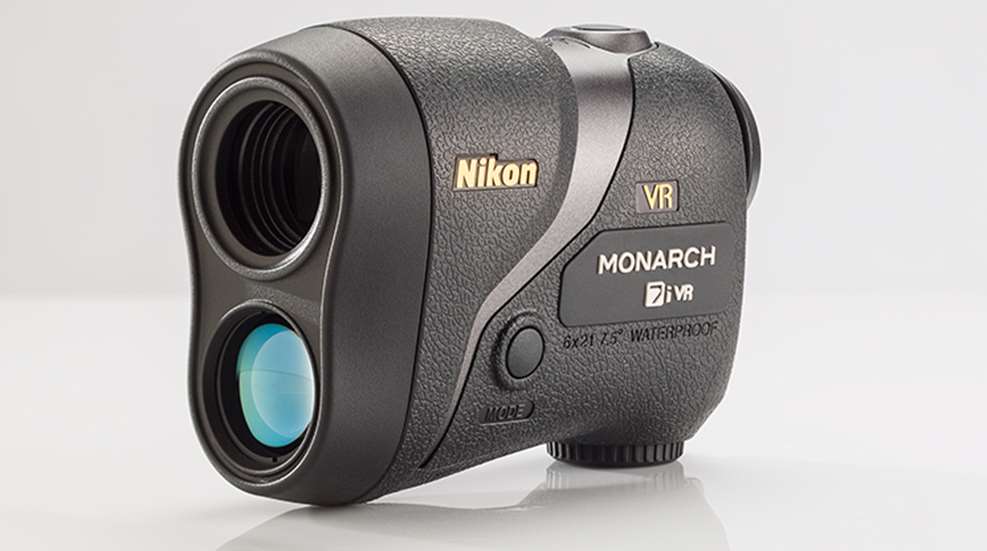
Nikon has remedied this problem with its new Monarch 7i VR rangefinder that features the same Vibration Reduction technology the company uses in its high-dollar VR camera lenses. Many professional photographers who work in dim light—dawn and dusk for hunters—only shoot lenses that contain this technology. Now it’s in a rangefinder, and it’s a game-changer.
What’s amazing is Nikon found a way to include the technology in a unit that’s half the size of a box of ammo, weighs less than 8 ounces and has a price tag comparable to other rangefinders at $399. In a nutshell, here’s how it works:
When the power-on/range button is pressed, two angular velocity sensors detect pitch (up and down movement) and yaw (left and right movement) every 1/1000th second. This data is instantly sent to an on-board microprocessor that in turn sends directions to two voice coil motors that move the floating lens system to counter the external movements placed on the unit in real time. Also necessary, the laser remains calibrated with the crosshair despite handshake so that the user can be certain of an accurate reading. It all sounds complicated, and from an engineering standpoint it is, but rest assured the technology is proven.
A great example of the 7i VR’s advantage happened when I ranged a truck parked at an unknown distance. Just looking through the 6X rangefinder without turning it on, I could easily see the truck, but as soon as I punched the range button I could also read the license plate (at 114 yards) whereas it was too blurry before due to hand shake. In the same way, the technology also makes it much easier to judge a buck’s rack. Make no mistake, this technology doesn’t make moving objects still or slow them down. Rather, pushing the button on the 7i VR makes it seem as though your hand is suddenly stabilized by a sandbag so that the crosshairs are steady, helping you to glean a more accurate reading with less chance of error.
Vibration Reduction technology aside, at its heart the 7i VR is a great rangefinder that’s accurate out to 1,000 yards and as close as 8. The unit features Incline/Decline technology that automatically compensates for uphill or downhill shots. This makes it great for bowhunters and mountain hunters, and I wouldn’t own a rangefinder without it. It also has what Nikon calls Tru-Target technology. If you press and hold the mode button on the left side of the unit, and then press it twice more to toggle through modes, you can opt to range one dominant object or an object that is partially obscured such as a deer behind grass or other animals. When I remember to use it, it works well. You can also choose between yards and meters for the range display.
The unit is shockproof and easy to grip with its rubber armor. Notably, it’s also waterproof to 1 meter. I dropped it in a bucket of water, then on grass five times from the height of my eye, and it still works. Honestly, this test made me feel much better about the floating lens assembly and electronics housed within the body. It has a two-year warranty.
For as revolutionary as the unit is, it isn’t perfect. First, I wish it had an illuminated reticle. Second, the lens is polarized and oriented in a way that makes it impossible to use while wearing my polarized sunglasses. I expect this to be remedied on future models.
Regardless, this thing will literally change the way you view rangefinders. The Nikon Monarch 7i VR is already in my pack as part of my standard hunting gear.
Technical Specifications:
• Type: laser rangefinder
• Magnification: 6X
• Objective Lens Diameter: 21mm
• Eye Relief: 18mm
• Exit Pupil: 3.5mm
• Field of View @ 100 Yds: 39.3'
• Measurement: 8-1,000 yds. in .1-yd. increments; First Target and Distant Target priority modes; Incline/Decline technology
• Coatings: multi-coated
• Construction: polycarbonate body, rubber armor; Vibration Reduction system; waterproof, shockproof
• Power Source: CR2 lithium battery (included)
• Dimensions: length 3.9", width 1.9", height 3"; weight 7.1 ozs.
• Accessories: carry case, neck strap
• MSRP: $399.95