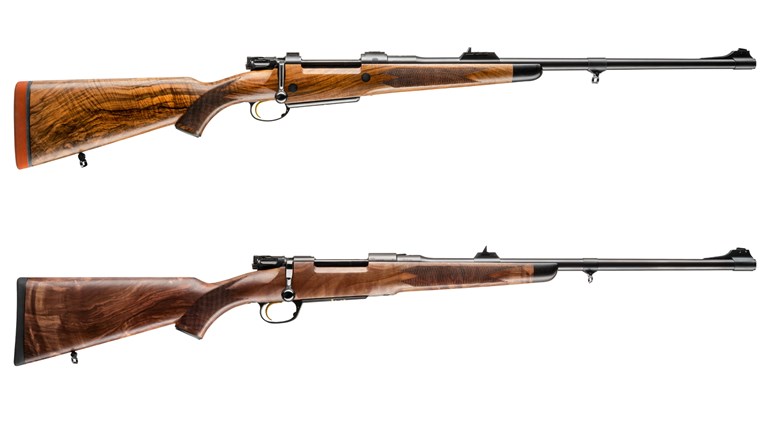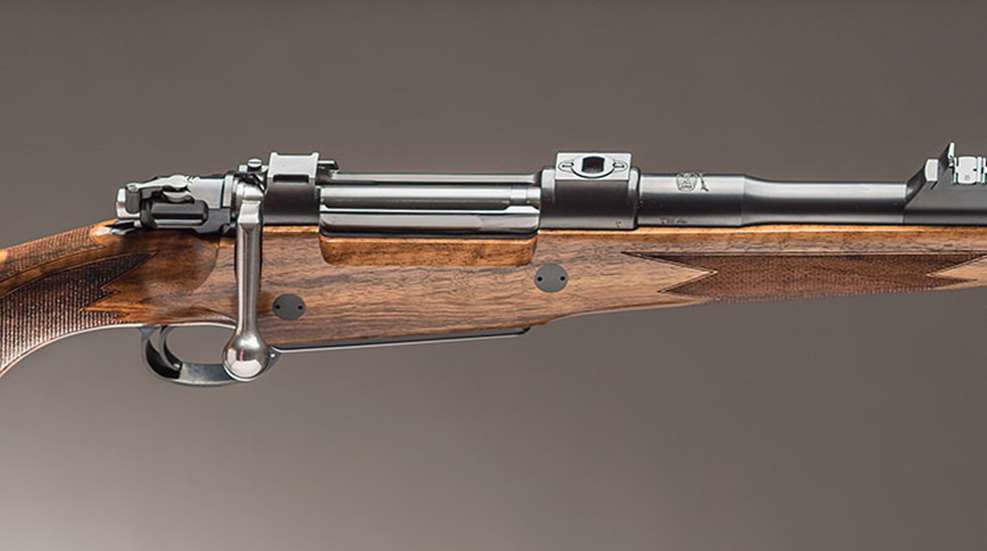
This is a bolt-action rifle. There are many like it, but this one is a Mauser 98. It is legendary. It is the culmination of much tinkering and testing by its creator, Paul Mauser, and the final result is a thing of strength and simplistic beauty.
The Mauser 98, or Gewehr 98, was adopted as the German service rifle in 1898 and became the mother of all bolt-action rifles; Britain’s Pattern 1914 Enfield service rifle took cues from it; our 1903 Springfield copied Mauser’s design and its stripper clip so explicitly the U.S. government paid royalties to the German company in order to produce it. All three controlled-round-feed rifles saw service through World War II. Many of them have been “sporterized” for hunting. Today it’s still not hard to find an M98 for this purpose because as many as 100 million have been made.
Mauser sold its own sporters, too, but a magnum version didn’t begin to take shape until John Rigby and Co., then the sole agent of Mausers sold in the British Empire, asked for design changes to handle its .400/350 rimmed cartridge in 1901. Other iterations followed as Rigby asked for 98s to accommodate the .303 British and, in 1911, its .416 Rigby. Only about 200 original .416 Rigby rifles were ever sold, but the Mauser Magnum as we think of it today nonetheless made history in game fields across the world, most notably in Africa.
As the 20th century progressed, Mauser languished and production actually ceased in Germany at one point. Then Zastava of Yugoslavia and Brno of Czechoslovakia, among others, produced 98s. But no endeavor lasted.
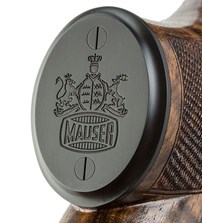 At the turn of the 21st century, though, Michael Lüke, a German who leads the L&O Group, bought the name, along with Blaser and SIG Sauer. L&O also owns J.P. Sauer and Sohn, German Sport Guns and now John Rigby, too. I’d say Lüke’s vision is to produce the finest light arms available in the world because that’s quite a portfolio.
Today’s double square-bridge action is machined from one block of premium steel, and it is 615/16 inches long. The ejection port spans 311/16 inches so hunters can load .375s and .416s into the magazine without canting them. The deep magazine well supports five-plus-one (.375) or four-plus-one (.416) capacity. Pillar bedding and double recoil lugs produce an action-to-stock fit that is absolutely tension-free. The receiver includes proprietary scope mounts; the rear is a dovetail, the front a twist-on. All metalwork is protected from corrosion by a low-glare, hard, rust-resistant plasma-nitride finish.
The bolt is classic Mauser. A long “claw” extractor moves back and forth in the receiver but otherwise remains stationary as the bolt rotates within its collar. Move the bolt forward and the bottom edge of its face pushes on the cartridge presented by the magazine. As the cartridge rises from the magazine, the claw grips the rim of the case and guides it into battery. The claw relinquishes its grip only when the bolt is opened and pulled to the rear, at which time the case is ejected either forcefully or gently, depending on the effort applied by the hunter working the bolt, by a standing leaf inside the left rear of the receiver. This is the basis of the 98’s legendary reliability. At no time during the feeding, firing or extraction of the cartridge/empty case does the claw relinquish its grip on the case rim. Failures to extract are few, if ever, and jams are reduced, too.
The bolt’s dual opposed locking lugs rotate into the chamber, which makes an incredibly strong union. More strength is derived from a third lug at the back of the bolt body, a fourth recoil lug at the seat of the bolt handle and an additional lug atop the bolt body that locks into the extractor. The 98 cocks on opening, so the only resistance encountered upon closing the bolt comes from the cartridge as it is pushed up and out of the magazine. A three-position wing safety, with newly improved ergonomics, locks the striker and the bolt, or locks the striker while the bolt is operated.
The barrel is made from solid bar stock and measures 24 inches long. In .375, its taper is typical of a dangerous-game rifle; .416 units feature a heavy profile. An express rear sight holds three leaves regulated to 50, 100 and 150 yards. A banded front sight is ramped, and fitted with a silver bead. A barrel band holds the forward sling swivel. This is the proper place to secure the front of a sling on a dangerous-game gun as it prevents pinching of a hunter’s support hand during recoil.
The grade 5 walnut stock showcases exceptional grain; higher grades are available at extra cost. Its straight comb sends recoil straight back into one’s shoulder, where it belongs. The pistol grip cap is steel, the fore-end cap ebony. The buttpad is not too squishy, and it’s polished in the right place to slide on clothing during gun mount. Length of pull is 14.76 inches, a bit long for my height but absolutely perfect when I’m staring into a scope while firing magnum cartridges. It’s also appropriate as the bolt travels almost 5 inches rearward when a hunter racks it, and at that point the end of it is awfully close to one’s nose.
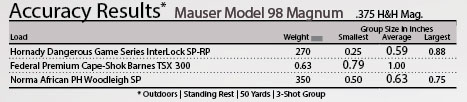
Is this gun a shooter? Woo-eee, I’d say so: The .375 H&H Mag. I tested last summer didn’t print anything larger than an inch at 50 yards from a standing rest. Then, just to see what it would do, I nestled in behind the gun on the bench and fired three groups at 100. My largest group was only 15/8 inches. To be honest, by then I was tired, and I think if I wasn’t I could’ve held on better. I have never actually seen a .375 that didn’t shoot, but I think this one takes the cake.
The Mauser Model 98 Magnum is made to hunt and kill dangerous game, and look good doing it. Given that, why would a dangerous-game hunter choose anything else? Well, price comes to mind, for a Mauser is not cheap. But it is a queen, and so it represents the pinnacle of design. Long live the queen.

Technical Specifications:
• Type: bolt-action centerfire rifle
• Caliber: .375 H&H Mag. (tested), .416 Rigby
• Barrel: 24.4"; 1:12" twist; normal or heavy profile
• Trigger: single-stage; 3-lb. pull weight
• Magazine: internal box w/hinged floorplate; 5+1 rnd. capacity
• Sights: express three-leaf rear, ramped front w/silver bead; scope bases integral to receiver
• Safety: three-position wing
• Stock: straight comb w/shadow-line cheek piece; grade 5 walnut; LOP 14.76"
• Metal Finish: plasma nitride
• Overall Length: 46.7"
• Weight: 9.7 lbs.
• MSRP: $13,495