For as long as I’ve been reading hunting and shooting magazines, I’ve seen advertisements for Conetrol scope rings. I’ve been intrigued but shamefully, Conetrol’s black & white ads never spawned more than a passing glance from me. I never knew what I was missing but I’ve now learned that similar to the old cliché, you can’t judge a product by its advertisement.
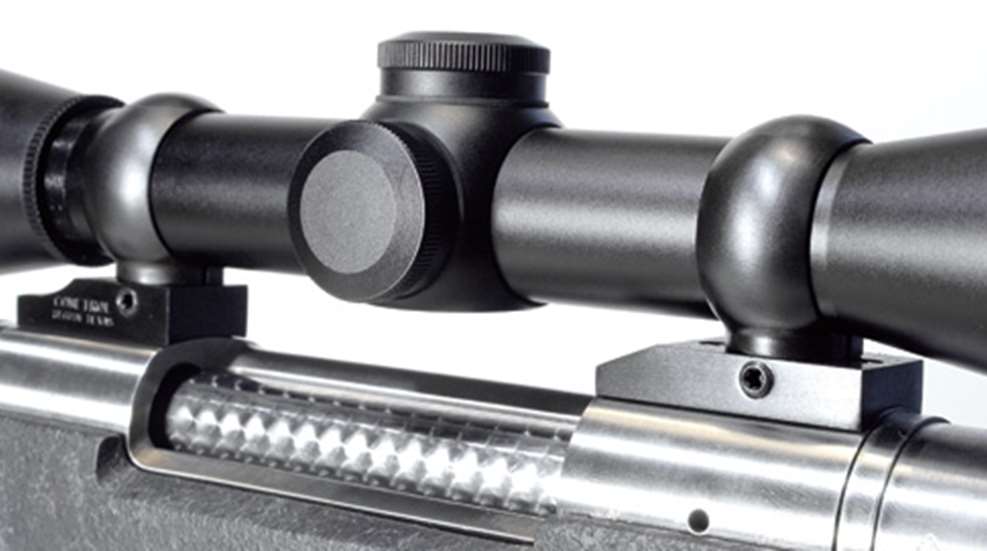
Conetrol rings are vertically split rings, but unlike others there are no screws connecting the ring halves. Instead, the ring halves lock at the top and form a round stud at the bottom. This stud fits inside a recess in the Conetrol base. On each side of the base are opposing screw holes. Screws with pointed tips screw into these holes and apply pressure on each side of the ring to lock the ring around the scope tube and in the base. Each ring half has a recess machined for these coned tips to engage.
The system has two really unique aspects. First, since each ring is locked in the base by pressure from opposing sides, you can use these opposing screws to help center the scope over the rifle’s bore. You can also slightly off-set the scope, in both mounts, while maintaining parallel alignment to accommodate for bolt handle clearance. Unlike some mount systems that also allow windage adjustment, Conetrol bases allow you to do this with both the front and the rear ring. The result is a mounting system that allows the scope to be perfectly aligned with the rifle’s bore. Since both the front and rear rings can be adjusted horizontally, this can be done without applying any torque to the scope.
The other unique aspect of Conetrol rings is the lack of ring screws. This makes for an incredibly stylish appearance. In fact, when you first see a scope mounted in Conetrol rings you’ll wonder how it is even possible. The secret is a small cap that encases a half-stud at the top of each ring half. This cap is contoured to match the profile of the ring halves, so once assembled it offers a seamless, custom look. (Each ring and cap is ground, polished and finished as one unit, so they should not be interchanged.) As pressure is applied to each ring half by the opposing screws through the base, it forces the top of the rings to engage a recess in the locking cap. It’s an ingenious design that, believe it or not, is 46 years old.
Not only does Conetrol manufacture screw-on bases for most every firearm, the company also offers bases designed to work with many integral mount systems like the 3/8 dovetail on many .22 rifles and the proprietary systems on Ruger and Sako rifles. They even offer a quick-detach ring/base system that is also windage-adjustable. All Conetrol rings offer that seamless, custom appearance. Cost for a set of rings and a one- or two-piece base starts at around $120.
The downside to the Conetrol system, depending on your mechanical ability, is the mounting process. It’s not difficult or complicated but more of an exercise of trial and error as you work to make sure the scope reticle is level before you lock down everything. Also, its scope base screws come with slotted heads. Torx head screws, like Conetrol uses for its opposing ring lock screws, would be more preferable. Regardless, if looks and performance are your top priorities, Conetrol rings are as elegantly curvaceous as a pin-up model and as rugged as a Marine.
Conetrol has been manufacturing quality steel scope mounts since 1964. Stainless steel rings and bases are also available. They have a comprehensive website but you must order by mail or phone. Because they have such a varied product line, I’d recommend you call and let them help you select the best rings and bases for your particular needs and specific riflescope.