Dangerous Game Sights

by
posted on April 6, 2010
** When you buy products through the links on our site, we may earn a commission that supports NRA's mission to protect, preserve and defend the Second Amendment. **
20104612033-front-sight-m.jpg

Danger is a proximate condition. An enraged Mike Tyson in the ring with you is dangerous, but Mike Tyson in another state is as harmless as a kitten. He can’t reach you. By the same token, a wounded Cape buffalo at 10 yards is dangerous, but that same buffalo at 200 yards is merely a potential threat, not an immediate danger. Something that can’t hit you, can’t hurt you.

Consequently, when discussing dangerous game sights for rifles, distance is an important factor. A sight that’s quick to pick up, aligns itself naturally and let’s you shoot with a precise sight picture is what you'll need.

Hands down, the best dangerous game sight is a peep sight. If I were to design the ultimate DGS, it would be a fixed ghost ring rear sight (a large aperture is referred to as a ghost ring) and a fiber optic red front sight.

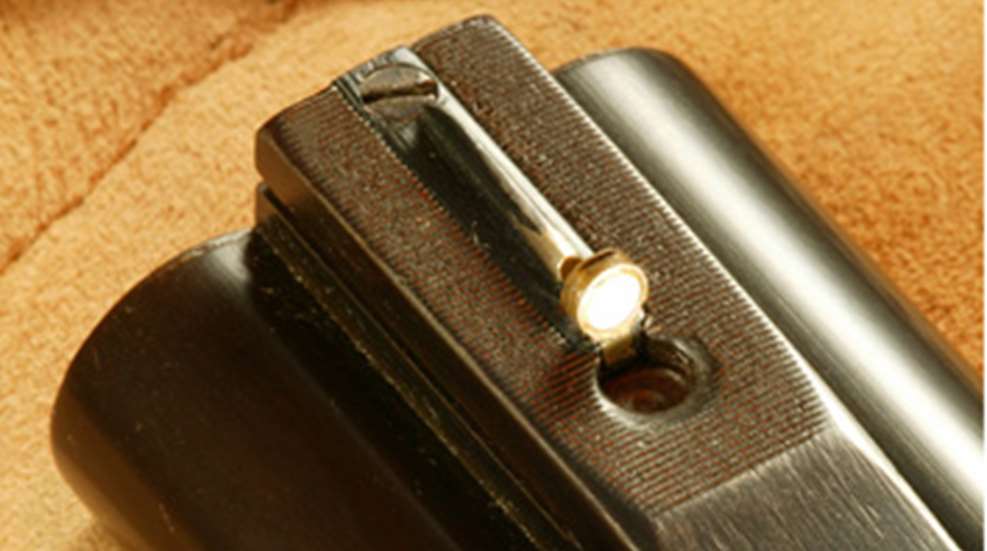
A close second is a classic English express sight with a V-notch rear and a gold bead front. While you still must align a sight picture with an express sight, if your rifle fits you, the gold bead falls into the V-notch naturally as you shoulder the rifle.

For an optical sight, the best one I’ve ever used is a Trijicon AccuPoint in a low-power variable (1-4x). The reticle is a large German post topped with a glowing red triangle that’s illuminated either by a fiber optic on top of the scope or via tritium in low light. I’ve used the AccuPoint on Cape buffalo and dwarf forest buffalo—it was superb.

The only drawback to an optical DGS is that the eye relief can be a problem, although it’s ample enough for a .458 Win. Mag., which I was using on both buffalo. This is why I’m very hesitant to recommend any other optic for a DGS, with one exception.

Leupold’s 1.5-5x variable has generous eye relief and will not give you a red crescent in your forehead. However, the duplex recticle is not optimum for close-range shooting, although it certainly is the most precise for longer shots.

However, long shots should be avoided with dangerous game. That’s why I use iron sights on everything except the cats. After all, the essence of hunting dangerous game is, as the name implies, danger. Out there at binocular distances, none of Africa’s game is dangerous. Stalk close and use your sights the way they were intended.

Latest

Ledesilencer Central Lauches

Free Chance to Win One of 200 Suppressors

Silencer Central has launched Silencer Central’s 100 Days of Silence, a daily giveaway that will award 200 suppressors over 100 consecutive days. The campaign, which is the largest suppressor giveaway ever staged in the United States, began April 17 and runs through July 25, 2026.

Member's Hunt: Patience is Tough When You Shoot a Big Buck

My phone still in my hands, I texted my teenage son, who was hunting along the field not far away. Trying not to move any part of my body but my thumbs, I sent the message, “Got a buck down, but he’s still alive. Help!” Tucker texted back, “What do you want me to do?” I replied: “Come kill the bastard before he kills me!” Intrigued? Read on.

First Look: 2026 Spypoint Trail Camera Lineup

Spypoint's 2026 trail camera line-up features three new models designed to deliver on flexibility and control.

Hardware Review: Christensen Arms Evoke .375 H&H

A .375 H&H Magnum for less than $1,000 is a win for hunters on any continent, especially when it comes packed with features and has the sub-MOA accuracy potential of the American-made Evoke from Christensen Arms.

New for 2026: Avian-X Waterfowl Backpacks

Expanding its assortment to include soft goods in 2026, waterfowl brand Avian-X has announced an all-new lineup of packs specifically designed to keep waterfowl hunters organized, mobile and ready for anything.

Behind the Bullet: The .308 Norma Magnum

Norma’s ballistician Nils Kvale saw the wisdom of having the velocity and horsepower of the .300 H&H Magnum, but in a shorter, more affordable receiver, and used the H&H case to develop his .358 Norma Magnum in 1959 as well as the .308 Norma Magnum one year later. The .308 Norma Magnum closely resembles the wildcat .30-338 cartridge, though the shoulder of the former is located a bit more toward the base than that of the .308 Norma Magnum. Intrigued? Read on about this often unfairly overlooked hunting classic.

Interests


Get the best of American Hunter delivered to your inbox.