We stared out across the aged sunflower field guarded by the Chester River as the last of our bunch geared up. Quaker Neck Gun Club President Tyler Johnson called our group to attention as he pointed toward the open field, only a fraction of the 2,800 acres of the club's family farmland located on Maryland's Eastern Shore.
"Anywhere in these sunflowers should be good," he said. "They come off the house and up to the right."
Maryland's early dove season, and the fall hunting season in general, was about to begin. Dove hunting is one of the simplest forms of recreation for most wingshooters, and there's nothing quite like an afternoon when birds and lead are flying. Not to mention they can make one tasty evening meal.
The Steiner Optics Annual Dove Shoot at Quaker Neck boasts a mouthwatering dove recipe that can't be beat. Club staff grills up the breasts and wraps them in long strips of smokey bacon. A legendary recipe to say the least, and my main motivation for downing some birds.
We headed into the field hoping that the doves, being the seed-eaters that they are, would return to their feeding area from their watering holes or afternoon roosts.
I sat in the right corner of the field near the far tree line as 15 other hunters spread out to my left. Safety, as always, was the No. 1 priority as the hunters were, at most, 100 yards apart. In some cases, as it was with American Hunter Editor-in-Chief Scott Olmsted and myself, only about 10 yards separated shooters.
After we agreed on our safety guidelines and loaded up, we were ready to go.
Down to Business
The first hour was uneventful, a few birds flew, but we mostly waited, told stories of hunts past and lamented the mid-day's heat. No matter, though, Johnson had told us that the birds didn't really fly until around 4 p.m., when we presumed we would start piling them up.
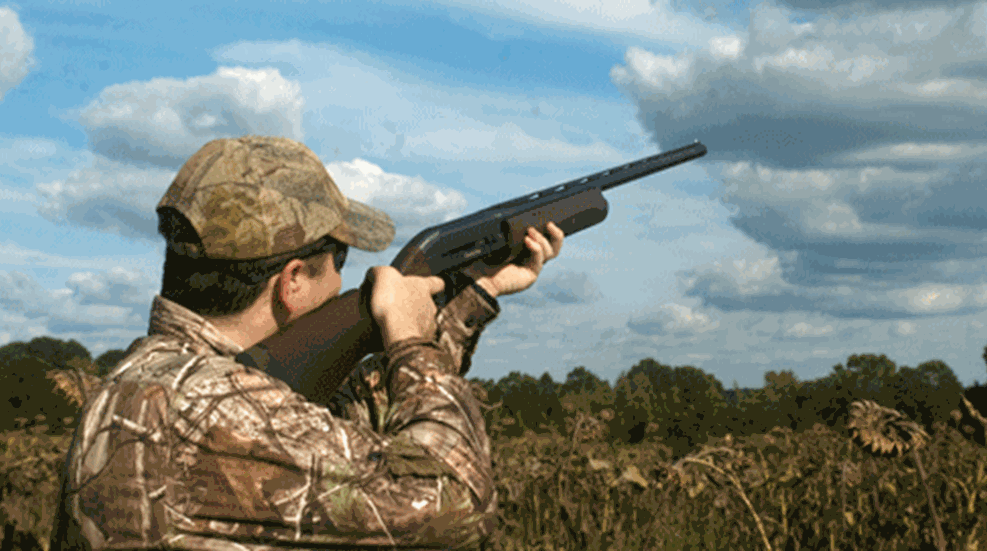
American Rifleman Assistant Editor Angus McClellan dropped one of the first doves that flew to our left, and the game was on. I swung my Benelli Montefeltro 20-gauge and blasted two at the first pair that flew over—two misses. As was heavily discussed pre-hunt, most dove hunters average about three or four kills in every 25 shots, so I shrugged off the first few.
After that, the skies lit up and the birds started to fall. Sven Harms of Steiner Optics and Associate Online Shooting Editor Paul Rackley whacked 'em down the middle of the field, as the doves began to zip by in all directions, and we began to get closer to our evening meal.
Meanwhile, Mr. Montefeltro and I weren't having much luck. Cut off by the tree line, I wasn't able to see some doves on approach and the couple I did knock down sailed into the knee-high soy beans in the next field—without a dog it was nearly impossible to recover those birds.
There's no excuse, but there were plenty of doves to breast when we had all cleared the field. My measly additions to the pile were quickly lost in the mix.
So, after an eventful day in the field (it's always fun when the birds are flying no matter how you shoot) we were ready for the most anticipated part of the hunt—the post-hunt meal.
Quaker Neck staff feathered and prepared the doves, as we snacked on some signature Maryland crab dip and enjoyed each other's company in the shadow of the Club's 18th century weathered brick farmhouse. Without a doubt, the best parts of any hunt are the laughs and good times spent with good folks.