I would have liked the Lanber Grey Stone anyway, but it so happens it was the gun I carried on the day last fall when my German shorthair puppy pointed his first rooster. Jed crawled down the steep bank of a creek and froze next to a tangle of brush, a look on his face reflecting equal parts intensity and puzzlement. Looking down at the cover I thought quail just as the rooster pheasant shouldered its way out of the blowdown beneath my feet. I let it get out 15 or 20 yards and shot the first of what I hope will be many, many birds over Jed.
Given the Grey Stone's role in that momentous occasion, I like the gun perhaps even more than I should. However, even after I separate my warm feelings for the Grey Stone from its features and solid value, it comes out a winner. And, I hope it's a gun that helps American shooters become more familiar with the Lanber brand.
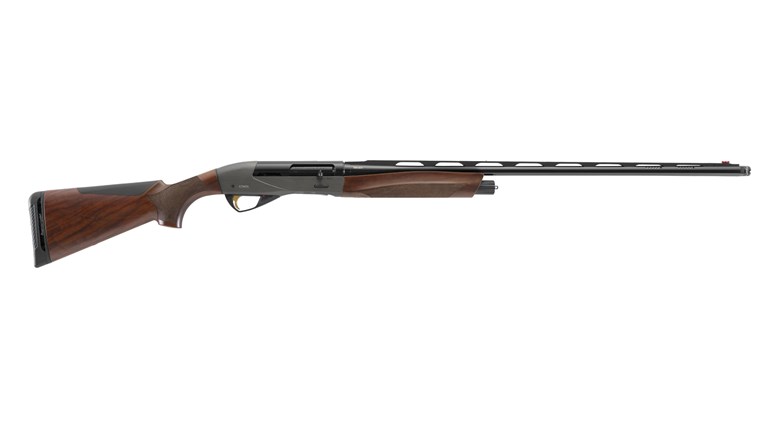
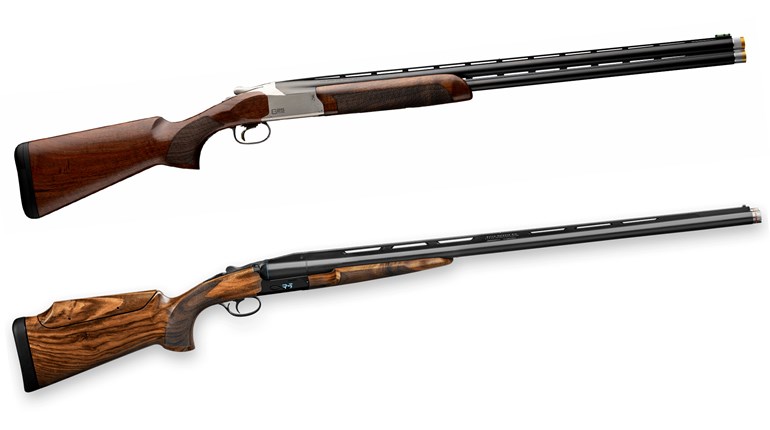
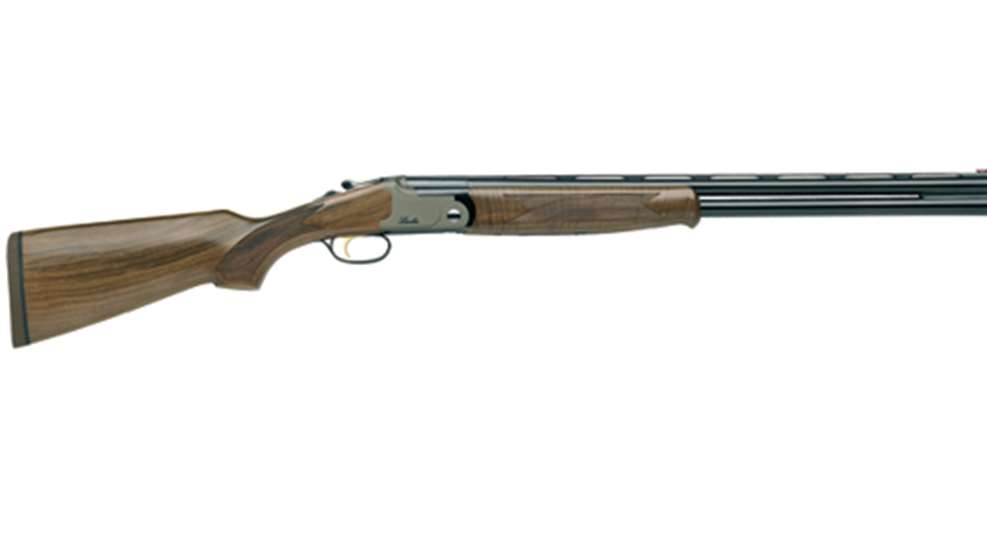
The Grey Stone Light is named, presumably, for its receiver, which is matte gray. It is milled from lightweight alloy, which keeps the weight of this 26-inch-barreled 12-gauge over/under down to 6 pounds, 6 ounces. Alloy receiver break-action guns are nothing new; "duralumin," first developed for zeppelin frames, was made into gun receivers in the 1930s. Browning, Winchester, Beretta and Franchi currently offer super-light alloy-framed doubles, most of them in 12-gauge, with strategic points reinforced with steel. The Grey Stone offers the same blend of 12-gauge punch and 20-gauge weight, but in a considerably less expensive package than its better-known competitors.
Lanber shotguns come from Zaldibar, Spain, located near the Basque arms-making center of Eibar.
Unlike more famous Spanish makers, such as Arrieta and AyA, well known for their high-end doubles, Lanber cruises along under the radar of most American shooters, building affordable O/Us and semi-autos. Lanber O/Us are popular in England where repeaters are rarely seen, and also in Australia, where the recent wrong-headed ban on pumps and semi-autos created a demand for affordable break-action guns. Although Lanber has a small following in this country, like many foreign makers, the company has switched importers through the years and never spent the advertising money necessary to do more than operate on the fringes of the American shooting public's awareness. Lanber USA has recently moved to an expanded headquarters in Westfield, Mass., so perhaps the guns will finally receive some recognition in the U.S.
The Grey Stone is a well-made gun. The alloy receiver has disk-set strikers and replaceable steel trunnions upon which the barrels pivot. The gun locks up by means of an underbolt that fits into lugs on the bottom of the monoblock, similar to the way Browning's Citori and many Italian O/Us lock. It's a proven system, although it adds depth to the receiver, making the Grey Stone ungainly in terms of receiver height when you compare it to sleeker O/Us like the Browning Cynergy, Ruger Red Label or Beretta 686/687. The gun has automatic ejectors, and a gold-colored single-selective trigger that breaks around 6.25 pounds for the bottom barrel and a pound more for the top. The barrel selector itself is a small, square button located on the automatic safety, modeled after the Beretta style.
The 3-inch-chambered, 26-inch barrels have a standard .726-inch, 12-gauge bore, a narrow rib with fiber-optic bead, and are threaded for interchangeable chokes. The barrels lack side ribs that save an ounce or two of weight and give the gun a distinctive look. Ordinarily I prefer longer barrels on 12-gauge doubles, but with the reduced weight of the receiver lightening the back end of the gun, the Grey Stone balances right over the trunnions with the shorter tubes. The combination of the short 26-inch barrels and high profile do make it look slightly stubby, not sleek, but it is a well-finished, slick-handling gun.
The walnut on my gun showed a little figure, with well-executed checkering, a Schnabel fore-end and a satin finish overall. The stock carving is fairly simple, without flutes on the comb or shields behind the receiver. The recoil pad is thin and hard, but at the Grey Stone's price, it's hard to complain; you can certainly afford a soft aftermarket pad with the money you save. The metal decoration is minimal, nothing more than "Lanber" written in black cursive on the matte gray receiver and light scroll engraving on the lever and trigger guard.
The stock measures 11/2 inches at the comb, 23/8 inches at the heel and 141/2 inches long-good dimensions to suit many shooters. Except for one light hammer strike right out of the box (which I suspect was caused by residual grease from manufacture and packing) the gun functioned perfectly. Ejectors popped crisply, the safety snicked off with ease, and when I shot skeet my three-quarter-ounce reloads reset the inertia triggers. I found the Grey Stone Light to be an easy gun to shoot; light, but not too muzzle-light to make hits. In the field, I found recoil wasn't terrible with ordinary field loads, although I would think twice about setting it off with 3-inch magnums.
The gun comes with a hard case and five choke tubes and a choke tube case. It is covered by a five-year warranty. In all, the Lanber Grey Stone is about the nicest bird gun you've never heard of-light to carry, easy on your pocketbook and hard on the birds.
Action Type: break-action O/U
Gauge/Chamber: 12-ga./3"
Barrel: 26"
Sights: fiber-optic front bead
Safety: tang safety w/barrel selector
Stock: satin-finished walnut
Overall Length: 43"
Stock Dimensions: LOP-141/2"; drop at heel-23/8"; drop at comb-11/2"
Weight: 6 lbs., 6 ozs.
Metal Finish: matte gray anodized receiver; blued steel barrels
Accessories: hard case, 5 choke tubes
MSRP: $1,199