The deep-chested whitetail sailed over the barbwire fence, barreled through 30 yards of head-high grass and then rocketed across the corn stubble as if its life depended on it. Probably because it did. If that eastern Colorado buck had stopped or slowed to a walk when clearing the field’s far edge, it would have presented a clear 250-yard shot for the .300 Weatherby sitting atop my SnipePod.
But the buck didn’t stop. I sighed in frustration as it crested the field at full throttle and burrowed into the tall, golden grasses covering the slope beyond. The great buck looked to be bound for Kansas, never again to amaze me. My companion, who hunts this region often, wasn’t so pessimistic. He reasoned we might be the only hunters within miles of the buck, and that it would bed in willow brush choking the dry creek bed below. Plus, the rut was over and this day was just starting.
“If we leave him alone, we might see him again near dark,” Tom said. “He’s run-down from the rut, he won’t find much to eat down there, and he’s got the whole day ahead of him. He’ll be hungry by late afternoon. The best food around is right here, so think positive.”
As daylight faded nine hours later, I steadied my shaking hands and snapped open my old KA-BAR folding knife. I then pulled out my flashlight and bit lightly into its rubberized end to start gutting that 12-point buck. To my shocked delight, it had made Tom look like a genius.
About 30 minutes before dusk we spotted big antlers weaving above the grasses halfway between the field and dry creek bed. When it stopped to feed in a small opening, we scooted and crawled into position 175 yards away. As I set up to shoot, the buck suddenly snapped its head erect and stared. Moments later it resumed eating. Our imitation of two rocks in prairie grass must have worked. Seconds later, with the SnipePod adjusted and scope cranked to 9X, I squeezed off the shot.
Defining Hunting Pressure
I couldn’t have felt luckier while gutting that mature buck. I had assumed Tom’s well-reasoned prediction was mostly meant to keep my spirits up. Having spent most of my life hunting whitetails east of the Mississippi River, I was certain we wouldn’t see that buck again unless we mounted a drive, kicked it out of a hiding spot and chanced to get the cross-hairs on it before it vanished for good.
But this buck had reappeared on its own near sunset, retraced part of its morning escape route, then resumed feeding after spotting and dismissing those suspicious “rocks.” Clearly, I was a long way from home. What wasn’t so clear was why this mature, experienced buck didn’t flee first and ask questions later.
So, what makes a “pressured buck?” How much hunting pressure does it take to change a deer’s behavior, send it “underground” and make it “go nocturnal?” And when deer flee, do they truly head for the nearest refuge, the next county or the next state, say Kansas? How long before they go back to what they were doing? And do all deer in a neighborhood respond similarly? Finally, how do habitat, cover, terrain, food, breeding and time of year factor?
Hunters aren’t alone with their questions. Several researchers at universities and wildlife agencies have studied the whitetail’s response to hunting pressure since the 1950s. And since the 1960s, deer have been toting radio-telemetry collars and, more recently, GPS hardware, to help wildlife biologists learn how, when and where whitetails react when hunters hit the deer woods.
In his 1967 report on hunting pressure at Illinois’ Crab Orchard National Wildlife Refuge, Donald C. Autry of Southern Illinois University found that .39 hours of hunting activity per hectare per day was “particularly harassing” to deer. Roughly translated, that would be about 6.25 hours of daily hunting activity spread over 40 acres.
However, University of Missouri researchers Brian Root and Erik Fritzell, working with Norbert Giessman at the Missouri Department of Conservation, found female deer activity might not be affected when daily human activity is less than .45 hours per hectare, or about 7.25 hours per 40 acres pressured. In their 1988 study of firearm hunting at the Deer Ridge Wildlife Area, Root and Fritzell described hunting pressure as “intensive” at 1.39 hours of human activity per hectare per day. In other words, that’s about 21 hours of daily hunting activity on a 40-acre parcel, roughly two hunters making a dawn-to-dusk effort.
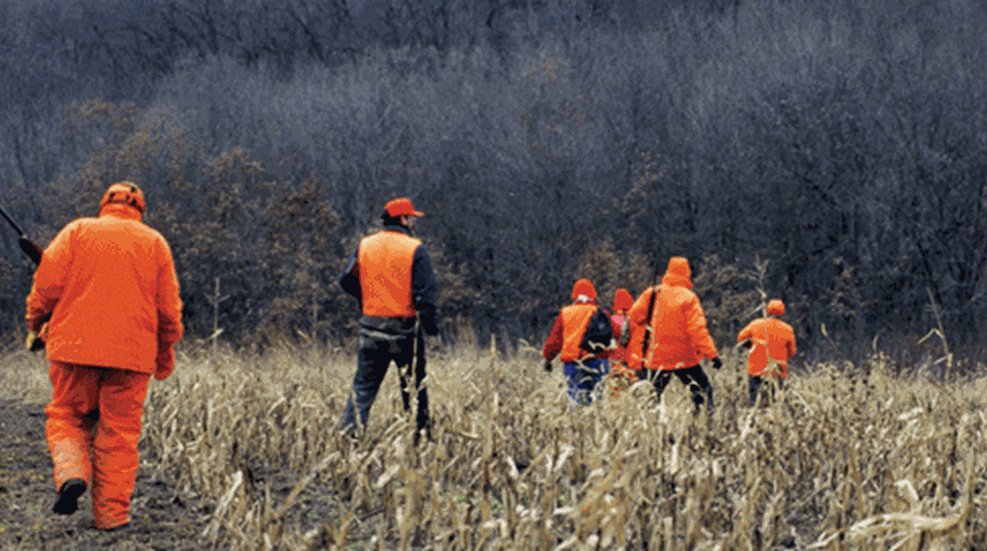
Most states that measure hunting activity don’t get so specific, and they usually describe hunting pressure in terms of hunters per square mile of deer range or huntable land. In those terms, Crab Orchard’s hunter density would be about 10 or 11 hunters per square mile, and Deer Ridge’s about 36. Meanwhile, opening-day hunting pressure in parts of Maryland reaches 90 hunters per square mile, while parts of Wisconsin draw 60 hunters per square mile.