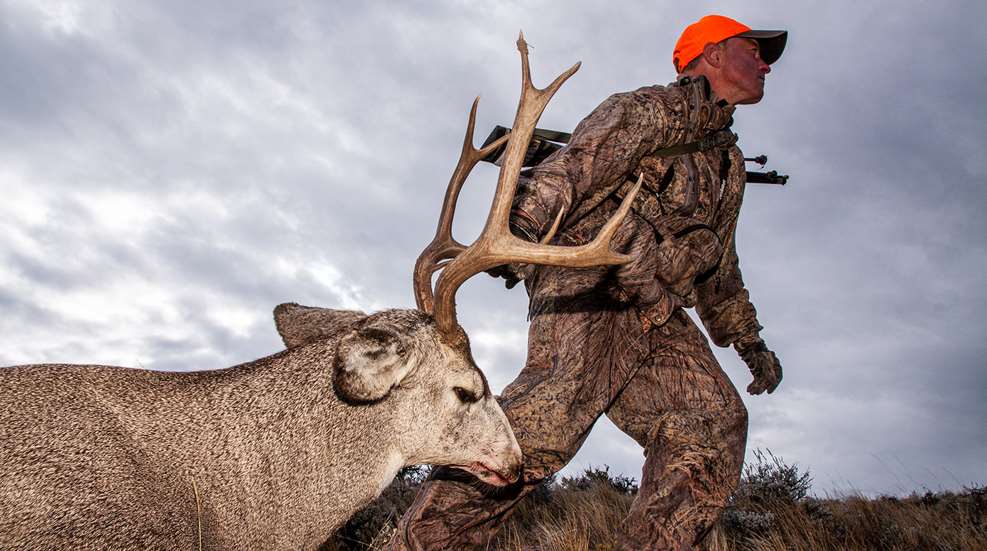
It didn’t make sense. The bachelor group of bucks was fragmenting the further they moved into the badlands cover. What started out as seven males traveling together was now down to two, my target buck and an adolescent that must have preferred the company of a veteran. As they descended the steep bank of an eroded creek, I lifted my gaze above them to locate their possible bedding site for the day. Returning my gaze to look for their reappearance, I was shocked. They had vanished in the crackling gumbo backdrop.
Muley Pre-Rut Mindset
Hunting any member of the deer family requires a biologist mindset, and that is true of hunting mule deer before the breeding season. First, determine the topography for your hunt and dissect it to analyze food, water and cover. Those elements, not females, have influence over a buck’s behavior and daily schedule.
Like early fall whitetails, mule deer have a focus on feeding. Rut and winter both take a toll on body mass. In the months prior to breeding season bucks wolf down as many high-energy calories as possible. In terrain mixed with hay or croplands, finding bucks merely requires simple glassing. Alfalfa, winter wheat, cut hayfields and irrigated grounds all attract mule deer.
Locating deer becomes a true test for animals relying on native browse. As a rule, mule deer are primarily browsers and their nutrition palette varies by the season. A browse species desirable in the early season may not have the same attraction after the first frost. Glassing may help you determine if deer are nibbling on late dandelions, sawtooth butterweed, bluebell or other broad-leafed vegetation that still offers green palatability.
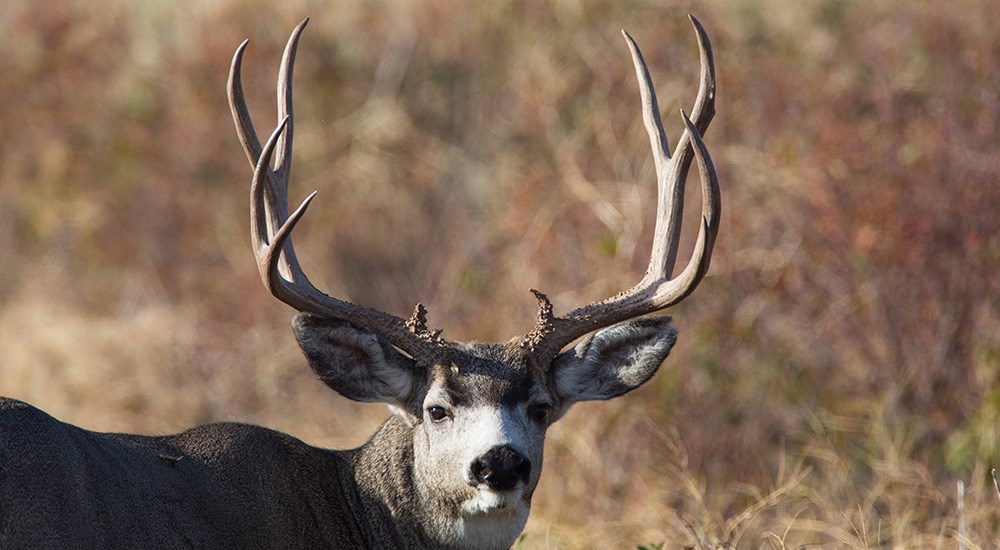
The problem is that different environments offer varying browse for mule deer, so a call to a biologist who oversees management in the hunting unit is warranted. Mule deer could be feeding 3,000 feet higher than you expected in alpine meadows, browsing in aspen stands or moved on to sagebrush munching in a desert environment. Onsite insight is good when determining the early-season feeding zone.
During the call, query about what habitat deer will be relying on for escape cover. That may be as obvious as deer ducking into the only canyon around, but some habitat is so vague, like a forest of lodgepole pine, that clues from experts are again required. Add those clues to your knowledge that deer will be frequenting open meadows and shying from allotments publicly grazed by sheep herds. Minor aspects count and when mule deer feel uncomfortable, they have no reservations about carpet bagging somewhere else.
Even open-country mule deer can be as elusive as Bigfoot. Some forest environments limit glassing potential, but time behind optics at dawn and dusk is the answer to finding treeless mule deer. After that, think climate and ruggedness. Climatic conditions, particularly temperature spikes, spur roly-poly deer to seek shade. In the open country, lone trees and steep banks offer the only awning relief. Scrutinize traveling deer to locate their preferred, sun-shielded bedding site and then continue to watch. Mule deer characteristically move an hour or so after bedding to readjust and then move whenever the shade moves to follow the coolness. Even in the high country you see bucks moving around in massive boulder fields chasing shade.
Water also weighs importantly in the world of mule deer. Unfortunately, outside desert locations or in the case of severe drought, water is naturally quite abundant in most environments. Regions defined as a desert (10 inches or less of rain annually) provide the top opportunity for a water ambush. Oftentimes, it may be best to establish your hide off a trail and out of sight of the water while hunting paranoid bucks, especially if you have a firearm in hand. Review the water source to appraise whether a near or separated surprise is best. Even so, on multiple occasions I have been in ground blinds pre-set by a week and mule deer stroll in never giving them a second look. Plan ahead.
Trail cameras are a boon to water scouting, even if deer avoid daylight drinking. Cameras can still confirm highly used water options and hint if bedding and feeding activity is nearby based on time stamps. Review all regulations and be considerate to wildlife using the waterholes if you decide to target a location.
Some habitats may simply have too much water for you to target. Even so, scouting does not hurt because just as you have a favorite watering hole to hang out with your friends, mule deer also have favorites. Some are based on location while others offer a better view to assure safety when they do put their head down to drink.
A final muley mindset is the bachelor mentality. September and into October, bucks travel in male-dominated groups. These factions begin disbanding as October arrives, but these groups follow a pecking order that asserts dominance while the grouping aids in security. Later in October the males separate. Until then, they travel with patternable consistency until testosterone drives a wedge amongst them.
A Pattern with Inconsistency
What does early season mean for strategy? It equals a pattern you can utilize for repeat meetings. You may catch mule deer bucks repeating patterns during the rut, but you may also never lay eyes on the same buck two days in a row. In advance of the rut, mule deer settle into a solid food source, secure cover and whatever water is available. Those clues, combined with your personal intel, pave the way to an early-season encounter.
Despite a sense of reliability, mule deer still differ from their ancestral whitetail brethren. They may show up at the same field, meadow or waterhole, but they habitually alter their arrival route. Instinct likely prods the move to survive ambush at the same general location. Nevertheless, it puts you in their universe if you can decipher the pattern. Mule deer winding out of the foothills to a hayfield provide a classic pattern with ample ambush setups. Forest-loving deer may require more analysis whether they are following a ridge or dropping into a canyon to follow a steep hillside to terminate into an open meadow. Your hunting app comes into play here by overlaying a topographical view. Any benches, shelves or saddles that appear in the topographic lines likely show routes deer will travel. That is a starting point, but you never know until you walk in the hooves of a deer. Cedar-covered hillsides also represent challenges for visually confirming patterns once deer enter and disappear into the boughs. Again, follow the topography for paths of least resistance.
With firearm in hand and within manageable shooting distance, you can make mule deer appear by blowing on a prey-in-distress call. Mule deer hear the peril and jump up to pinpoint the origin, and possibly lend a helping hand.
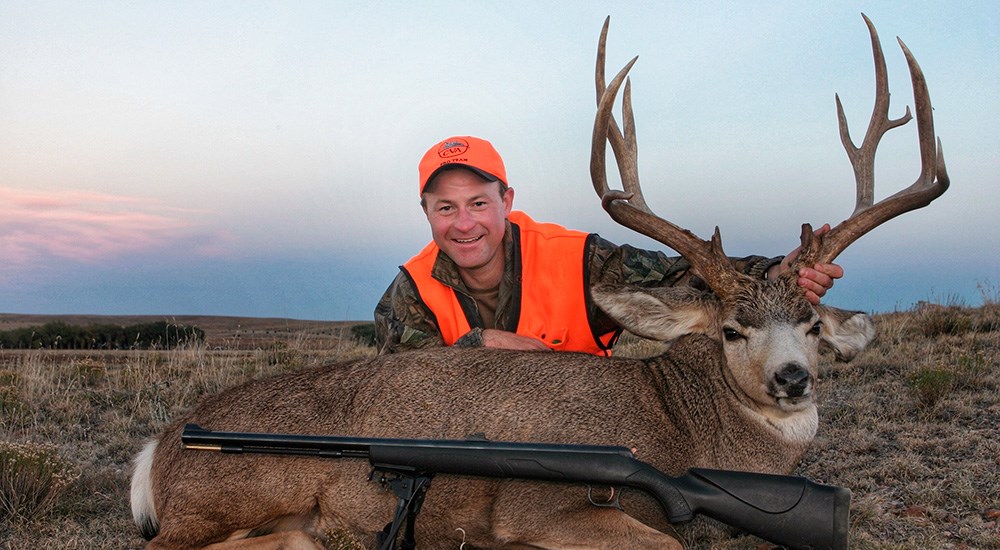
After an hour of watching the creek where the bucks disappeared, I felt as if the duo was still there in the shady recess of the steep, gumbo bank. It was the middle of the afternoon with hours to wait before the bucks might consider revealing themselves again. Thinking back to other situations, I felt a good coyote howl might be enough incentive to make the bucks rise for a look-see. I howled and sure enough the duo jumped to their feet giving a full view at 90 yards. I centered the open sights of my CVA on the veteran and lost him in a cloud of smoke. As the prairie winds cleared the powder charge, I saw the buck stumble and the youngster bound off. Hunting mule deer before the rut ruckus certainly was a sound option.