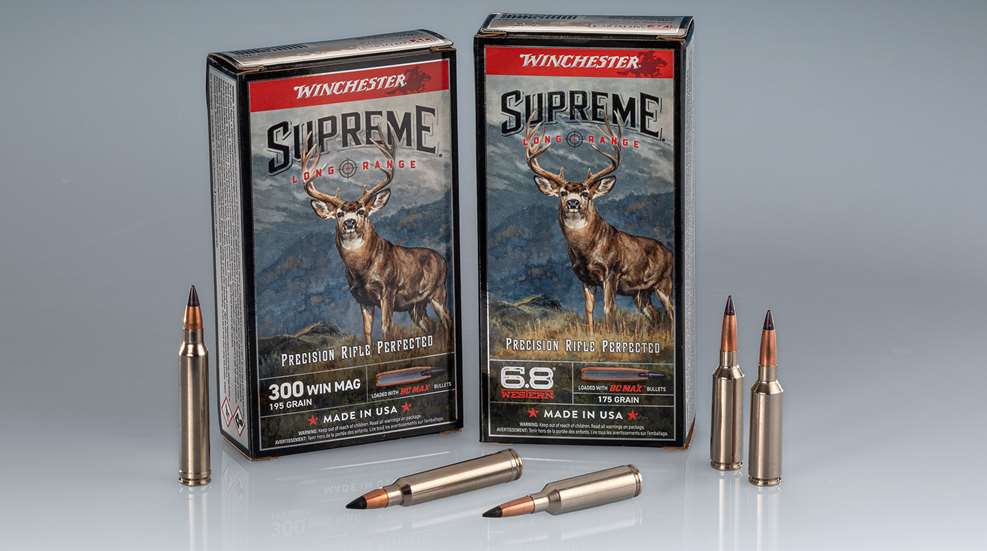
The popularity of hunting at extended ranges doesn’t show signs of slowing down anytime soon. Rifle and optics manufacturers have responded in kind by developing products with increased performance to push the distances hunters can reliably make an ethical shot. This includes rifles that are competition-grade accurate without being a boat anchor and optics that can dial elevation adjustment consistently and precisely to adjust for the bullet drop past traditional point-blank distances. Ammunition companies have also had to up their ballistics game with cartridges that are more accurate and that deliver bullets with better aerodynamics with great terminal performance across a wider range of velocities. The ammo innovation is necessary because bullets used in long-range hunting ammo have to expand, yet also hold most of their mass if shot into a game animal at 100 yards, but also have to perform almost exactly the same when shot at greater distances like 400 yards and beyond, even though the bullet velocity is significantly less at that range. It’s no easy task. This is where Winchester’s new Supreme Long Range fits into the mix.
Late last fall I had the chance to try out this new Winchester ammunition on an Oklahoma whitetail hunt, including zeroing the rifle, gathering some ballistic data and fortunately punching the tag on a nice buck. At the time I didn’t have much information about this new Winchester ammo, other than it featured a new bullet and was aimed at the long-range hunting crowd. OK. Fair enough. As Dr. Venkman said in Ghostbusters, “I love this plan, I’m excited to be a part of it, let’s do it!”
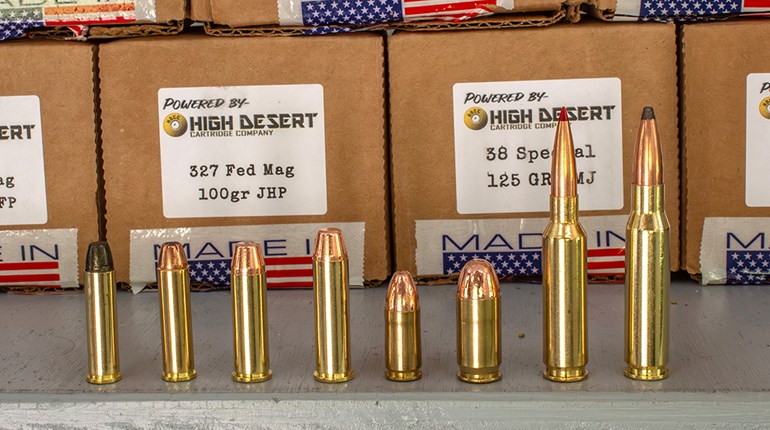
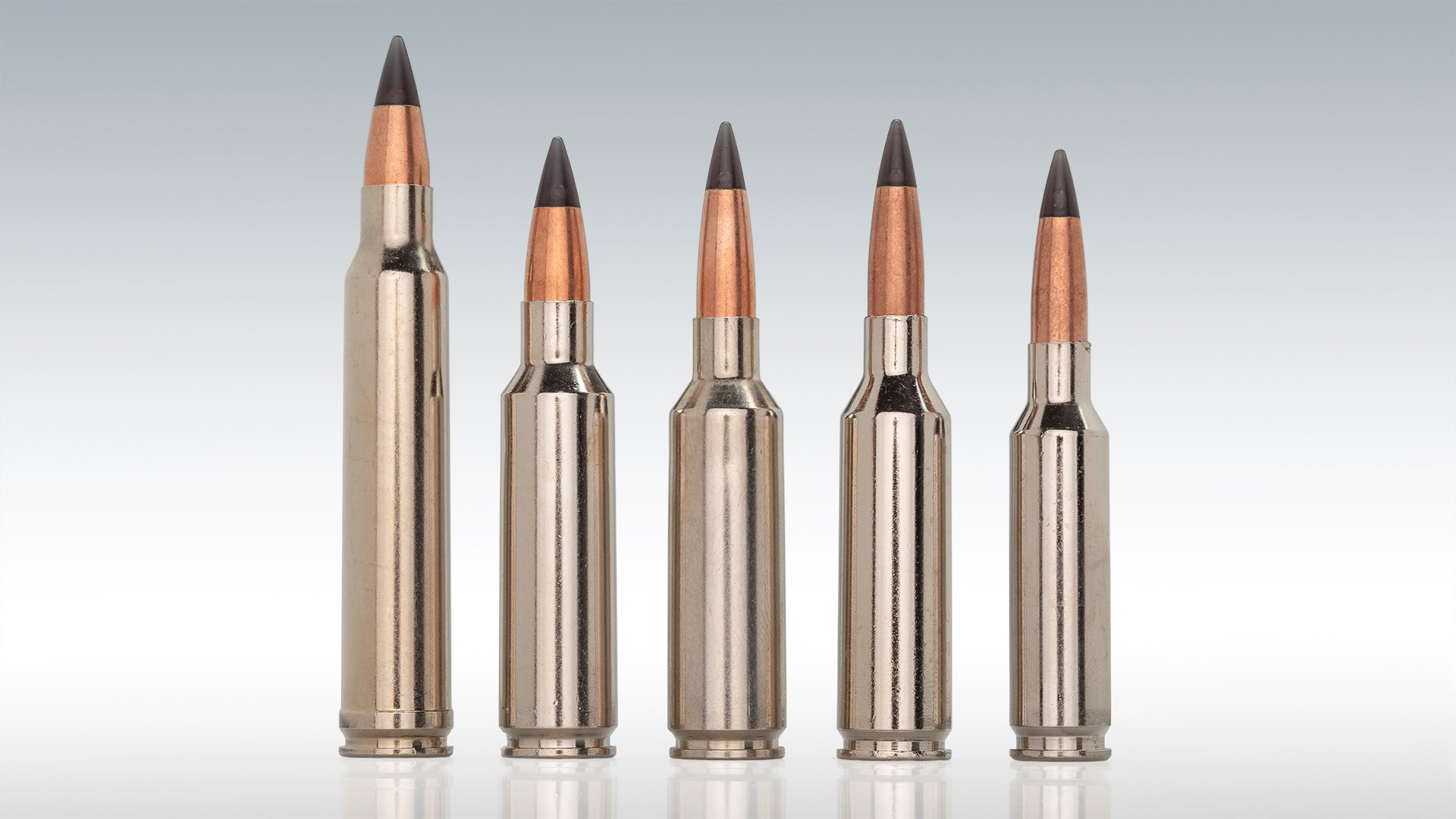 Shown left to right: 195-grain 300 Win. Mag., .300 WSM; 175-grain 6.8 Western; 140-grain 6.5 PRC, 6.5 Creedmoor.
The ammo arrived under the cover of darkness in boxes marked “TOP SECRET,” with warnings of imprisonment or death for any breach of security. OK, not really, but it did arrive with generic white labels attached to boxes for older products already in their catalog. The cartridges, in this case 6.5 PRC, didn’t appear much different than what you might expect with other premium loads for long-distance shooting; electroless nickel-plated cases and copper-jacketed bullets with the now ubiquitous polymer tips, albeit the polymer tips were noticeably larger than on other bullets of this genre.
The bullet is the heart of any long-range cartridge; in this case it’s Winchester’s new BC Max bullet. This bullet is designed and manufactured in-house. Winchester has been noticeably absent from the long-range cartridge playing field; this new bullet and ammunition is their entre into this category.
The bullets are heavy for the caliber, which is common in long-range bullet design because it helps achieve the high ballistic coefficients necessary for the flatter trajectories desirable when shooting at extended ranges. A copper jacket staked at the boattail, and the lead alloy help control expansion at closer ranges and high velocities, while the hollow point with its large polymer tip help with the expansion once velocity has dropped off at greater distances. All of this is fine and dandy, but it’s useless if the bullets aren’t accurate. Winchester is making these on new, precision bullet manufacturing equipment also designed in house to ensure part-to-part and bullet-to-bullet consistency for maximum accuracy.
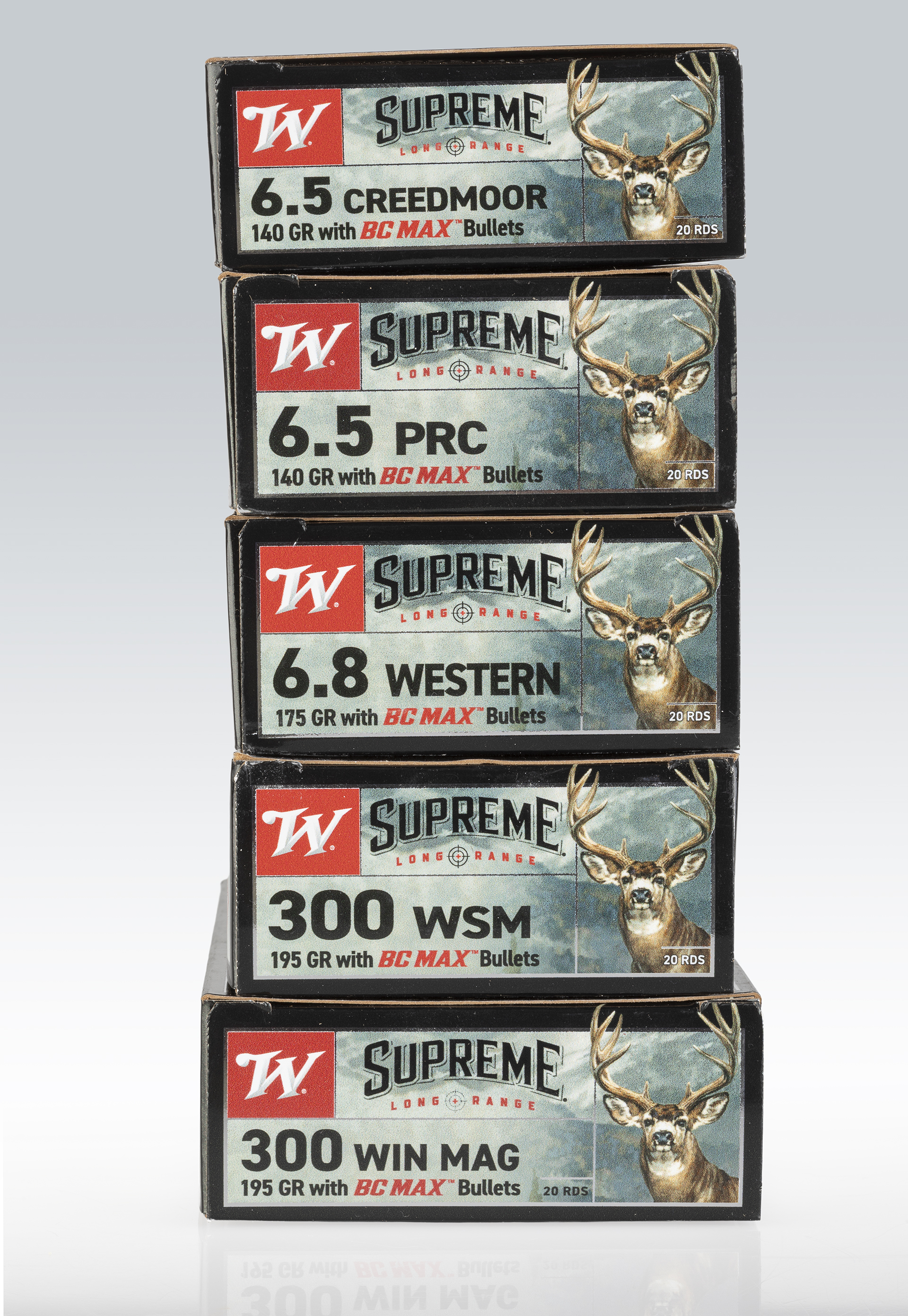
Ammunition is a system, and it takes more than just the bullet to make cartridges that are reliably accurate. The Supreme Long Range ammo uses nickel-plated brass for smooth feeding and extraction, and match-grade primers to help with consistent ignition for accuracy. Overall, it’s great looking stuff, which of course adds at least ¼ MOA worth of accuracy improvement. Obviously, I’m kidding, but why shoot ugly ammo if you don’t have to?
Accuracy testing, which was also dialing in the rifle for the hunt, was done with a Browning X-Bolt, a then yet-to-be-introduced Leupold VX-4HD 4-16x52mm scope, and a Banish Backcountry .30-caliber suppressor. Both zeroing the rifle and accuracy testing were done shooting prone, off a bipod with a rear support bag.
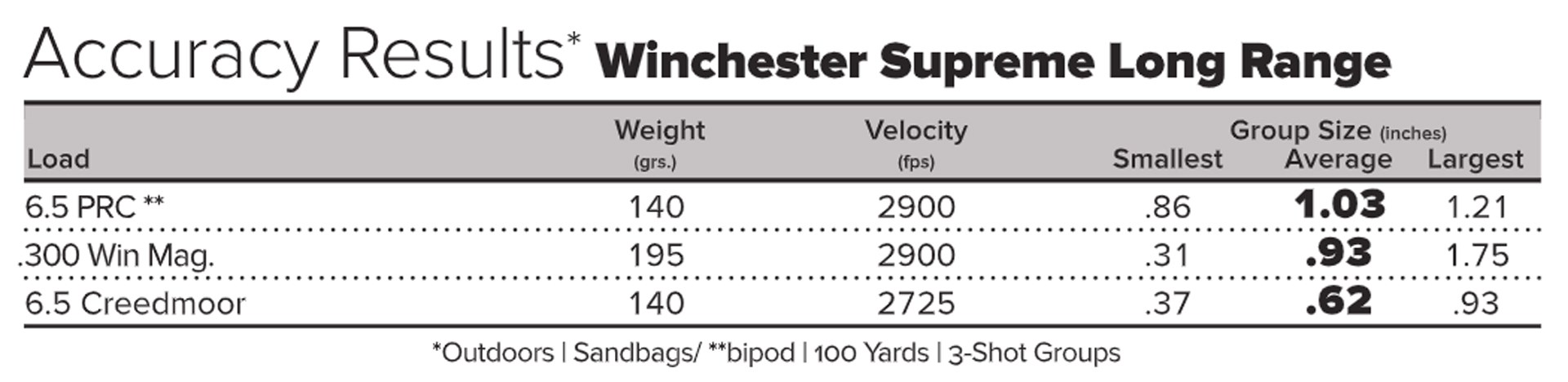
Full disclosure for the accuracy testing: I only had the 6.5 PRC ammo available to me for testing. The AH editorial team was kind enough to provide the formal accuracy results for the .300 Win. Mag. and 6.5 Creedmoor (see chart—impressive).
Initial groups for zeroing the rifle were encouraging. So was the performance while practicing for the hunt and simultaneously wringing out the new Leupold VX-4HD. More formal accuracy testing after the hunt turned in groups ranging in size from 1.21 inches to .86 inch. Given the X-Bolt was a lightweight rifle with a sporter barrel profile that got warmer than you’d ever see hunting, this is extremely solid performance.
Speaking of performance, how did it perform on the unfortunate whitetail buck, and later on a gel block at a greater distance? Well, the buck crumpled in his tracks. The shot was only at about 150 yards, but it was a good opportunity to see if the bullet would expand at that range or if it would drill a hole through him like a full metal jacket projectile. The buck was quartering toward me. The bullet entered just inside his right front shoulder and exited just in front of his left hindquarter. Like I said, he didn’t go far. While we didn’t recover the bullet, there was evidence of expansion, and it certainly didn’t come apart or blow up.
But I wanted to shoot this at longer ranges per its namesake. So back home I shot the rifle at greater distances and shot a gel block at 460 yards and measured the velocity at that distance with a Garmin Xero. The rifle, bullet and optic combination were accurate enough that I wasn’t worried about hitting the gel block lengthways at that distance. The bullet hit the block, left a massive temporary wound cavity, a significant permanent wound channel and exited the block. It also hit the target stand and moved it back a few inches. This bullet will expand and still penetrate, even after losing 300 fps at 460 yards. If you have one of the Garmin chronographs and want to measure your downrange velocity, set it up in line with the target about 15-20 feet back; just try not to shoot the Garmin.
Overall, Winchester’s new Supreme Long Range is a solid option for hunters looking for accurate ammunition with good terminal ballistics at extended ranges. It will expand at typical whitetail hunting distances without jacket separation or coming apart, but also do its job at extended ranges, and it has the accuracy to get the bullet where you need it. Initial offerings include .300 Win. Mag., .300 WSM, .30-06 Sprg., 6.5 Creedmoor, 6.5 PRC, 6.8 Western, .308 WIN, 300 PRC and 7mm PRC.
Winchester Supreme Long Range
- winchester.com
- Cartridges/Bullet Weights: 6.5 Creedmoor/140-gr.; 6.5 PRC/140-gr.; 6.8 Western/175-gr.; .300 WSM/195-gr.; .30-06 Sprg./195-gr.; .300 Win. Mag./195-gr.
- Bullet Type(s)/Style(s): BC Max; jacketed, extended boattail w/polymer tip
- Ballistic Coefficient: .617 (6.5 Creedmoor, 6.5 PRC); .682 (6.8 Western); .589 (.300 WSM, .30-06 Sprg.); .569 (.300 Win. Mag.)
- Muzzle Velocity (fps): 2725 (6.5 Creedmoor); 2900 (6.5 PRC); 2825 (6.8 Western); 2900 (.300 WSM); 2570 (.30-06 Sprg.); 2900 (.300 Win. Mag.)
- Muzzle Energy (ft.-lbs.): 2,308 (6.5 Creedmoor); 2,614 (6.5 PRC); 3,101 (6.8 Western); 3,641 (.300 WSM); 2,859 (.30-06 Sprg.); 3,641 (.300 Win. Mag.)
- Uses: medium-large game
- MSRP per box: $38-$60
Most Popular