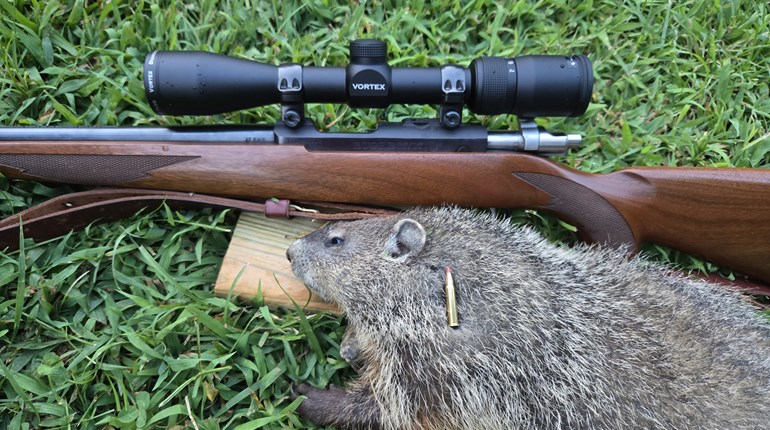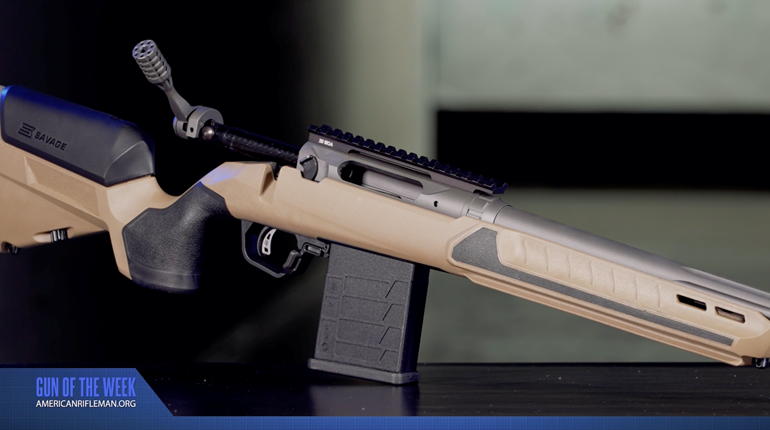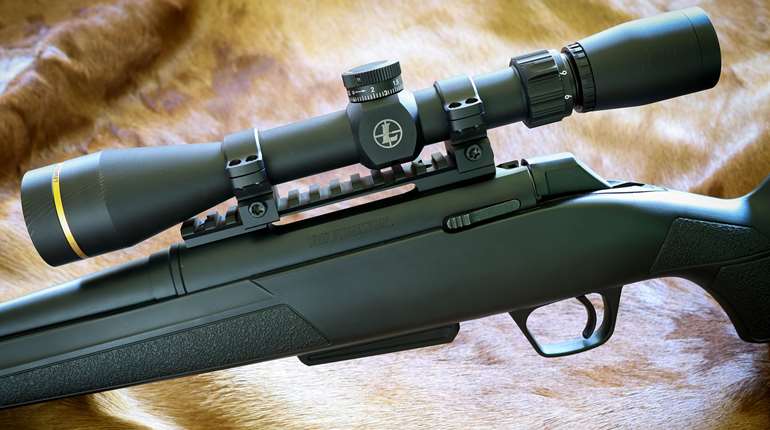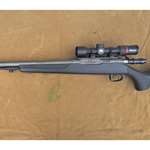
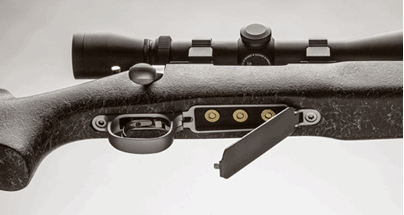
 One of the showstoppers at the 143rd NRA Annual Meetings & Exhibits was the Remington Model 700 Ultimate Muzzleloader. The company unveiled its new smokepole in front of a crowd of more than 75,000 attendees, calling the gun's Accelerated Muzzleloader Performance (AMP) ignition system a "jet engine of progress" and claiming it brings "300 yard performance to muzzleloader season."
I tested the Model 700 Ultimate Muzzleloader for several weeks before the show, and I have to admit there is much truth in Remington's marketing campaign. You can read about some of my findings in the May 2014 print edition of American Hunter, or watch the Gun of the Week video. But now let's take a closer look at this 300-yard claim. That's a fairly long shot for a centerfire rifle, let alone a muzzleloader.
The reason why Remington is able to tout the gun as a 300-yard muzzleloader mainly lies in its AMP ignition system. Most modern muzzleloaders rely on a 209 primer to get things started, but the Ultimate Muzzleloader uses a large, magnum rifle primer contained within a modified cartridge case instead. The hotter flame of the rifle primer allows the Ultimate Muzzleloader to ignite, and burn within its 26-inch barrel, four, 50-grain pellets of blackpowder substitute. That's not a typo. Four pellets; 200 grains of powder by volume.
With a 209 gun, "magnum" performance is limited to three pellets or 150 grains of powder by volume. In my testing, the fourth Hodgdon Triple Seven 50/50 pellet in the Ultimate Muzzleloader added almost 250 fps to the muzzle velocity of a 250-grain bullet. Remington says the Ultimate Muzzleloader will produce a muzzle velocity of 2450 fps with a four-pellet charge behind a 250-grain bullet. I didn't quite get that kind of velocity when I ran that load through the chronograph; three shots averaged 2372 fps. Since that's a proven muzzle velocity under field conditions, let's use it to determine the trajectory of a 250-grain Parker Productions Ballistic Extreme bullet (the one I used in testing).
With a 100-yard zero, the bullet will be 24.4 inches low at 300 yards. Hold a foot over a deer's back at 300 yards, and the bullet will drop into its vitals. That's a reasonable holdover, but to zero the Ultimate Muzzleloader at 100 yards would be foolish if you intend to take full advantage of its performance. Instead, zero it at 225 yards to maximize the bullet's point-blank range. Assuming a deer's vital zone measures 10 inches in diameter, a 225-yard zero will let you hold dead-on out to a bit beyond 250 yards. At 125 yards, the bullet will be 4.7 inches high, resulting in a high lung shot if you hold on the center of the deer's vitals. With the same hold, the bullet will be 2.9 inches low at 250 yards, impacting the heart or very close to it. At 300 yards, the bullet will be 11.1 inches below the point of aim. Hold on the deer's spine, and it's dead. That's completely doable. (These figures are based on a bullet's flight at sea level with an ambient temperature of 60 degrees. Adding altitude and/or temperature will flatten trajectory a nominal amount at 300 yards. The opposite applies for a decrease in temperature.)
All the above assumes you know the exact range to the target, which isn't difficult to determine with a rangefinder. It also assumes no wind, which is rare in the field. With a breeze, you must make a proper wind call and adjust accordingly. This is the toughest part. At 200 yards, the 250-grain Ballistic Extreme bullet will drift almost 7 inches in a full-value, 10 mph wind. Drift increases to more than 16 inches at 300 yards with the same wind. Blow the wind call by 5 mph in either direction at 300 yards, and the result will be either a miss or a marginal hit. You're looking at an 8-inch difference in drift between a 5 and 10 mph wind, and between a 10 and 15 mph wind. Dealing with wind, of course, is dependent on the shooter--not the gun.
At 300 yards, the 250-grain Ballistic Extreme bullet is still traveling at about 1550 fps and will have more than 1,350 foot-pounds of energy at impact. It's up to you to put it where it belongs. The gun is accurate enough; it shot sub-MOA groups at 100 yards when I tested it. Know your load's trajectory and wind drift, and the Remington Model 700 Ultimate Muzzleloader will let you reach out to 300 yards--and maybe even beyond.
Most Popular