Setting its sights on the growing side-by-side off-highway vehicle (OHV) market, Yamaha has announced it will introduce a number of new side-by-side models over the next five years. For 2014, the Yamaha launch features the Viking, a side-by-side with three-abreast seating. Its articulating steel bed/box is rated to haul 600 pounds of cargo. Its 2-inch receiver hitch allows for an additional 1,500 pounds of cargo to be towed.
At the heart of the power train is Yamaha’s 686cc, single-cylinder, four-valve, SOHC, fuel-injected, water-cooled engine. The engine is married to a continuously variable transmission (CVT) that features a centrifugal clutch to minimize wear and tear on the CVT belt by reducing the heat load that can be generated on the belt. Engine oil is cooled by taking cooled engine/radiator fluid downstream from the radiator and passing it through a cooling coil between the oil filter and engine. Suffice it to say Yamaha has mastered the optional Electric Power Steering (EPS) system employed on the Viking. Comfort and wheel control are enhanced on the Viking, and upper-body fatigue is a non-issue over the most torturous terrain. Long hours behind the wheel are not demanding.
Positioned aft, just forward of the rear axle below the bed, access to the engine and CVT is made easy by releasing the dump release latch (one on either side of the unit) and raising the cargo bed to its open or dump position. Latching the bed for the trail-ready down position is equally easy.
Unitized chassis construction yields rigidity and torsional strength. Floor boards are staggered in height (not flat) to accommodate the feet and legs of all three occupants. The center seat is positioned slightly aft (5 degrees) relative to the two outside seats to maximize individual shoulder and arm comfort for everyone. A two-passenger grab handle is slightly offset (a dog-leg design) so the middle passenger can reach it comfortably. All seats are equipped with lap/shoulder restraints with inertia reels, and each restraint has a clip that permits micro adjustments to the belt and latch to accommodate different body shapes and sizes. Each seat also features an individual cushioned head restraint. All seats pop out and are interchangeable. Below the middle seat is the housing that contains a washable air filter that is easily accessed.
Standard instrumentation includes digital LCD readouts for the speedometer and 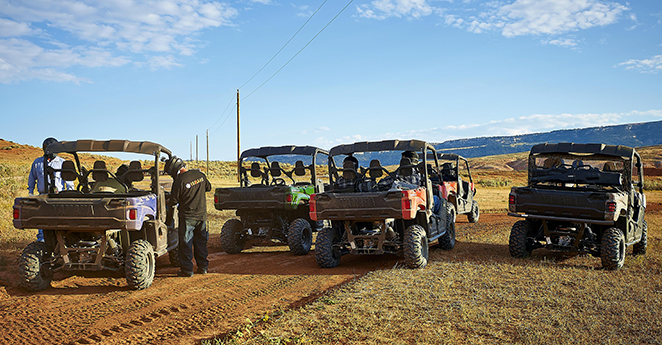 odometer, a dual trip meter, hour meter, 4WD status, transmission position, clock and fuel gauge. The dash-mounted shifter offers five positions (park, low, high, neutral, reverse). The dash-mounted ignition switch and parking brake lie immediately to the right of the steering column. With the gear selector in the high/low positions, the ignition can be turned off and the engine restarted, so long as the foot brake is depressed. This function permits the operator to return to the exact power train configuration the vehicle was in when the unit was shut down. When the gear selector is in the neutral position the engine can be started without depressing the foot brake. The fuel tank holds a hair less than 10 gallons.
To the left of the steering column is the large dash-mounted 2WD/4WD/4WD diff lock control. Functionally, this large selector knob eliminates the challenge of making selections while wearing gloves. Yamaha foregoes a 4WD system where the front wheels engage after slippage is sensed at the rear wheels. Instead, when the 4WD mode is selected, an instantaneous and permanent mechanical engagement of all four wheels occurs. This comes into play, for instance, when loading the vehicle onto a truck or trailer. With a sensor-type system, the nano-second it takes the front wheels to sense rear-wheel slippage (the triggering event for engaging all four wheels) can potentially cause loading ramps to be thrust to the side or rear, away from where they need to be to get the unit loaded (not a good thing).
Yamaha recommends coming to a complete stop before switching between 2WD and 4WD. When changing the selection on the shift lever from high to low or back, the unit must also be at a full stop. The independent four-wheel suspension features 8.1 inches of travel on each wheel. Undercarriage clearance is a lofty 11.8 inches.
Dog-leg-shaped composite doors are taller in front where they are hinged to permit easy ingress/egress. A composite sun roof attached to the roll bar is standard equipment on most models. An optional see-through composite wind deflector spans the A-pillars just above the dash and is a welcome feature on cool mornings. A full windshield made with the same translucent, chip- and scratch-resistant composite material can be added.
Below the operator’s seat three options can be added. One is an auxiliary battery that powers optional electrical equipment without draining the main battery. A water-resistant cargo box stores things like handheld electronics. And for those who value superior stereo sound, an optional waterproof woofer can augment the optional in-cab sound system.
A unit-wide, continuous steel sheet underbelly skid plate prevents damage should high centering occur on an obstacle. Steel wheels and Maxxis Big Horn 2.0 tires were designed with maximum performance and durability specifically and exclusively for the Viking.The Viking is available in three colors (red, blue, green) and in an upgraded Realtree camo treatment. Options for hunters total more than a hundred and include gun boots, storage boxes, and additional luggage and protection accessories.
Yamaha Viking
Drivetrain: 686cc, single-cylinder, four-valve, SOHC, fuel-injected, water-cooled engine; CVT w/high, low, neutral, reverse, park, engine braking; On-Command 4WD w/3-way locking differential; shaft drive
Suspension: independent double-wishbone w/8.1" travel front and rear
Brakes: dual hydraulic discs front and rear
Dimensions/Capacities: length 122"; width 61.8"; height 74.1"; wheelbase 84.1"; ground clearance 11.8"; fuel capacity 9.7 gals.; bed capacity 600 lbs.; towing capacity 1,500 lbs.
MSRP: $12,599-$13,349