During my scout camp days, my older brother, who was an avid backpacker and trail guide at the time, loaned me his bright orange plastic Coghlan's trowel for digging a rain trench around my tent. He said it was a good addition to my kit because it would come in handy and it only weighed 2 ounces. Compared to my Mom's steel garden trowel, this little plastic version proved to be a challenge to work with. It probably took me two or three times longer to dig the trench than if I had used a 'real' trowel. Nevertheless, half a dozen other kids on the trip asked to borrow it since they didn't have a similar tool to use.
This experience came to mind while working on this write up, because when it comes to hiking, camping or backpacking long distances, outdoor enthusiasts regularly sacrifice comfort and convenience in favor of reduced weight and greater portability. The tiny gas stoves, Swiss Army knives and folding trenching tools that we would be unlikely to use at home become indispensable on the trails.
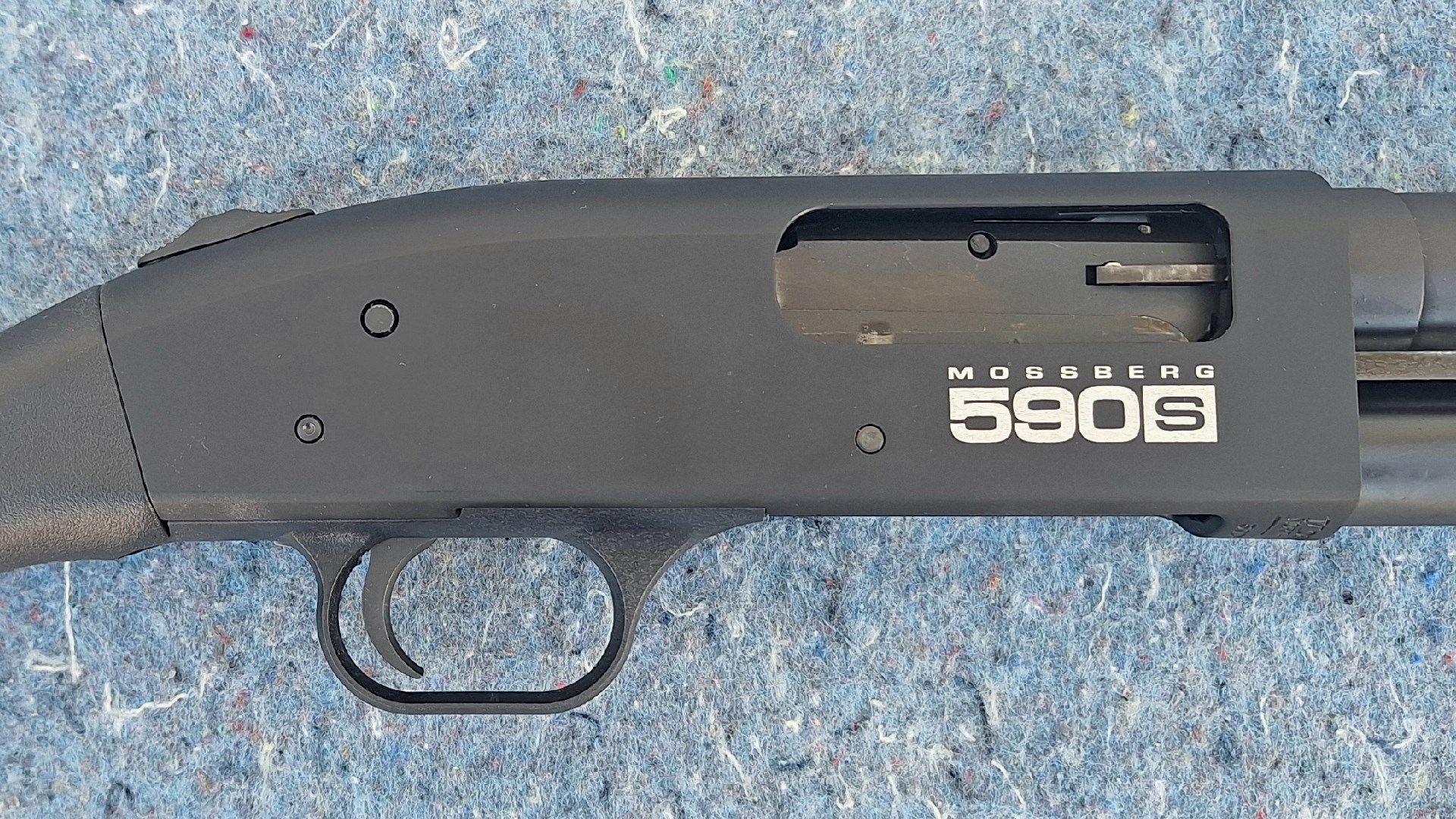 The Mossberg Shockwave pump-actions made non-NFA firearms mainstream.
But does this trim-it-down and lighten-it-up approach to backpacking and camp gear work when applied to defensive long guns? Take the 12-gauge shotgun, for example. It is among the more potent choices for defense against dangerous game. When loaded with slugs or buckshot, they are among the most effective stoppers at close range.
But just how much of a shotgun can you trim away and still have a viable defensive option in the great outdoors? And what about the ammunition? How much smaller or lighter can shells be and still get the job done? These are the questions I wanted to explore. Let's start with the shotgun.
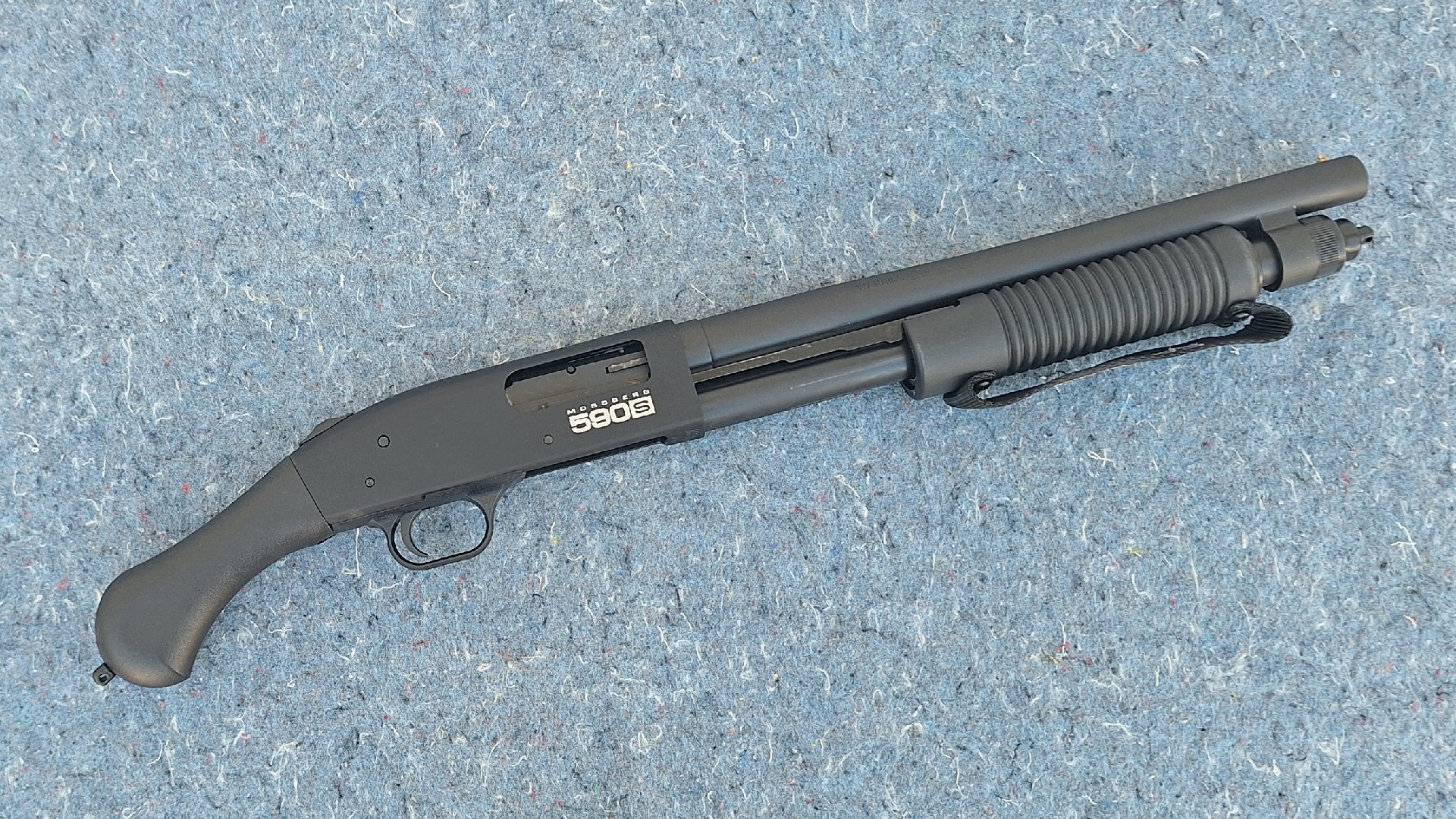 The 590S series has been modified to reliably feed mini shells along with more typical 12-gauge shell sizes.
For many years, packing a smaller shotgun was an inconvenient proposition due to NFA regulations, especially if you wanted to modify a sporting shotgun you already had on hand. Cropping a 12-gauge barrel still requires an elaborate registration process with the ATF, a $200 tax stamp and verification of compliance with local and state regulations. Add that to the time and expense of the required engraving and gunsmithing. Overall, it was much less complicated to obtain an 18.5-inch barrel security shotgun and make the most if it.
Riding the Shockwave
But the commercial compact shotgun scene changed in 2017 with Mossberg's introduction of the Shockwave series of non-NFA firearms. These 12-gauge pumps sport a noticeably shorter 14-inch barrel along with a factory installed birdshead grip for an overall length of 26 inches or more. These features allow the Shockwaves to qualify as 'Firearms' under NFA regulations. They can be purchased over the counter, just like other pump-actions, without the extra paperwork.
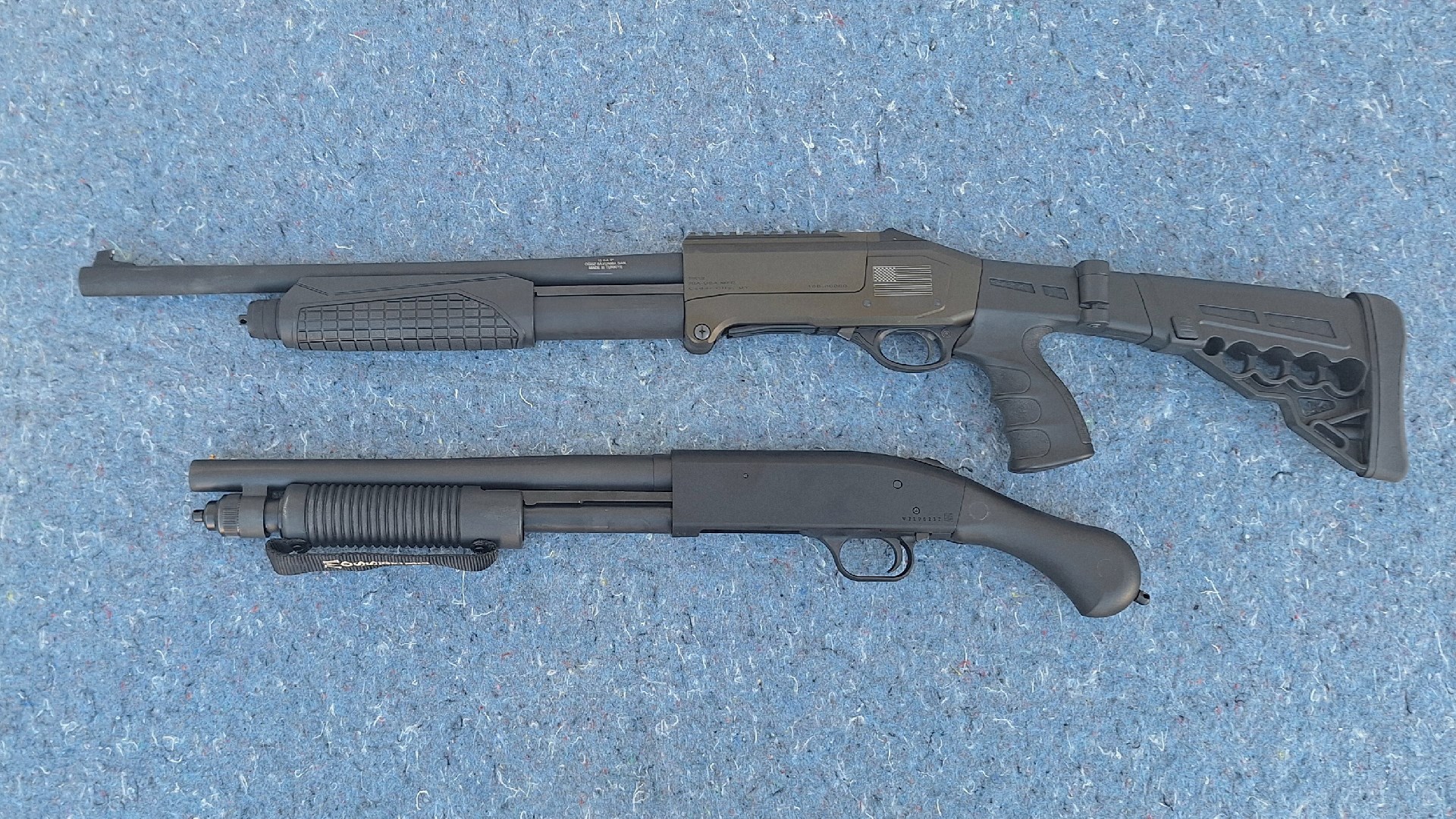 The 590S Shockwave (Bottom) compared to RIA's PAK-OUT folding 12-gauge.
The pump-action Shockwaves are now available in several configurations along with a recently added semi-automatic 990 Aftershock. With the success of the Mossberg offerings it should come as no surprise that other manufacturers hopped on the non-NFA train with their own versions, including the Chiappa Honcho, the Henry Axe and the Remington Tac-14, to name just a few.
--- 005_590FMS_L_Grip_01 The polymer birdshead grip shape extends the gun's overall length in order to meet the 26-inch minimum requirement.
As I looked over the field of options for this particular evaluation, I was drawn back to the Mossberg 590S Shockwave that I first had a chance to work with back in 2021 (see that review here). The 590S series is unique among the non-NFA crowd because the action has been re-designed to reliably cycle three sizes of 12-gauge shells, including 3-inch, 2.75-inch and 1.75-inch mini shells. You can even mix and match shell sizes inside the magazine tube without the need for any added accessories or external adjustments to the gun. That brings us to the ammunition.
Do Mini Shells Get Short Shrift?
Without a doubt the 1.75-inch mini shells are the smallest 12-gauge options available, which makes them an attractive option from a backpacking perspective. Not only do they take up less room in storage pockets but you can fit more of them into the magazine. The Mossberg 590S has a capacity of 4+1 when loaded with 3-inch shells and room for one more round when using the 2.75-inch shells. But when it is loaded up with mini shells, it holds 8+1 shots, or nearly double the round count of the 3-inch shells.
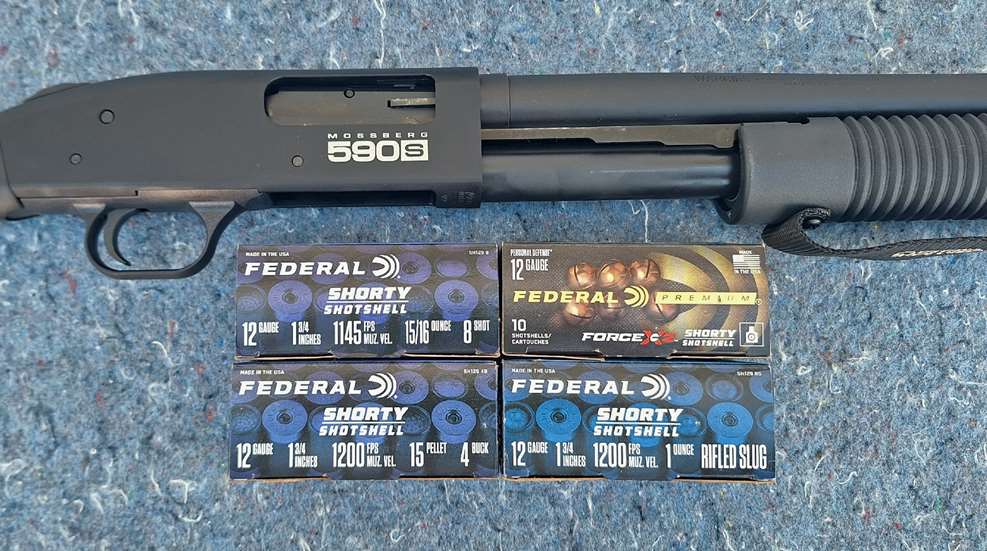
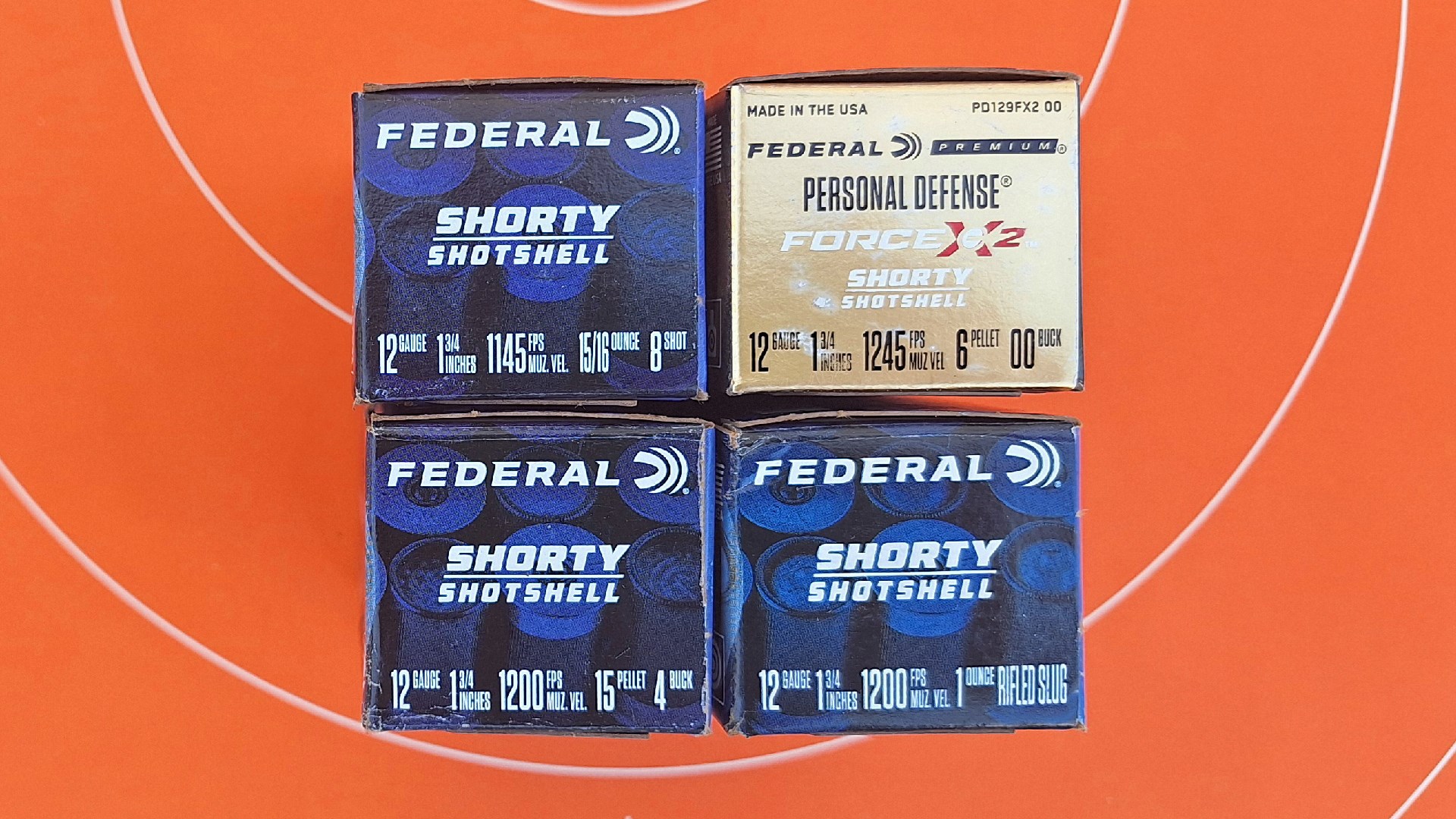
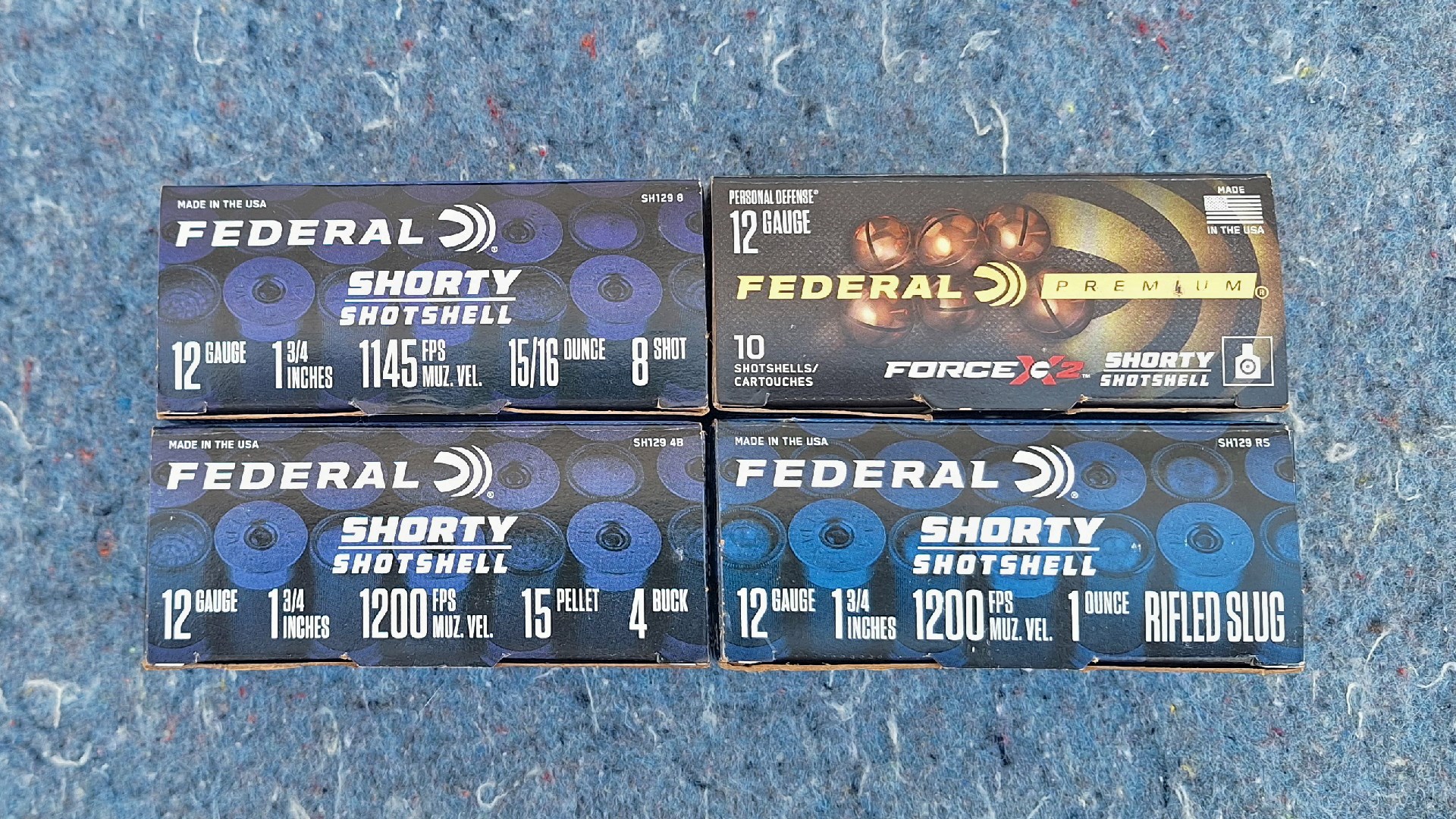 Federal Premium Ammunition offers four Shorty Shell loads.
But the trade-offs for the smaller shell size include lighter payloads and more moderate velocities. These two factors reduce levels of felt recoil, which can be a bonus with the fairly rambunctious Shockwave. But do you still have enough performance for dangerous game?
Although you can find a variety of mini shells that are imported or sold by boutique manufacturers, the most consistent, reliable and readily available shells that I've worked with have been members of the Shorty series from Federal Premium Ammunition. As of this writing, Federal's line-up consists of four options, including two buckshot shells along with a slug and a birdshot load. Let's take a look at how they performed.
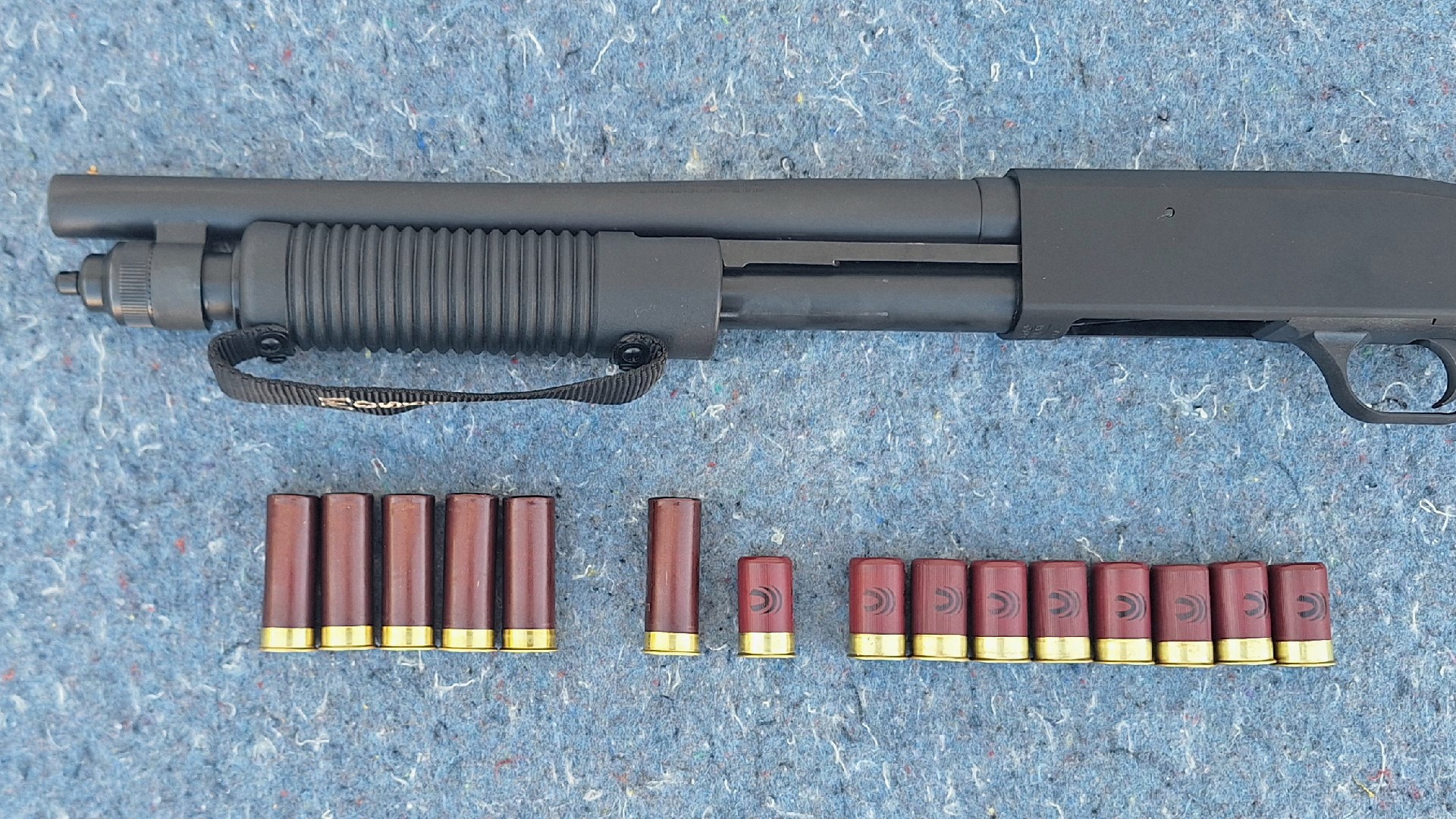 This model can be loaded with 5+1 rounds of 2.75-inch shells or 8+1 mini shells.
At the Range
The Federal Shorty Shell pattern tests consisted of firing individual rounds into Action Target Law Enforcement 23" x 35" B-27E Silhouettes posted at a distance of 7-yards. Some of the targets exhibited patterns up higher, around the top of the 9-ring, rather than the X at the center of the bullseye. That's most likely on me. I tend to bring the front brass bead up just a bit too much when shooting Shockwaves. The patterns are good and the shot placement is still viable, but keeping the patterns a bit more centered is a part of managing the platform.
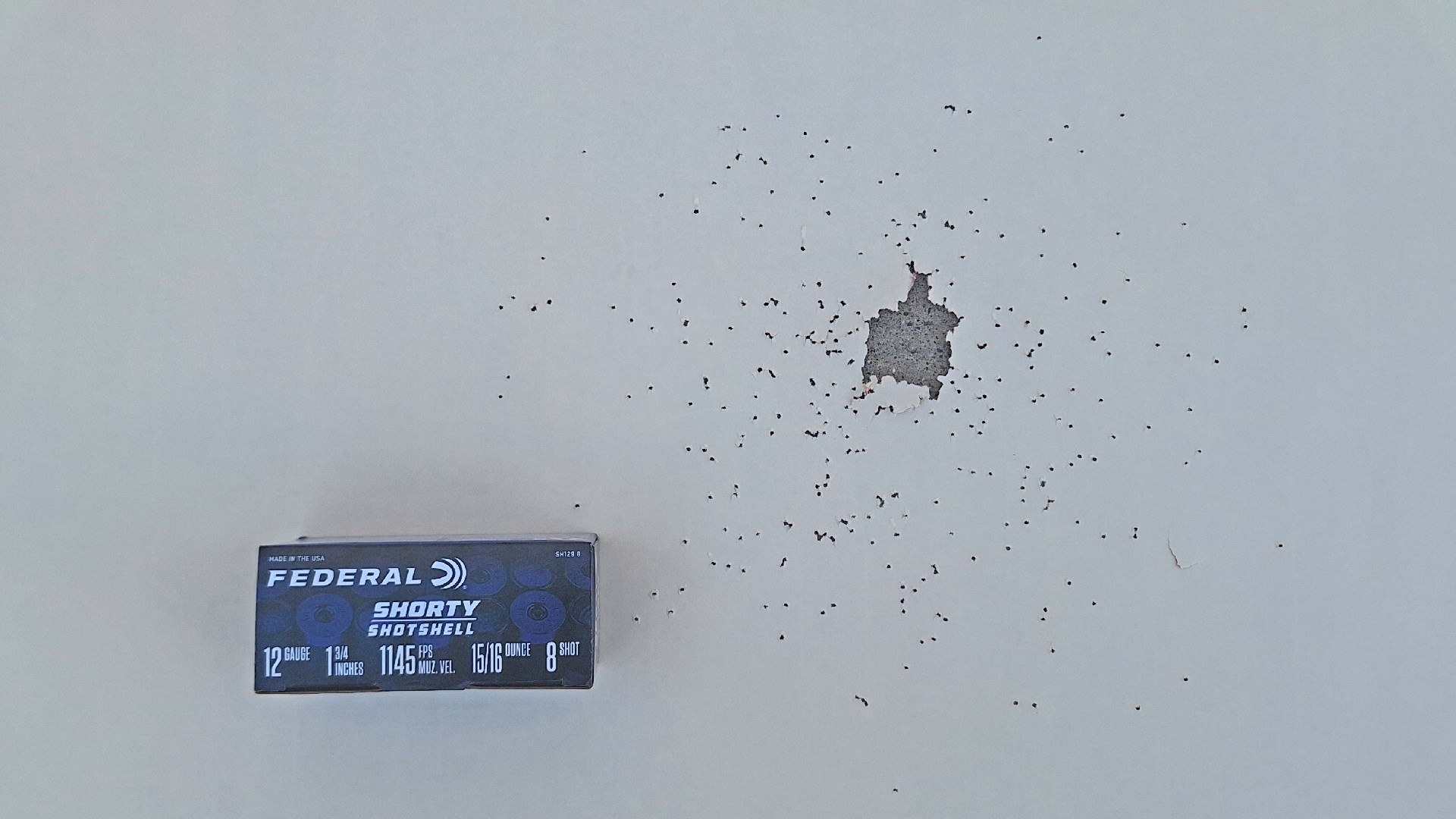
First up was the Federal Shorty birdshot load launching 15/16 of an ounce of #8 lead birdshot at a listed velocity of 1145-fps. This round punched out a tidy pattern of 11-inches. The ragged hole in the center was caused by the wad passing through the target. Recoil with this load was modest and controllable.
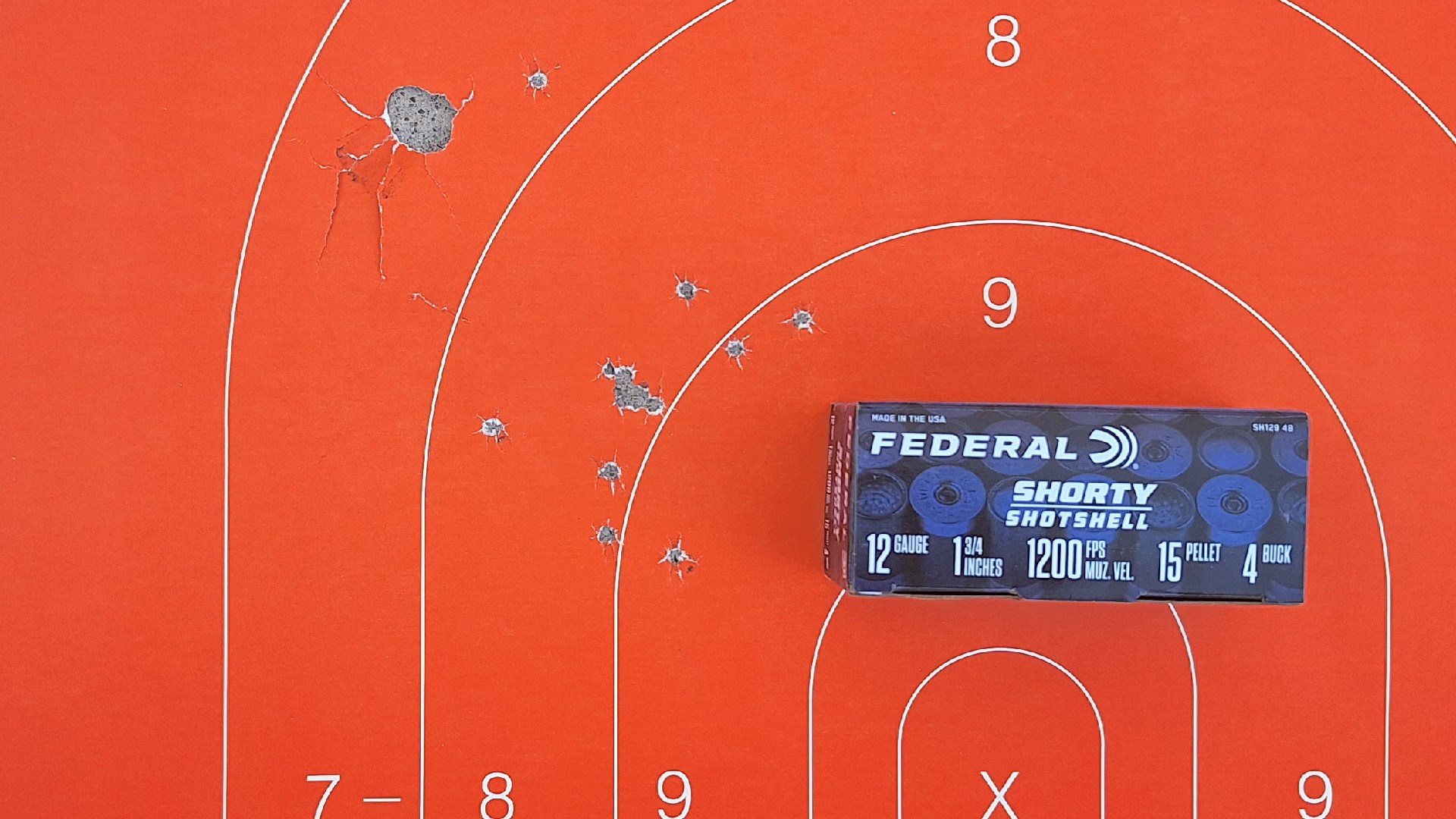
Next up was the Shorty #4 buckshot load. It is topped off with 15 lead pellets that are .24-caliber in size, weighing roughly 20.7-grains each, launching at a listed velocity of 1200-fps. In this case, seven pellets formed a ragged hole with seven more forming a 3.75-inch group around it. The 15th pellet was a flyer that passed through close to the wad and opened up the pattern to 5.25-inches. Recoil increased with this load but was still on the softer side of the low-recoil buckshot rounds.
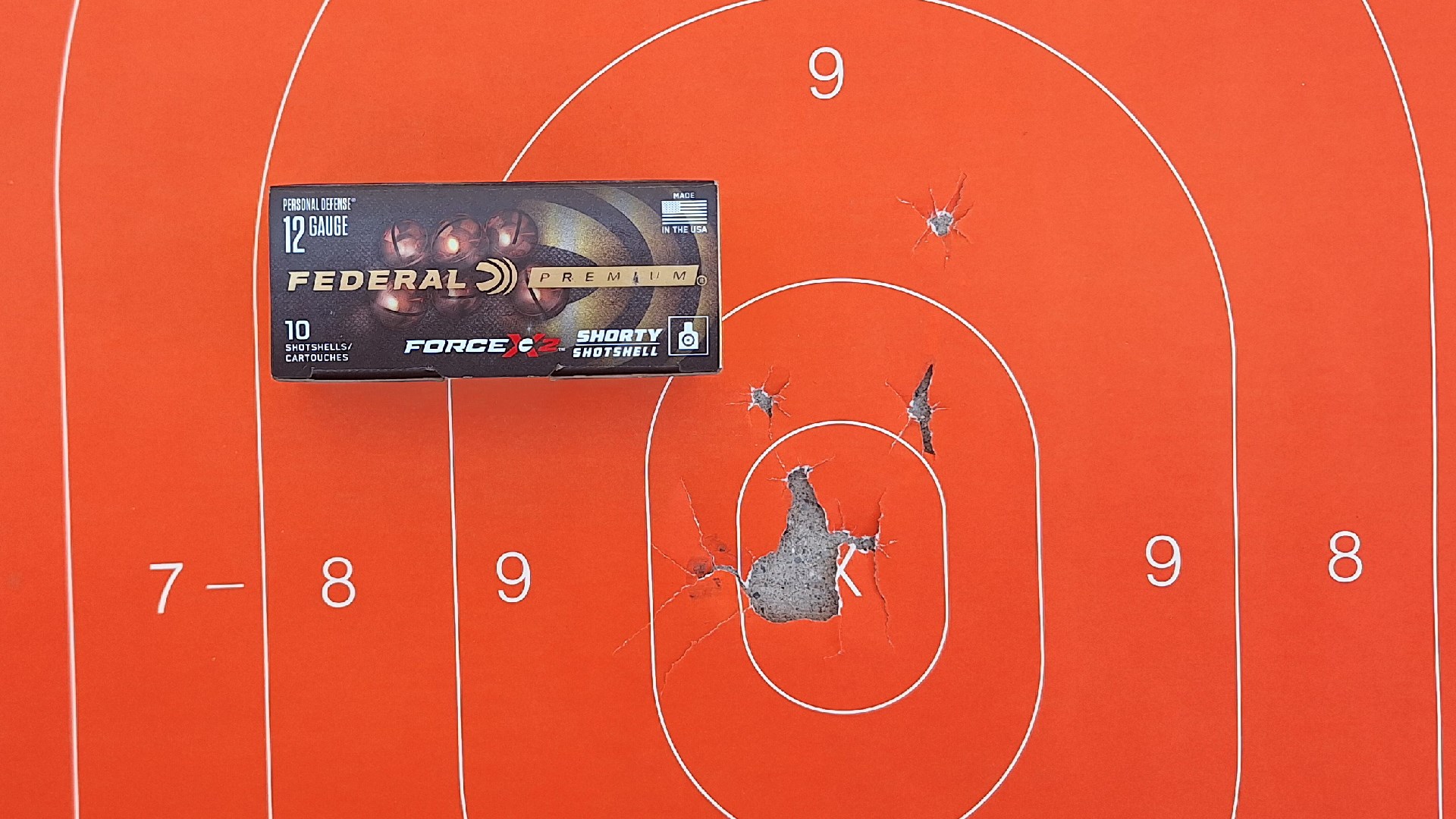
Federal offers their Force X2 buckshot in a Shorty configuration. The 00-size copper-plated lead pellets are cut most of the way through so that when they strike a soft target they split apart to form two wound channels instead of just one per pellet. Packed with half a dozen pellets, the Force X2 Shorty fires its payload at a listed velocity of 1145-fps. The wad passed through the target along with half of the pellets resulting in a pattern that is about 4.75-inches in size when measured side-to-side. Recoil was similar to that of the #4 buckshot.
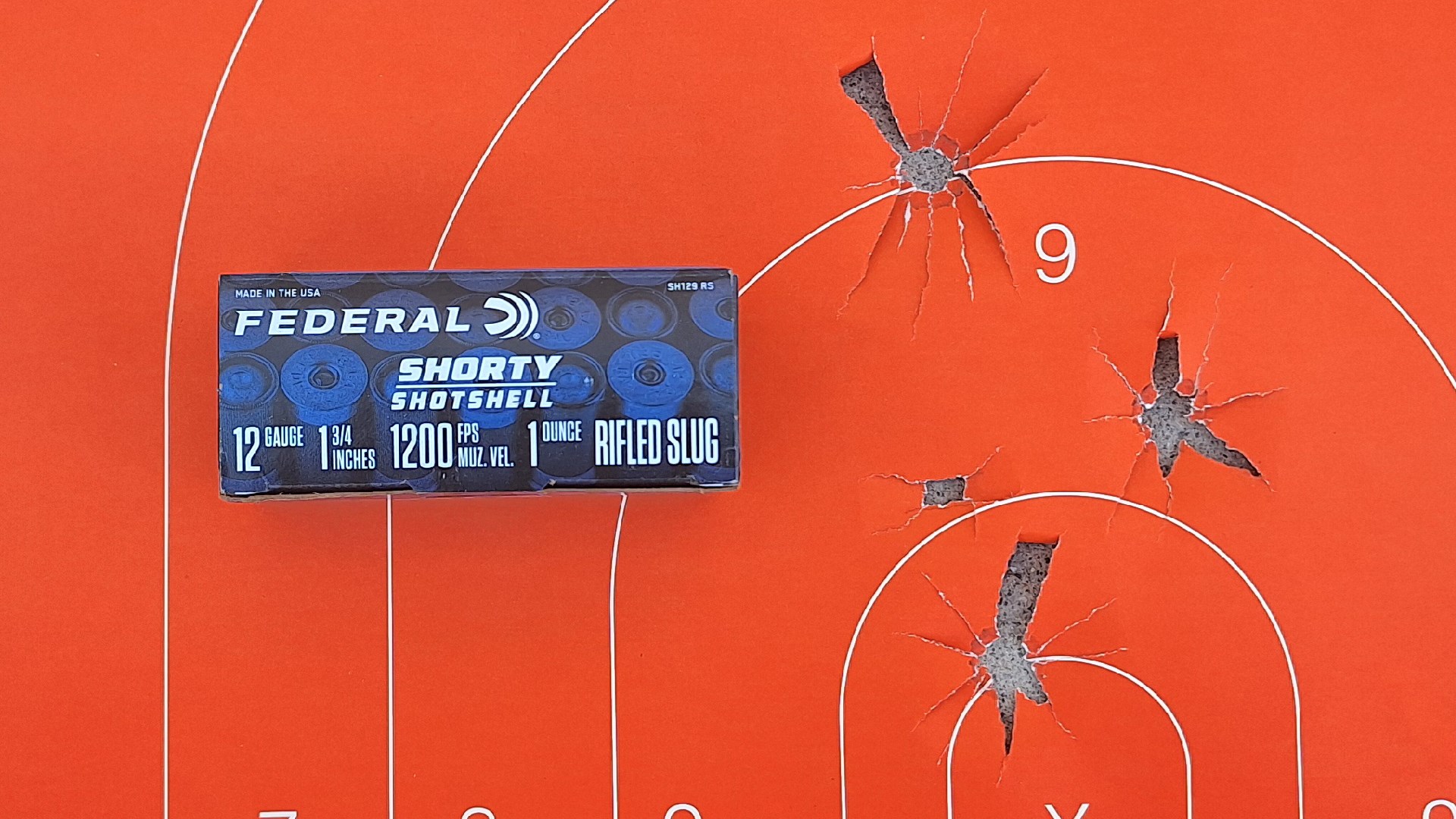
Last, but not least, the test set was rounded out with the Shorty 1-ounce rifled lead slug with a listed velocity of 1200-fps for a muzzle energy of 1401 ft.-lbs. This is the one Shorty load with a kick on par with the 2.75-inch low-recoil slugs. It was a handful! The 3-shot group shown here is 5 inches in size. The first round hit the top of the X ring while the other two slugs rode up into the bottom and top of the 9 ring, which was more of a recoil management issue than one of accuracy potential. All three shots were still viable hits, but it was a good reminder to keep that front bead pressed down.
Shockwave & Shorty Shell Testing Takeaway
Based on my experience with a variety of defensive firearms over the years, the Mossberg 590S Shockwave, and other non-NFA models like it, are essentially the pocket pistols of the shotgun world. Their compact dimensions makes them impressively portable and quick handling. But just like snubby revolvers and single-stack micro nines, they are harder to shoot and have a shorter effective range. Neither the Shockwaves nor pocket pistols are un-shootable, but you have to put in the sweat equity at the shooting range to learn how to handle them properly.
As for the Shorty Shells, they can have a place at the outdoor table depending on how they are used. The birdshot load, fired from a cylinder-bore 14-inch barrel, yielded an effective pattern for close-range applications, like pest control. But don't plan on harvesting any high-flying waterfowl with this gun and ammunition combination! Low recoil 1-ounce rifled slugs tend to launch at listed velocities between 1,100 to 1,350-fps. The Shorty slug is listed at 1,200-fps, which is dead center of the low-recoil range. It should get the slug job done if the shooter manages the non-NFA firearm properly.
However, the usefulness of mini buckshot loads is limited in regards to protection against dangerous game. Standard and magnum-power #4 and 00 buckshot rounds have a well deserved reputation for being effective close-range fight stoppers for threats of the four-legged and two-legged varieties. But the mini buckshot shells hold fewer pellets traveling at lower velocities. Overall, it would be inaccurate to call mini buckshot loads ineffective per se. A more representative evaluation is to say that they are highly specialized for at-home defense.
As for use on the trail, the mini-buckshot options simply do not provide the same deep, terminal penetration necessary for heavily muscled, thick-skinned critters like bears, as their 2.75-inch and 3-inch compatriots. In some bear-free regions, folks may be able to squeak by with a mini buckshot load. They may be enough for small-to-medium predators at up-close and personal distances. But in most cases, a standard-size buckshot load, even though it kicks more, would be the better all-around choice on the trail.
Hopefully this information is helpful if you are in the market for a 12-gauge trail gun. If, however, a Shockwave-style pump stoked with mini shells is not quite what you have in mind, other portable shotgun options are available. Here are a few more reviews to consider:
- Rock Island Armory PK-12 Pak-Out
- Utility .410-Bore Roundup
- 3 Handy Guns For Your Trunk
- ATI RUKX/Nomad Shotgun Combo
Specifications:
- Manufacturer: O.F. Mossberg & Sons
- Model: 590S Shockwave (51601)
- Action: Pump Action
- Caliber: 12-gauge 3”, 2 ¾” and 1 ¾” Shells
- Barrel: 14" Heavy-Walled Smooth Bore, Matte Blue Steel
- Choke: Fixed Cylinder Bore (0.729”)
- Receiver: Hard Anodized Aluminum, Drilled & Tapped for Scope Mounts
- Stocks: black polymer
- Sight: brass-bead front
- Overall Length: 26.32"
- Trigger Pull: 6-pounds 15-ounces
- Weight: 5 lbs. 5 ozs. unloaded
- Capacity: 3" Shells = 4+1, 2 ¾” Shells = 5+1, 1 ¾” Shells 8+1
- Accessories: lock, owner's manual
- Suggested Retail: $700