By Jim Winjum, Bozeman, Mont.
I’m an avid hunter from Montana. Hunting is the focal point of both my professional and recreational life. In fact, for more than 25 years, I’ve been in the hunting footwear busines. I even started my own boot company, Kenetrek, to build boots for hunters, designed by hunters.
I’d applied for a special bow hunt in one of Nevada’s most coveted areas, and after eight years of waiting, the tag came through. My friend Thomas Brunson, of Timberline Guide Service, had talked about finding a 200-inch mule deer near his native Ely, Nev., so off I went.
After an almost sleepless night of gearing up, we set off up a ridge Thomas had been looking at for a few weeks. On the way up, I encountered the series of draws I would eventually get to know intimately, and I began slowly easing over and through each one, glassing the basins below me.
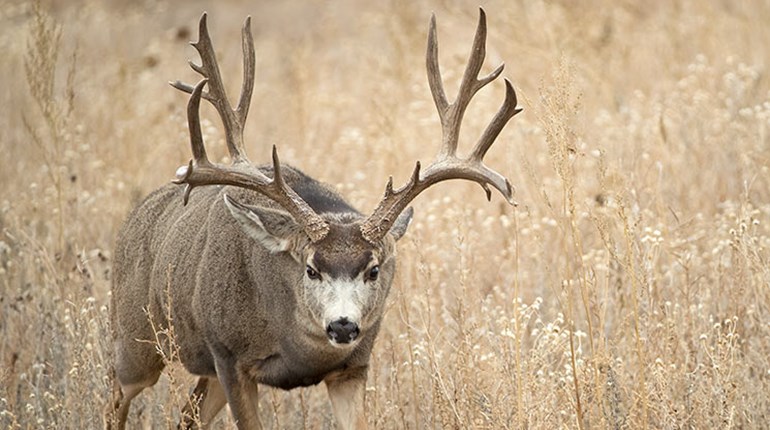
I inched my way over the crest of the third basin, and below stood six bucks surrounding a huge seventh one that appeared to sport a 9x7 rack, which would make it the largest deer I had ever seen. I immediately named the deer the “Crown Buck.”
Lying prone on the apex of the ridge, with the warm, high-desert wind blowing from my back straight down the draw where the Crown Buck was feeding, I sat and waited. Nothing changed but the fading daylight until it was finally too dark to hunt.
We practically bolted out of camp the next morning, quickly and quietly moving up that same ridge to find an empty draw. The rising temperature limited us to hunting just a couple of hours in the morning and an hour in the evening before dark. We hoped for a late-afternoon thunderstorm to calm things down and get the deer up and moving, but nothing came.
I’ve been hunting long enough to know that bowhunting is about getting inside an animal’s comfort zone—and I don’t know whether it was the crunchy, dry terrain, but these deer were on predator-high alert. When I finally saw a respectable buck, my only chance was to move quietly downwind, using what little I could find for cover. As far as stalking goes, this was about as challenging a hunt as I’d ever experienced.
On the evening of day four, we had some much-needed rain, which thankfully quieted the ground a bit. That’s when we headed back to the ridge where I first saw the Crown Buck. Eagle-eye Thomas then spotted a really good deer bedded under a juniper tree 3 miles away on a different mountain—man, could this guy spot!
We made the trek. As I got closer to where we’d spotted the buck earlier I slowed to an almost crawl, taking several minutes to move only a few feet. I knew I was close. I could feel it. The only question was whether I would spot it before it spotted me. All I could do was move quietly and slowly, using the same cuts that hid the deer to hide myself.
While I inched through the cuts, Thomas watched from above. When I finally spotted the buck, it turned and looked in my direction, but couldn’t make out what I was. I ranged the bush behind it at 60 yards. Only a small sage bush separated us. I estimated my arrow would clear the bush and I could make the shot, so I drew my bow and shot. At the release, the deer jumped, spun and disappeared. I ran up and out of the ravine to try to maintain sight of him and ran smack into two hunters who were stalking him from the other side.
Completely startled by the encounter, I lost sight of the deer. Between not knowing where—or if—my arrow hit, and the fading sunlight, I decided to wait for morning to track him down.
The next morning we found him only 100 yards or so from where he had stood. The shot had been fatal within seconds. The giant buck was even bigger than the Crown Buck. He had seven points on each side and measured 214 inches. He had really worn, 10-year-old teeth, and I could barely get my hands around his gigantic bases. He was unbelievable.
What a wondrous experience to stalk and harvest such a magnificent animal with my bow. My thanks to Thomas Brunson and the entire crew at Timberline Outfitters.