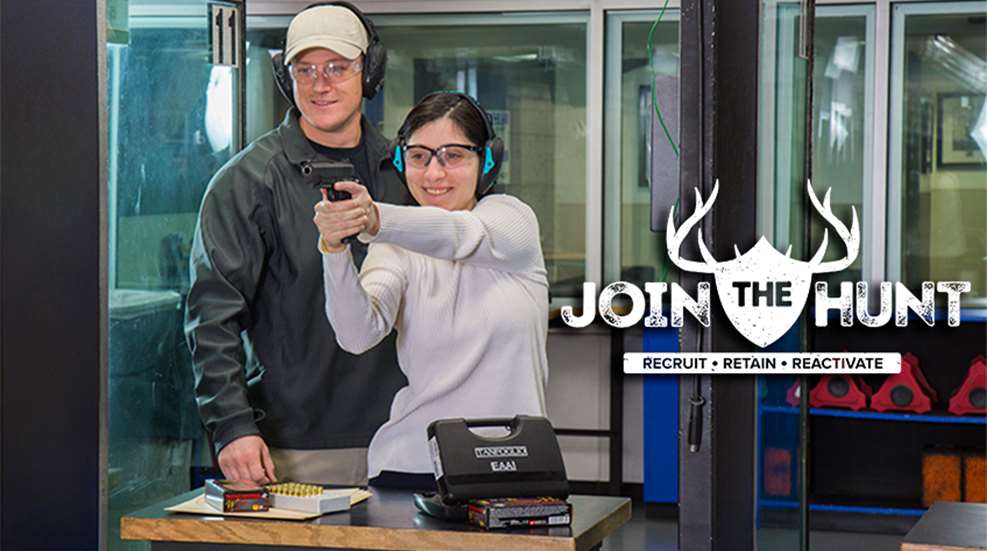
Several years ago a buddy asked me to teach a couple of Dutch journalists to shoot: “Not a full-blown class,” he said—“they just want to shoot some pistols. Neither of them has ever shot a pistol.”
I could do that. I knew exactly how to structure what I call a “familiarization fire”—what in the Marine Corps we called a “fam fire.”
At the range, first I revealed a Ruger Mark III .22 LR, which I like to hand students first when teaching the NRA Basic Pistol Course. The rimfire pistol wears a heavy barrel so it settles on target nicely. Its open sights force students to focus on sight alignment and sight picture. The low-power loads it shoots don’t scare anyone when the gun goes pop, pop, pop, making it easy for students to focus on grip and marksmanship.
We moved up to a 9mm Browning Hi Power and a .45 ACP Springfield 1911—and then I pulled out a couple of conversation starters.
“This is a Walther PPK⁄S,” I said. “It’s a .380, a small 9mm cartridge. You know James Bond? This is what James Bond carries. It’s small, easy to fire, easy to wear, easy to hide—exactly why James Bond would carry it.”
After both men burned through a couple of magazines in the spy’s gun, I pulled out the big gun.
“Remember Dirty Harry?” I asked. “This is the kind of gun Clint Eastwood carried in all the ‘Dirty Harry’ movies, a .44 Remington Magnum revolver. It kicks a lot,” I explained.
When it came time for each man to select which of the five guns he would like to shoot again, the requests were predictable. The big fellow said, “I would like to shoot the Dirty Harry” and the small fellow said, “I like the James Bond.”
You know you’ve done something right when you hear comments like that. This time of year, many of us are asked to conduct “fam fires” for family and friends. The sessions can go one of two ways: Experienced shooters like us can sneakily hand a newbie a “ringer,” a big gun a new shooter has no business handling; or we can be gracious and introduce someone the right way. Here’s how to avoid the former and aim for the latter.
Think safety. By all means explain the three “always”: Always keep the muzzle pointed in a safe direction; always keep your finger off the trigger until ready to fire; always keep the gun unloaded until ready to use. Explain why each of these rules is mutually supportive, how one might fail to regard two but if at least one rule is adhered to no harm will come to anyone if, indeed, an accidental discharge occurs.
Explain the primary reasons accidents happen: either through ignorance or carelessness. That is, an accidental discharge is most apt to be attributed to the inexperience of a new shooter or to complacency that may arise in a seasoned shooter.
There are other rules, of course, and they should be shared. Point out the range’s left and right parameters, the targets and how they are back-stopped, the firing line and why we don’t cross it when the range is hot, and range commands likely to be heard. But don’t overload your pupil with regulations.
Make it fun. There is serious knowledge to be imparted when handling firearms, but you must remember the primary reason this person is interested in shooting is because it seems fun. So plan a fun event.
Stay away from the tactical crowd. Do not take a newbie to a public range filled with firepower, where on the right “Johnny SWAT Team” rips through 30-round mags and on the left “Johnny Tacticool” sends hot .45 brass down your student’s collar. Visit a public range when it’s least busy then pick a stall at the end of the line where it’s quieter so you may better control your student’s experience. Fewer eyeballs are less intimidating, too. No one ever felt comfortable doing anything the first time before a gaggle of onlookers. Better yet, find a private range if possible.
Keep in mind paper targets don’t “talk back” to the shooter. A newbie is apt to get bored when he can’t punch the 10-ring regularly. Where feasible downrange, place interactive targets: steel spinners and poppers, clay birds, jugs of water.
Throw a muzzleloader into the mix. Loading and firing a muzzleloader exposes a new shooter to the “secrets” inside a cartridge case: the powder, projectile and primer. We pour the powder, ram the bullet down the barrel then prime the lock. We squeeze the trigger—the gun goes boom, there is fire, a lot of smoke and a distinctive whap as the bullet slaps the target. It’s all instructive. And it is perhaps the most fun any man-boy can have short of shooting 500 rounds somebody else pays for.
Aim small. You may carry a small handful of guns to the range, but never more than that. Conversely, you may choose to carry only one gun to the range. It all depends on your goals. Regardless, keep it simple. Of course you want your student to be successful, to take home a target with the 10-ring knocked out. But don’t expect it to happen. Success may be measured many ways.
After I explain how to hold and operate a firearm, I like to stress the acronym I learned in the Marine Corps: BRASSF—breathe, relax, aim, stop, squeeze and follow through is what we should do every time we fire a gun. Still, those six steps are a lot to remember, so with first-timers I usually boil it down to focus, breathe, squeeze. Place targets close to build confidence in marksmanship. This is not the time to show off your long-range skills or to teach someone a tactical reload.
Make it memorable. The James Bond-Dirty Harry scenario outlined above is a good attention getter for fans of pop culture but of course it can be performed only if you own certain guns. What scenario will your gun collection support?
Perhaps you can add some history. With four rifles I own—an ’03 Springfield, ’98 Mauser, Springfield SOCOM 16 (essentially an M14) and AR-15 (essentially an M16 without the selector switch)—I can imbue a session with some history of World War I, World War II, the Korean War, the Vietnam War and beyond. (I know, I need an M1 Garand.)
Setups like this help instructors mix it up. They help us cement the important things like safety, handling and marksmanship with little asides from outside the realm of firearms—they help us inform while entertaining.
Imagine your pupil telling someone, “It was a blast. I shot the same rifle the Marines used on Guadalcanal.” Then imagine repeat customers.