I have attended every ATA (Archery Trade Association) trade show in the organization’s history. At each show, I spend almost an entire day making my way around the perimeter of the exhibit hall. This is where the shooting lanes are located and where you can step up and test drive most of the major manufacturer’s new bows.
After all this time, I can tell you that, without a doubt, there are few inadequate compound hunting bows on today’s market. If they’re offered by one of the major bowmakers, the chances are extremely good they’re winners. What that means for bowhunters is that, unlike the old days when you really did have to sort the wheat from the chaff, today buying a new bow is more a matter of shooting as many as you can and seeing which one you like best.
“You really will have a hard time going wrong choosing any of the major manufacturer’s best compound bows,” said Rob Kaufold, President of Lancaster Archery, one of the country’s largest archery distributors, and a former competitor on U.S. national archery teams. “The key is finding the one that, when you pick it up and shoot it, just says ‘Take me home.’ After that, though, it is all about selecting the right accessories, using arrows of the proper spine, setting it up right, and tuning it properly.”
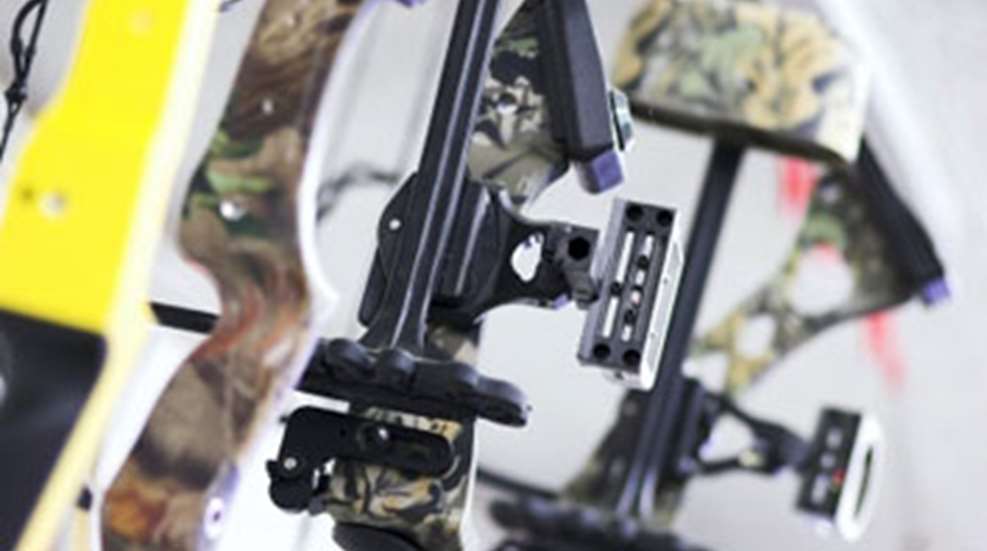
We’ll assume you have that new bow, and that you release your arrows using a release aid, not your fingers, as 95 percent or more of all bowhunters do today. The next thing you need to do is select the right accessories, including arrow rest, bow sight, peep sight, bow stabilizer, string loop or nock point and bow quiver. This can be somewhat confusing, as all major bowmakers sell accessories under their own brand names (even if they are made by someone else), and there are lots of quality aftermarket choices out there.
Before getting specific, I have found it wise to follow the KISS (Keep It Simple, Stupid) principle. Accessories should do a specific job, and do it with a minimal amount of parts that can rattle loose or break. They need to be able to take abuse in the field and be built to last for many years. I personally select those with a track record of performance. I mean, I love innovation, but when it comes to my hunting rig, I’d just as soon let the other guy work the bugs out for me. Here’s what to look for.
Arrow rest: There are only two choices to consider—drop-away and full capture. The drop-away rest employs launcher arms that cradle the arrow, rise up to the proper height when the bow is drawn back, then “drop away” at the shot quickly enough to be completely out of the way of the fletching before it reaches them, eliminating any chance of accuracy-destroying fletch contact. There are lots of good ones out there that cost between $75-$150—and they’re worth every penny. The full-capture rest uses a system that totally surrounds the shaft with a circle of hard bristles so that the arrow cannot fall off. You then shoot right through the bristles. These rests work well for those who shoot short to medium distance, though over time the bristles will erode slightly, degrading accuracy.
Bow Sight: All top-quality hunting sights today employ some sort of fiber optic sight pin that makes seeing the pin in the dim light of dusk and dawn, when game is moving most, possible. Most bowhunters use sights with three to five pins that can be set at varying distances. The key to a quality hunting sight is to choose one with a minimum of screws and/or bolts, that features a rugged pin guard to protect the fiber optic material, has easy-to-use vertical and horizontal adjustment,and has a bubble level. You can spend anywhere from $40 to $200 for a hunting sight.
Peep Sight: Most all bowhunters use a peep sight, and you should, too. There are two kinds of peeps. The first uses a piece of rubber tubing that stretches when the bow is drawn, pulling the peep into alignment. The other uses no tubing, relying on the peep being centered perfectly between the bowstring strands when the bow is set up. I prefer the latter, as they are quieter at the shot, but both work equally well. You want a peep with an aperture at least quarter-inch in diameter that will allow enough light in during dawn and dusk to make shooting possible.
Stabilizer: Stabilizers aid in both balancing the bow and soaking up vibration at the shot, which helps quiet things down. Hunting stabilizers can range from as short as 4 inches in length all the way up to a foot long. I prefer those in the 4-to 6-inch range, choosing the shortest one that gives me the right balance.
Nock point: If you are a release shooter you should be shooting with a string loop and not attaching the release directly to the bowstring, as we did in the “old days.” A loop—a short piece of cord tied into a loop above and below where the arrow nock attaches to the bowstring—will make you a much more accurate shooter. Loops can be tricky to tie, so have your local pro shop do it for you and show you how the first time.
Quiver: While there are a lot of bow-attached quivers out there, it’s smart to begin with one from your bow’s manufacturer. If you hunt from a tree stand, you may opt for a detachable quiver, which lets you take it off and hang it in the tree so you can shoot without the quiver on the bow. Many people do it this way, but many more do it the way I do—using a two-piece quiver and leaving it attached to the bow. It doesn’t matter one way or the other. When choosing a quiver, select one that will hold between four and six arrows.