There is something almost magical about big-bore lever guns; to me they represent big-game hunting at close quarters. The fluid motion of the action and those huge, rimmed, brass cases make for some formidable medicine for the largest bears, bison and cervids. The Marlins, Winchester, Brownings and Henrys all handle those big-bore cartridges well, and among them the .444 Marlin and .45-70 Government are a pair of undeniable classics.
My late Godfather – Oren “Mick” DeCheck, my maternal great-uncle—enjoyed a .444 Marlin as his deer/bear rifle, and my Dad—Ol’ Grumpy Pants—still reaches for his Browning 1886 centennial .45-70 Government, so both of these cartridges played a role in my shooting world. Both are suitable for nearly any big-game animal, save the African dangerous heavyweights, and both have fervent, passionate followers. Let’s look at the similarities, differences and applications of each.
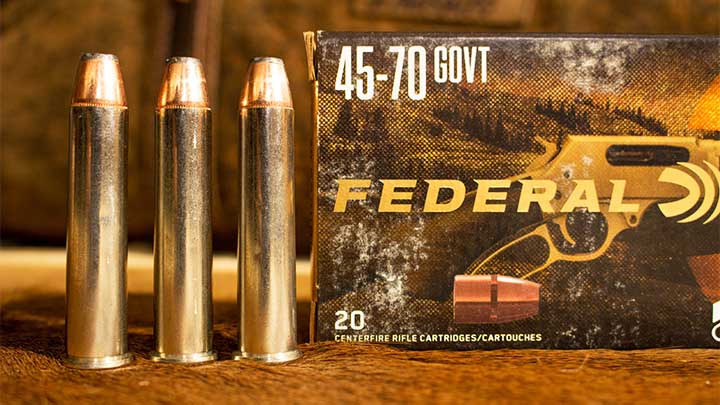
The .45-70 Government is definitely the older of the two, having been released in 1873 in the famous Trapdoor Springfield. The U.S. Army adopted the new cartridge, which replaced the .50-70 cartridge it employed in 1866. Formally known as the .45-70-405—relating caliber-powder charge-bullet weight specifications—the cartridge was commercially known as the .45-70 Government, and that 405-grain lead bullet travelled at a muzzle velocity of just about 1400 fps, though a heavier 500-grain bullet was soon employed. As the official military long-arm cartridge from 1873 to 1893—when the .30-40 Krag kindled the American love affair with .30-caliber cartridges—the .45-70 Government was used in both shoulder-fired rifles and the Gatling guns, but like so many military cartridges, it also quickly gained a following among sportsman. In the late 19th century, the .45-70 would have been viewed as an average-diameter cartridge, as the ‘small bores’ like the .30-06 and 7x57mm Mauser would take some time to gain ground as the all-around military/hunting bore diameters.
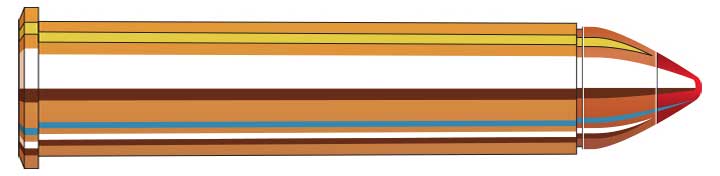
The .45-70 uses a straight-walled, rimmed case measuring 2.105 inches, and maintains an overall length of 2.550 inches. Though certainly designed for black powder, the .45-70 Government survived the transition to smokeless powder, though the chosen firearm will certainly dictate the pressure levels to which the cartridge can be loaded. The old Trapdoor rifles are restricted to a lower pressure level than are the modern, strongly-built lever guns like the Marlin Model 1895 and Winchester Model 1886; though the case may be thin, it can generate impressive numbers in a modern gun. The Buffalo Bore .45-70 “Magnum” load will see the 405-grain jacketed bullet driven to a muzzle velocity of 2000 fps for a muzzle energy of just about 3,600 ft.-lbs.; this is a formidable load in any rifle. The case can also be handloaded to impressive figures in a suitable rifle, and there are some excellent bullets like the Swift A-Frame which will further enhance the performance of this old design, yet the classic cast-lead bullets at low velocities are still fun to shoot.
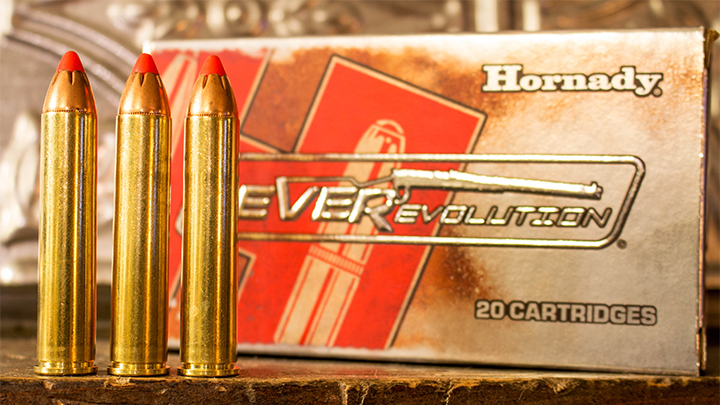
Though the .45-70 Government cartridge has been in production since 1873, there was a time when a new rifle chambered in that cartridge just wasn’t offered. To fill the void, Marlin Firearms teamed up with Remington to develop a cartridge which would see the light of day in 1964: the .444 Marlin. In essence the rimmed .444 Marlin is an elongated .44 Magnum (the case length is 2.225 inches, with an overall length of 2.550 inches), as it uses the same .429-inch diameter bullets as the classic revolver cartridge, albeit at a much higher velocity. The standard load will push a 240-grain .429-inch diameter bullet to 2400 fps for just over 3,000 ft.-lbs. of muzzle energy, and that combo will handle any North American game animal. Heavier bullets are available; they can run as heavy as 335 grains, though the 265- and 280-grain remain the most popular.
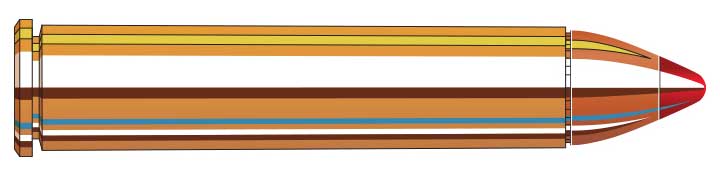
The .444 Marlin was available in a svelte Marlin lever-action rifle—the Model 444—and proved to be a thumper on big game from whitetails to moose and bear, though like the .45-70, the range was limited by the low velocity and bullet profiles. The .444 Marlin has the advantage of using the jacketed and cast bullets for the .44 Magnum, making it a rather flexible design for the handloader. The .444 did have its moment in the sun, and there are still quite a few shooters who quietly enjoy their lever guns each season.
Which of these big cartridges makes the better choice for the prospective lever gun buyer? The decision may now be influenced by availability of both rifles and ammunition, with the breakup of the parent company which owned Marlin (thankfully Marlin has been purchased by Ruger). Looking at the variety of ammunition available for the two, the .45-70 Government has the undeniable advantage in the number of choices, with nearly every manufacturer including the cartridge in their lineup, in some form or another. The .444 Marlin has a smaller frontal diameter, and bullets of equal weight will possess a higher Sectional Density than those .458-inch diameter bullets, and should offer better penetration. The .45-70 Government has quite the bullet range in comparison to the .444 Marlin; bullets will run from 250-grains all the way up to the behemoth 600-grain slugs, with a slew of choices in between.
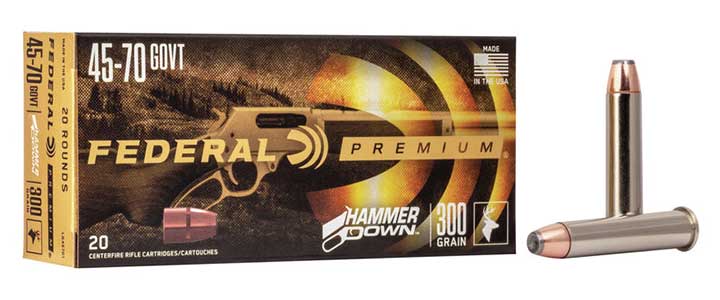
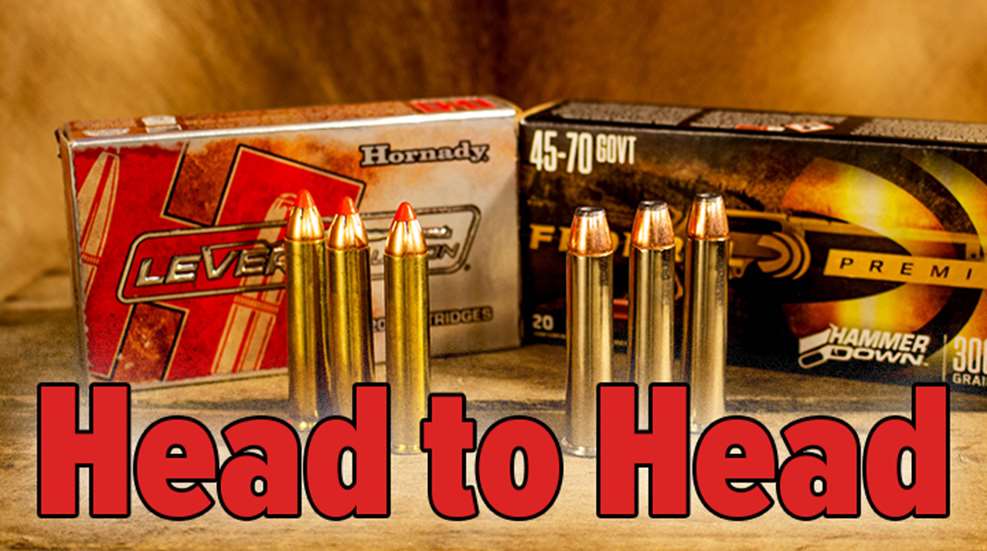
Hornady has included both cartridges in their excellent LeveRevolution line, with the .444 Marlin loaded with a 265-grain FTX bullet at 2325 fps, and the .45-70 Government loaded with a 250-grain FTX at 2025 fps. Looking at this product line, you’ll be inclined to give the nod to the .444 Marlin, especially coupled with the Hornady Superformance load of the 265-grain InterLock at 2400 fps. But in my opinion, the sheer flexibility of the .45-70 Government in both rifles and ammunition gives it a definitive advantage. While I think the .444 Marlin is a sound design, there is such a diversity in the .45-70 Government makes it a logical and abundant choice for the hunter. It has been used for everything from deer to Cape Buffalo, and remains popular among the bear guides to this day. The Winchester 1886 is back in several iterations, the Henry lineup includes the .45-70 and even Marlin saw fit to offer its Model 1895 Guide Gun in .45-70. Like the .44-40 WCF and .45 Colt, the .45-70 Government has been with us since 1873, and shows no sign of fading anytime soon; its roots in the American shooting industry run deep, and I’d bet the affection for the design will extend another century.
Looking for previous installments of our "Head to Head" series? We've got you covered.
• 7x57mm Mauser vs. .280 Remington
• .300 Win. Mag. vs. .300 Wby. Mag.
• .375 Ruger vs. .375 H&H Magnum
• 7mm-08 Remington vs. .280 Remington
• .280 Remington vs. .280 Ackley Improved
• 7mm vs. .30 Caliber
• 6.5 Weatherby RPM vs. 6.5 PRC
• .338 Win. Mag. vs. .340 Wby. Mag.
• .300 RSAUM vs. .300 WSM
• .500 Jeffrey vs. .505 Gibbs
• 7mm RUM vs. .300 RUM
• .308 Winchester vs. 7mm-08 Remington
• 6.5 Creedmoor vs. .260 Remington
• .303 British vs. 8x57 Mauser
• .30-06 Springfield vs. All Other .30s
• .17 HMR vs. .17 WSM
• .450 Nitro Express vs. .470 Nitro Express
• 350 Legend vs. .35 Remington
• .280 Ackley Improved vs. 7mm Rem. Mag.
• .404 Jeffery vs. .416 Rigby
• .243 Winchester vs. 6mm Creedmoor
• .300 PRC vs. .300 Win. Mag.
• .30-06 Springfield vs. .270 Winchester
• 6.5 Creedmoor vs. 7mm-08 Remington
• 8x57 Mauser vs. .318 Westley Richards
• .358 Winchester vs. .350 Remington Magnum
• .22-250 Remington vs. .220 Swift
• .270 Winchester vs. .270 WSM
• .26 Nosler vs. 6.5-300 Weatherby Magnum
• .458 Win. Mag. vs. .458 Lott
• 7mm Rem. Mag. vs. .300 Win. Mag.
• .243 Winchester vs. 6mm Remington
• 7x57mm Mauser vs. 7mm-08 Remington
• .25-06 Remington vs. .257 Weatherby Magnum
• .338 Winchester vs. .375 H&H Magnum
• .30-30 Winchester vs. .35 Remington
• .257 Roberts vs. .250-3000 Savage
• .270 Winchester vs. .280 Remington
• .35 Whelen vs. 9.3x62mm Mauser
• .416 Rigby vs. .416 Remington Magnum
• .308 Winchester vs. .30-06 Springfield
• .22 Nosler vs. .224 Valkyrie
• .300 Win. Mag. vs. .300 WSM
• .223 Remington vs. .22-250 Remington