In the early 1950s, Robert Ruark set off for British East Africa having never killed an animal with a rifle before. His safari battery—a .220 Swift, .30-06 Springfield, .375 H&H and a .470 Nitro Express—was based on the recommendations of friends; he was well advised. While the latter three rifles make up a well-rounded safari battery, it was Bob’s professional hunter—Mr. Harry Selby—who had what would become the most famous rifle of the lot. It was made by Rigby of London on a Mauser 98 action, chambered for a proprietary cartridge: the .416 Rigby.
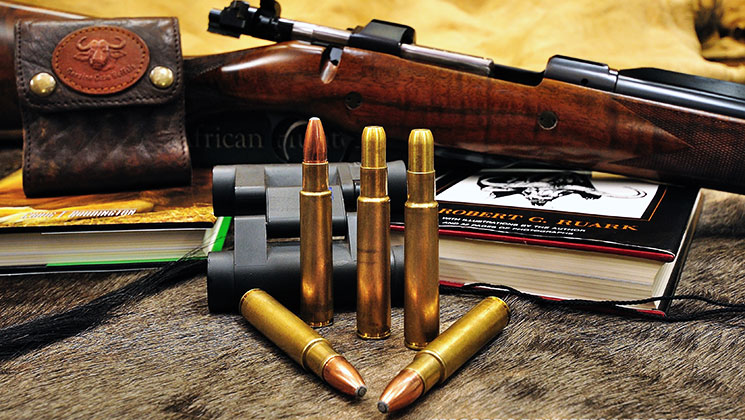
From its release in 1911 until the beginning of WWII, there were less than two hundred .416 Rigbys made, yet it had developed a great reputation among the serious hunters in East Africa. The design of the huge case, with the 45 degree shoulder and its immense girth, points directly at cordite—the common smokeless propellant at the time of the .416’s inception. Being highly temperature sensitive, cordite would generate dangerous pressures in the tropical heat, resulting in cases being stuck in their receivers. When pursuing dangerous game this is never a good thing. So Rigby designed a very large case in order to keep those pressures down. Driving a 410-grain bullet at 2370 fps, it quickly developed a reputation for being a big-game stopper; few hunters who ever used one for any length of time ever had a complaint. While relatively rare, hunters like John ‘Pondoro’ Taylor loved it, and even W.D.M. ‘Karamoja’ Bell ordered more than one. However, at the end of WWII, Kynoch—the major British ammunition manufacturer—was in financial ruin and ammunition became increasingly rare.
The bore diameter refused to fade, with several important developments that aided its relevance. Bob Chatfield-Taylor necked down the belted .458 Winchester case to hold .416″ bullets, resulting in the .416 Taylor, and American professional hunter George Hoffman necked up the .375 H&H case to give us the .416 Hoffman. Both are sound designs, with the Taylor being housed in a .30-06-length action, and the Hoffman requiring a magnum-length action.
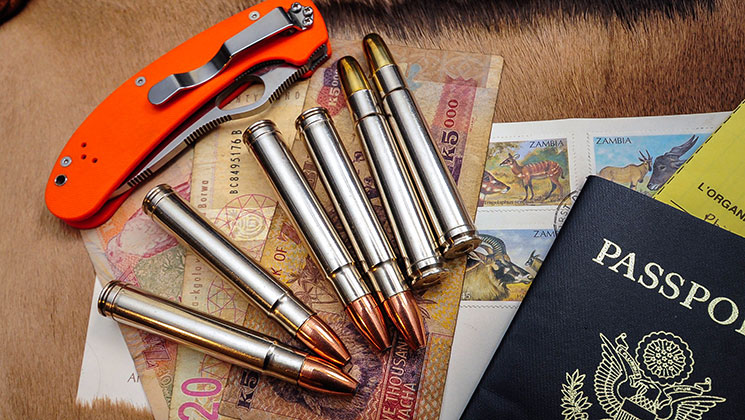
Fast forward to the late 1980s, and we see Remington releasing a very Hoffman-like cartridge: the .416 Remington Magnum. Loosely based on the ailing 8mm Remington Magnum (the 8mm and .416 share the 25 degree shoulder), the .416 Remington adopted the ballistic formula of the later .416 Rigby loads: a 400-grain bullet, at a muzzle velocity of 2400 fps, for 5,000 ft.-lbs. of energy. This came at a price though, in the form of higher chamber pressures. If that didn’t make the shooting world cock an eyebrow, the Model 700 rifle it was chambered in featured a push-feed design (as they all have) and a relatively small extractor. Several instances in truly hot weather—like Zambezi Valley hot—saw some broken extractors and stuck cases, resulting in a hunter holding a club instead of a rifle. I firmly believe those situations arose more from a rifle design problem than from the cartridge. I’ve used the .416 Rem. Mag.—in a controlled round feed Winchester Model 70—in temperatures approaching and exceeding 100˚F and have never had an issue.
Undoubtedly, the Rigby and Remington variants on this bore diameter are the top dogs in this fight, with the .416 Weatherby and .416 Ruger becoming more obscure each year. The .416s fill a definite gap between the very flexible .375s and the heavyweight .458s, giving a best-of-both-worlds solution to the need for a cartridge that will shoot relatively flat, yet have the horsepower to tackle huge beasts at close ranges. So, which .416 do you choose and why?
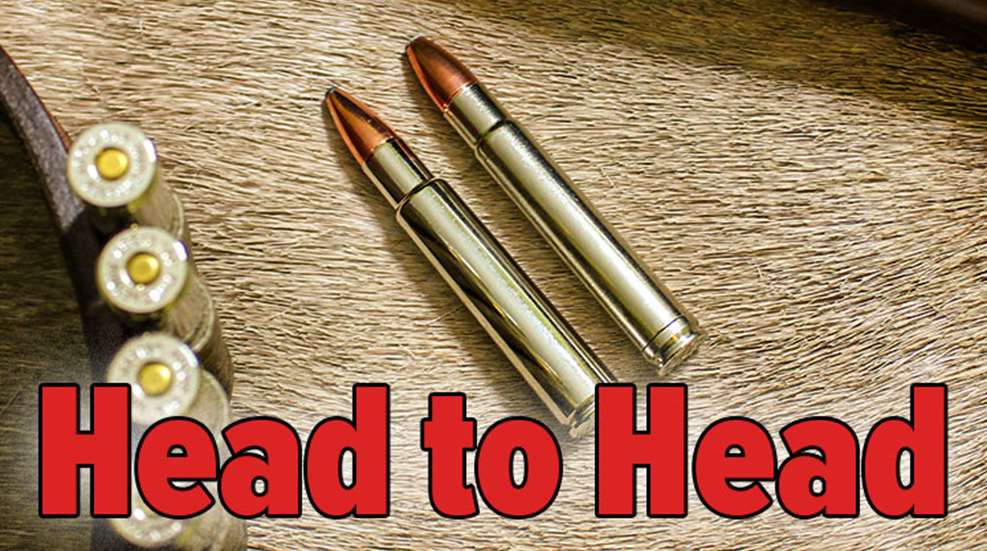
Firstly, let’s agree that both cartridges—handloading aside—have identical ballistics, pushing a 400-grain bullet at 2400 fps, so velocity is off the menu. Secondly—without steering this into another campfire argument—I believe that a bolt-action rifle for dangerous game should be in the controlled round feed configuration, with a beefy extractor. Too many times I have been in a place where you absolutely depend on a rifle of this caliber, and a broken extractor would be a terrible thing. Both cartridges require positive extraction, each and every time, and I’ll reiterate: the .416 Remington has posed no issue, irrespective of temperature, in a CRF rifle.
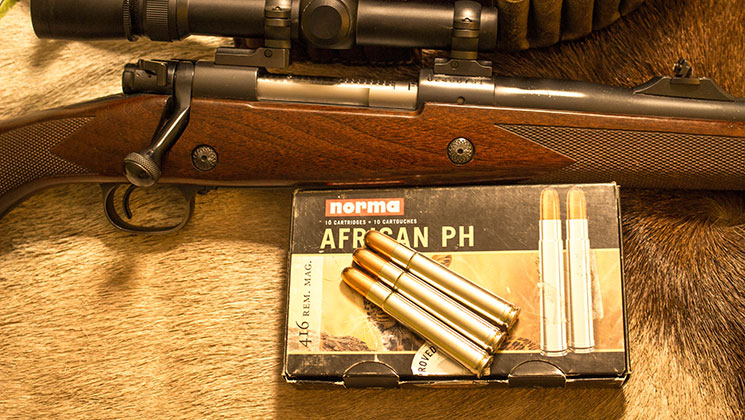
So, with the ballistics being equal and the pressure differences posing no problem, who has the advantage? This is one of the rare instances where you’ll see me give the nod to a new design over the old, especially among the African cartridges; I do, in fact, prefer the .416 Rem. Mag. over the .416 Rigby, and I’ll cite the reasons why.
Magazine capacity is my first reason. The Rigby case measures 0.5949″ at its widest, while the Remington (and all the H&H family) measures .0.532″ at the belt; that difference allows for greater magazine capacity for the slimmer cartridge. When it comes to dangerous game, more is better.
Length is also an issue. The Rigby cartridge requires a longer (read heavier) action than the Remington does, which adds weight and expense. There are fewer of these actions made, and therefore they are less-readily available. The .416 Remington rifles can be made more affordably. Thirdly, there is the cost of ammunition. Rigby ammunition is expensive, roughly 30 percent more than .416 Remington ammo. When you take into consideration the cost of a dangerous game safari, it’s a minimal investment, but the Remington represents a better value for identical ballistics.
I’ve also found the recoil of the Rigby cartridge to exceed that of the Remington cartridge. I can and do handle both, but there is a noticeable difference, more than likely caused by the larger powder charge in the bigger Rigby case required to attain the velocity.
If you prefer the Rigby based on cool-factor alone, I totally get it. It deserves the respect it gets; it’s been with us for over a century, and it immediately conjures images of the classic safari era. But looking at it from a practical point of view, I give the edge to the .416 Remington; I’ve shot mine for years, and wouldn’t hesitate to take it anywhere in the world with me.
Looking for previous installments of our "Head to Head" series? Click here.