Opening morning in Wyoming proved to be as picturesque as I imagined it; my pal Mike Ruella and I were teamed up with a competent guide, there were antelope everywhere, and the weather was perfect. Mike had taken a very handsome buck, with horns in the shape of a heart when viewed head-on, and it was now my turn. We spotted a unique buck from nearly a half-mile, following a hot doe like a heat-seeking missile. Using the slight folds in the prairie, we stalked, walked, crept and crawled to get within 200 yards of the pair, who remained engrossed in their own affairs.
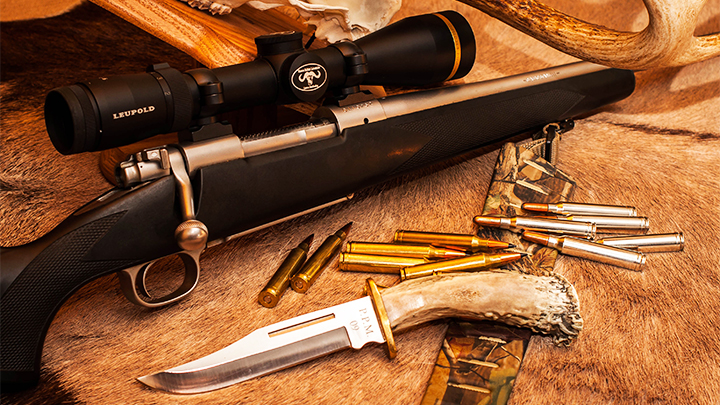
I got into the prone position, put the crosshair just behind that buck’s shoulder and rudely interrupted its soirée with a 180-grain Scirocco from my well-worn Winchester 70 in .300 Winchester. It wasn’t the first head of game to fall to that rifle, and by no means would it be the last.
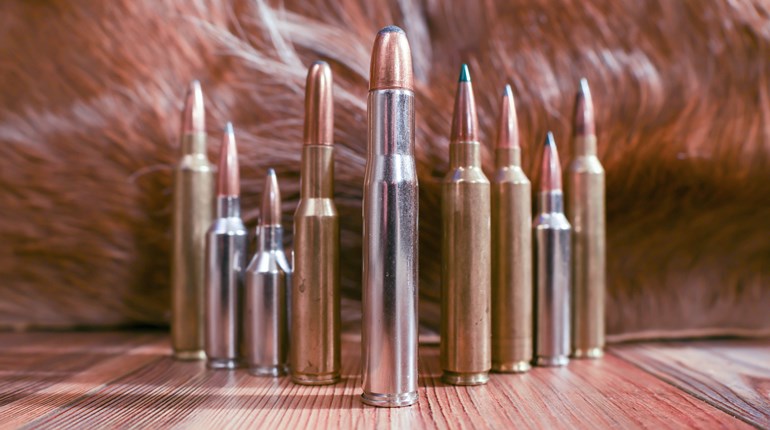
The quest to improve on the performance of the .30-06 Springfield has been going on for well over a century, but the first commercial success was Holland & Holland’s Super .30, released in 1925, and known here in the U.S. as the .300 Holland & Holland Magnum. Bettering the Springfield’s velocity by 150 to 200 fps depending on the load, the belted .300 H&H Magnum required a longer receiver and though the American ammunition companies had embraced the cartridge, the Springfield was—and is—more readily available and affordable. However, Americans have a definite love for speed, and the .30-caliber magnums weren’t going to go away.
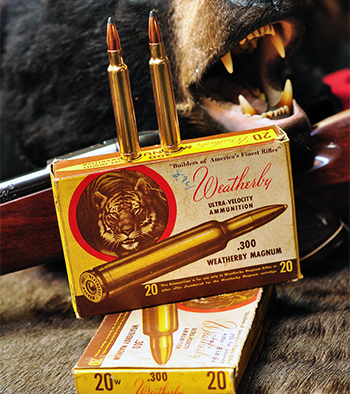
Roy Weatherby experimented with that belted Super .30 case in the early 1940s, sometimes shortening the case to .30-06-length, sometimes using the full 2.85-inch-length of the .300 Holland case, but all of his designs featured the unique double-radius shoulder. While I don’t have access to the official sales numbers, according to Weatherby, Roy’s .300 Weatherby Magnum is the most popular of the bunch. The .300 Weatherby Magnum is a fast, hard-hitting cartridge, driving a 180-grain bullet to a muzzle velocity of 3250 fps, for over 4,000 ft.-lbs. of energy at the muzzle, it is far ahead of the .30-06 Springfield and .300 H&H Magnum.
Shortly after the end of WWII, Winchester began work on its own series of magnum cartridges based on the belted H&H case, and by the end of the 1950s, they’d released the straight-walled .458 Winchester Magnum which would become popular in Africa, the .388 Winchester Magnum, the darling of elk hunters as well as those headed to Alaska, and the flat-shooting .264 Winchester Magnum. A .30-caliber version was expected from Winchester, but the .308 Norma Magnum showed up in 1960. It was very close to a .338 Winchester necked down to hold .308-inch-diameter bullets, and still makes a good choice for all-around hunting. Winchester finally released its .30-caliber magnum three years later; the .300 Winchester Magnum came onto the scene with a bit of a different approach. While Winchester maintained the ability to house the 3.34-inch cartridge in the long-action receiver, they moved the 25-degree shoulder forward in order to increase case capacity, and shortened the neck to measure 0.264 inches, with a case length of 2.62 inches. Winchester’s marketing—and the availability of both rifles and ammunition—saw the rapid rise to success of the .300 Winchester. Sending a 180-grain bullet at 2960 fps, the .300 Winchester Magnum gave a ballistic advantage over the .30-06 Springfield, yet isn’t so fast that premature barrel wear becomes an issue.
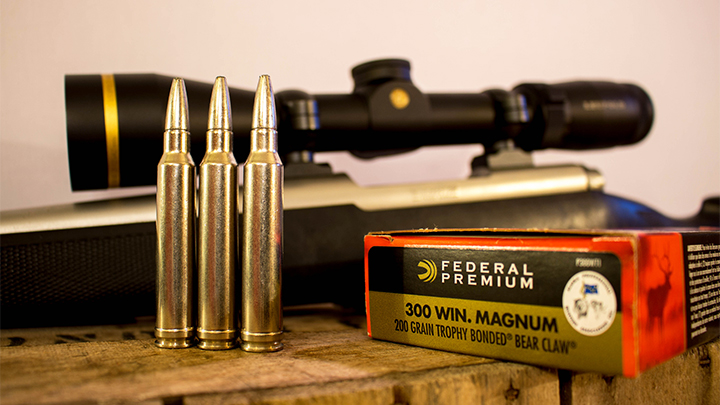
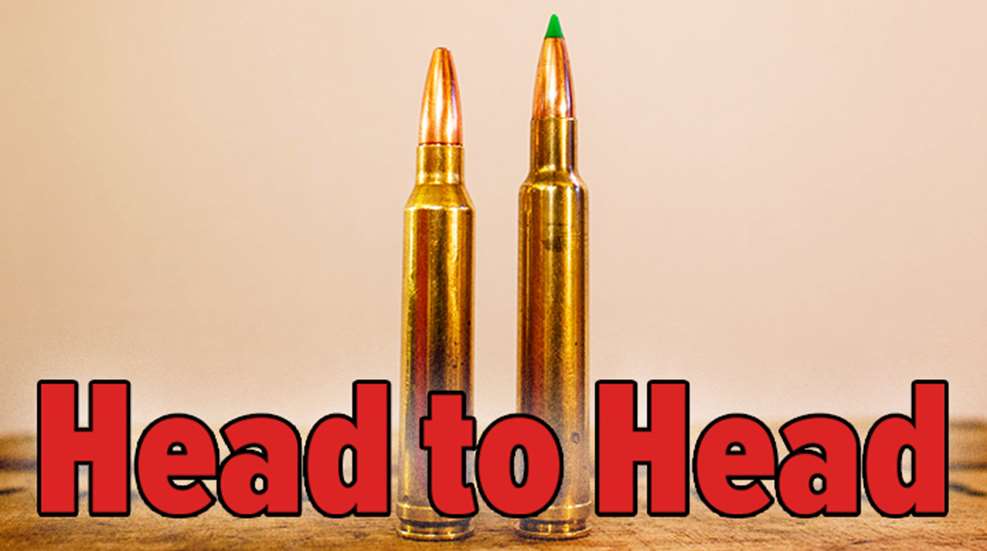
Comparing the cartridges, both use the belt for headspacing—though many reloaders will resize their cartridges to allow the shoulder to handle the headspacing duties—and both can effectively use the full range of .30-caliber bullets. Both are fully capable of taking the full range of North American game animals, and both make a solid choice for a light rifle on safari. So, which makes the better choice for the hunter looking for a .300 magnum?
While the velocity advantage of Weatherby is certainly attractive, giving a bit flatter trajectory and better resists wind deflection, it comes at a price, and that price is a considerable increase in recoil. What exactly is the trajectory advantage? Comparing both cartridges shooting a 180-grain Nosler AccuBond (G1 B.C. of 0.507) with a 200-yard zero, at a muzzle velocity of 2960 fps for the Winchester and 3250 fps for the Weatherby, you’ll see the former drop 19.3 inches at 400 yards, and the latter drop 15.6 inches. At 500 yards the gap opens a bit wider, with the Winchester dropping 38.7 inches and the Weatherby dropping 31.7 inches. At that distance the .300 Winchester retains 1,766 ft.-lbs., and the Weatherby retains 2,186. It’s an appreciable advantage, but again, there’s that recoil tradeoff.
I’ve owned or hunted with a good number of rifles in .300 Winchester Magnum, and have done load development for a half dozen .300 Weatherby rifles; across the board the .300 Weatherby had a much sharper and faster recoil. Many hunters have commented on various social media sites that the .300 Winchester Magnum kicks too hard, and the .30-06 is all you need. Well, the .300 Weatherby ramps up both felt recoil and muzzle blast, and is actually too much gun for a good numbers of shooters. If you can handle it well, it will make a good choice, but I’d advise trying one before purchasing one.
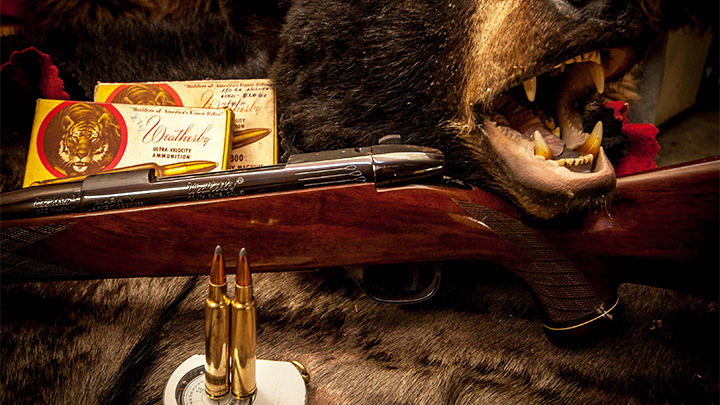
Another major factor between the two is ammunition choice and availability. Hopping onto MidwayUSA to look at the options, you’ll find the .300 Winchester has five times the different SKUs than does the .300 Weatherby. Don’t get me wrong, the ammunition for the .300 Weatherby is good stuff, but there’s just less of it to choose from. The same can be said for rifles: The line of Mark V rifles from Weatherby are quality, and there are other companies that chamber for the .300 Weatherby, but they are grossly outnumbered by the choices in .300 Winchester Magnum.
Since 1963 the .300 Winchester Magnum has been a great choice for those looking for a bump up in performance from the .30-06 Springfield and .308 Winchester. Some folks gripe about the neck length, others don’t like the belt, but I find the .300 Winchester Magnum to be one of the most useful of the .300 magnums. The .300 Winchester Magnum gets the nod from me in this instance.
Looking for previous installments of our "Head to Head" series? Click here.