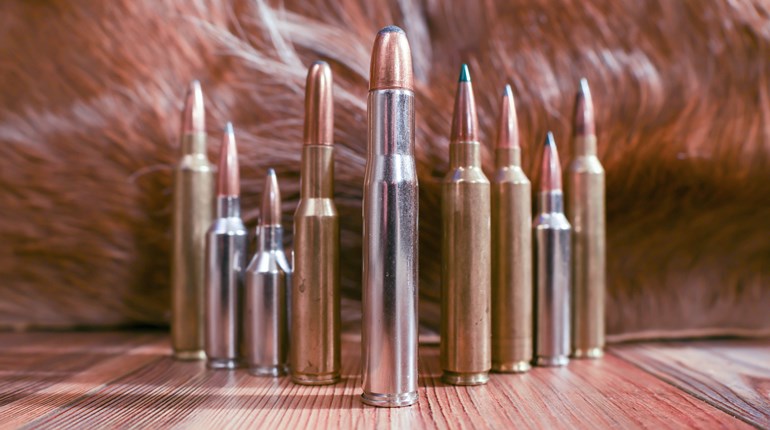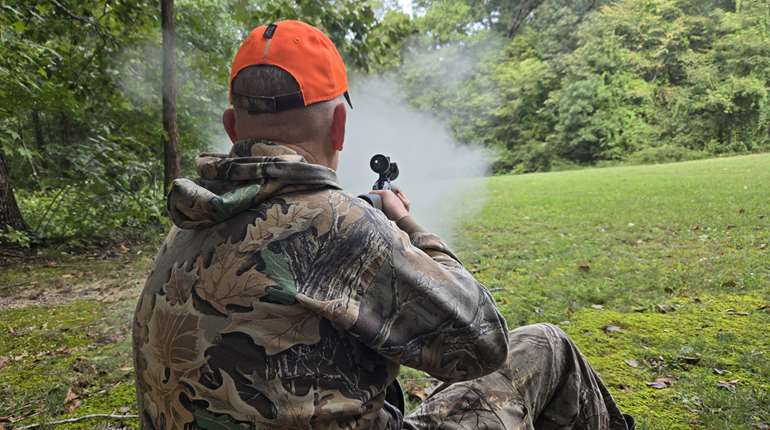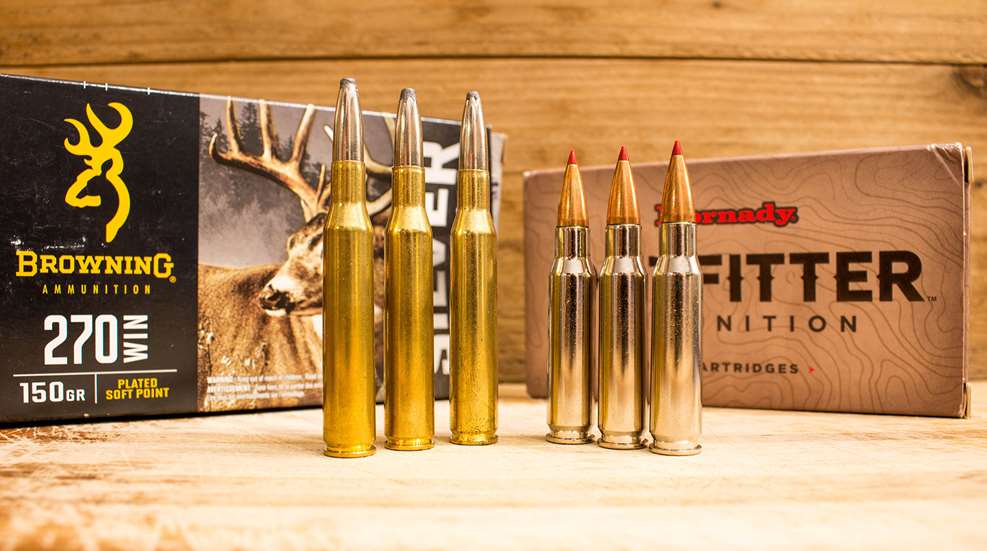
At the top of the heap of the “Reader Comment Bin” is a comparison of a couple of undeniable classics: the .270 Winchester and .308 Winchester. Both have proven themselves as excellent all-around choices, having been used around the globe on animals of all shapes and sizes, and both have their champions. Inevitably, comparisons have been made (and continue to be made) for both of these cartridges to the venerated .30-06 Springfield, but the comparison between the two is something hunters contemplate quite often. Both the .308 Winchester and .270 Winchester are still popular chamberings, and ammunition is readily available from nearly every manufacturer. Let’s toss ‘em in the ring.
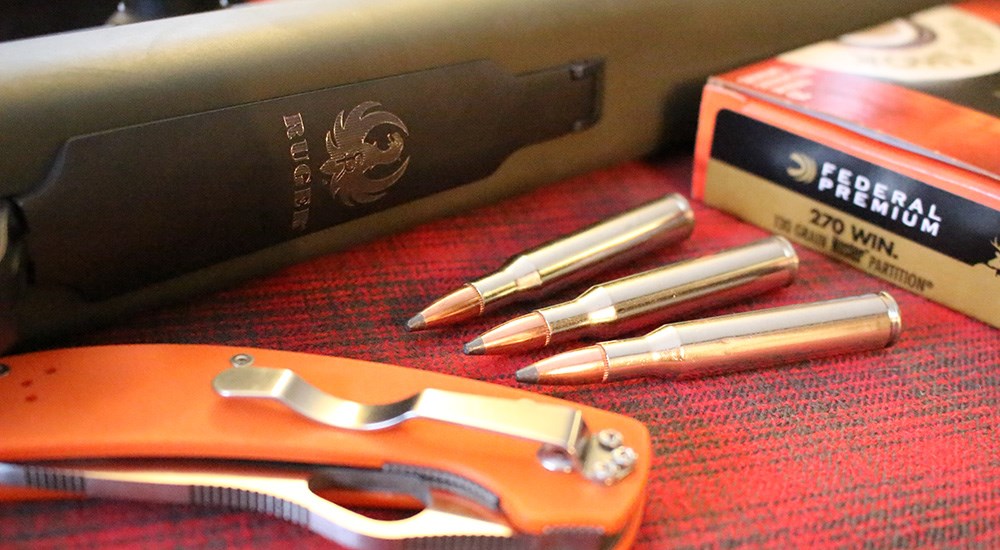
The .270 Winchester is the older of the two, dating back to 1925, and is based on the 30-03 cartridge. With a 2.54-inch case, and retaining the 17½-degree shoulder, the .270 Winchester uses a .277-inch bore diameter, and that was unique at the time of release. History is cloudy as to the origins of the .277-inch bore, but history is not cloudy about the success of the 270 Winchester, championed by Jack O’Connor in his numerous writings. For 1925, the .270 Winchester was a speed demon, and in an era which was still dominated by iron sights, the 270 proved to be very flat shooting, especially at hunting distances common to that time. With a bullet weight range of 100 grains on the lower end—designed for use on varmints and predators—up through the 130- and 150-slugs for the big game species, the .270 Winchester could check the “all-around” box. It requires a long-action receiver, but that’s not a big deal, and the shoulder angle gives a good blend of chamber concentricity and positive headspacing, not to mention ease of feeding. Recoil is manageable, and while some folks might prefer a bullet heavier than 150 grains for the larger species like moose and grizzly bear, the .270 has been used to take both of them, as well as the largest antelope in Africa. The 130-grain bullets are wonderful for deer—both whitetail and mule deer—and can take black bear and pronghorn antelope neatly as well.
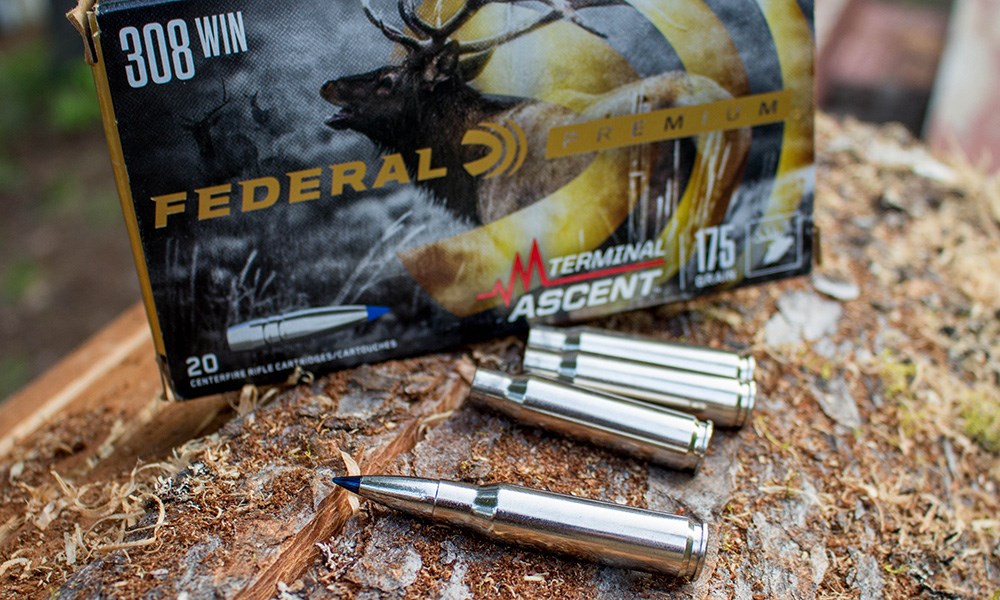
The .308 Winchester came along 27 years later, as the result of years of the U.S. Army’s efforts to replace the .30-06 Springfield. The 1952 release of the .308 Winchester actually preceded the Army’s adoption of the 7.62x51mm, and was immediately chambered in Winchester’s Model 70, and subsequently in the Model 88 lever gun, and Model 100 autoloader. Seventy-plus years later, the competition between the 308 Winchester and 30-06 rages on, but make no mistake, the .308 Winchester is a fully capable big game round, capable of both hair-splitting accuracy and possessing enough knockdown power for the majority of the world’s game species. Being .30-caliber means you get one of the best bullet selections of any bore diameter, and despite the fact that the .308 Winchester lacks the look of a long-range cartridge, it possesses the attributes needed for hunters who shoot game at sane hunting ranges. A 20-degree shoulder allows for good headspacing without feeding issues—the numerous fully-automatic military rifles so chambered are a testament to the potential rapid feeding of a case such as the 308 Winchester—in fact in nearly every platform in which it has been chambered, it has thrived. A short-action cartridge, the .308 Winchester is one of those cartridges which belies its appearance, and can do it all. In fact, the great W.D.M. ‘Karamoja’ Bell, the elephant hunter who made his reputation using the 7x57mm Mauser and .318 Westley Richards against the continent’s greatest pachyderms, opined in his later life that the .308 Winchester would be the world’s greatest elephant cartridge, because of the short-action rifle in which it was housed.
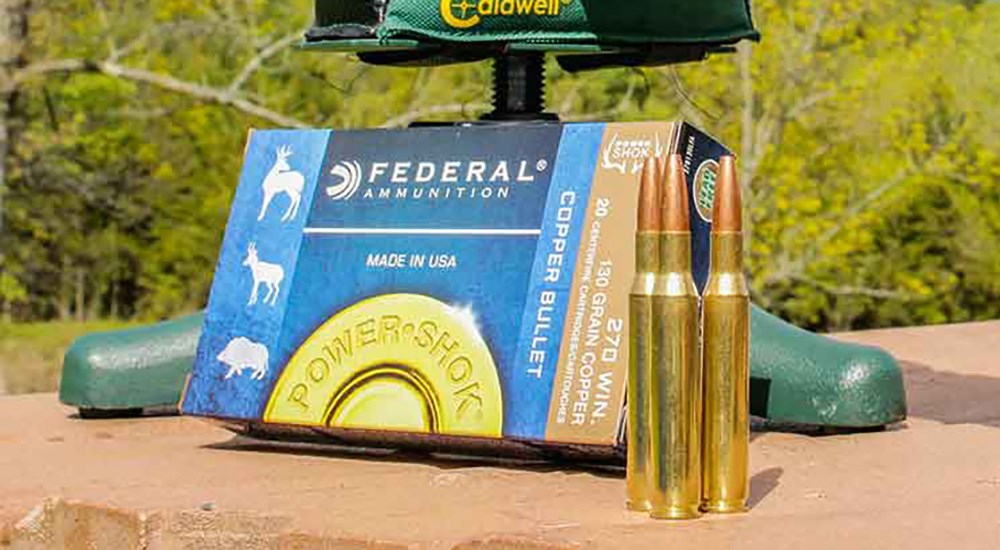
Pitting these two against one another, the .270 Winchester has a slight velocity advantage. With a 130-grain bullet traveling at 3060 fps and a 150-grain bullet at 2850 fps, the .270 still beats the .308 Winchester, but not by much. The latter drives a 150-grain bullet at 2775 fps or so, but it is the ability to push bullets as heavy as 180 and 200 grains which separates the two cartridges. If we were to simply compare performance with 150-grain bullets, the .270 Winchester would win, because the nearly identical velocities would cancel out, but the superior sectional density and ballistic coefficient of the .270 Winchester would be enough to tip the scale. Or, if Winchester had provided a 1:8 twist barrel for the .270 from its inception, so it could push the 165- and 170-grain bullets now used in the 6.8 Western, it would’ve walked all over the .308 Winchester, and maybe even the .30-06 Springfield as a sporting round. But, that wasn't case.
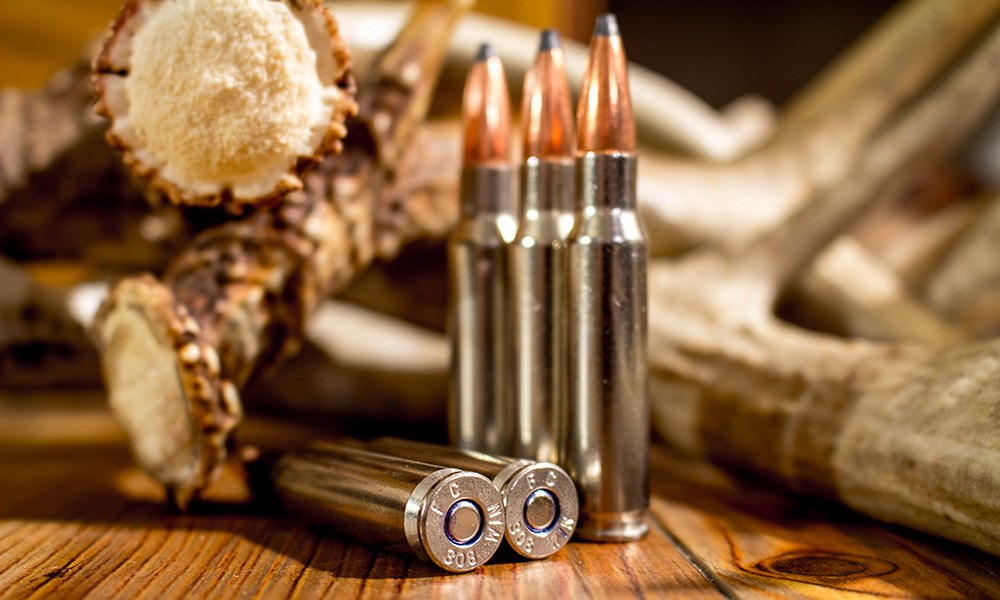
So, for the ability to use a wider range of bullet weights, I feel the .308 Winchester comes out on top in this comparison. Quite obviously, hunters use the .270 Winchester for all sorts of species, including moose, elk, even antelope up to the size of eland, and it’s been working for nearly a century, provided the proper projectile for the application is chosen. But I also feel a .308 Winchester with a premium 180-grain bullet hits larger species harder than does a .270 Winchester with a comparable 150-grain bullet, so if flexibility appeals to you, maybe the 308 Winchester should get the nod. Maybe for your style of hunting, the .270 Winchester with the 130- to 150-grain bullets is “enough gun”, and you like the nostalgic connection to Jack O’Connor and all the exploits he waxed so poetically about. Tough call here, as both cartridges have attractive attributes, but I do prefer the .308 Winchester for nothing more than the huge selection of .30 caliber bullets it can house.
Looking for previous installments of our "Head to Head" series? Click here.