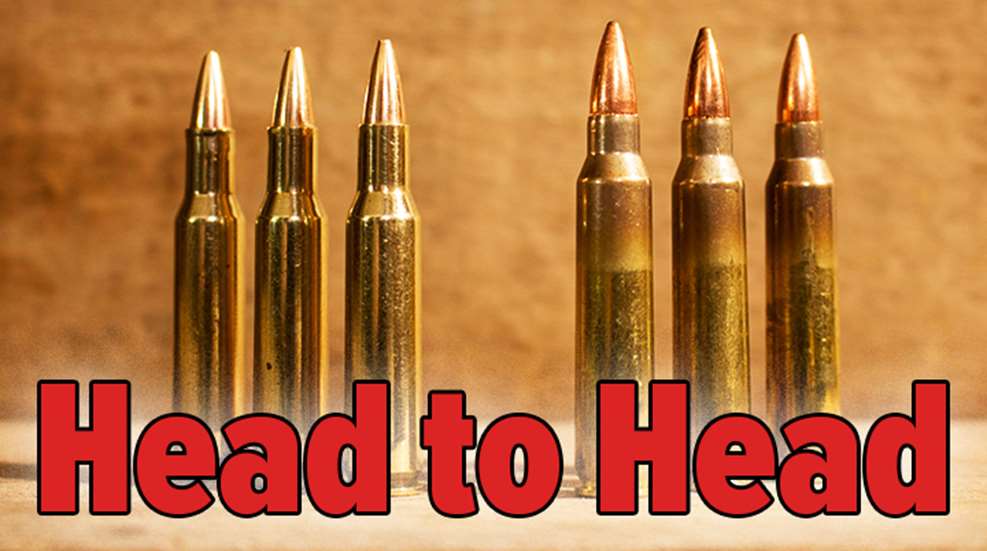
I was sitting over a hot prairie dog town in Wyoming, evaluating the then-new Sauer Model 100 bolt rifle, with multiple rifles available to the group of us writers in both .223 Remington and its older brother, the .222 Remington. The Sauer 100 is an accurate rifle, and we were having no trouble stacking those prairie dogs at all sorts of ranges. And, most important to me, it gave an opportunity to evaluate the difference between the two cartridges in the field, in real world conditions, on warm targets.
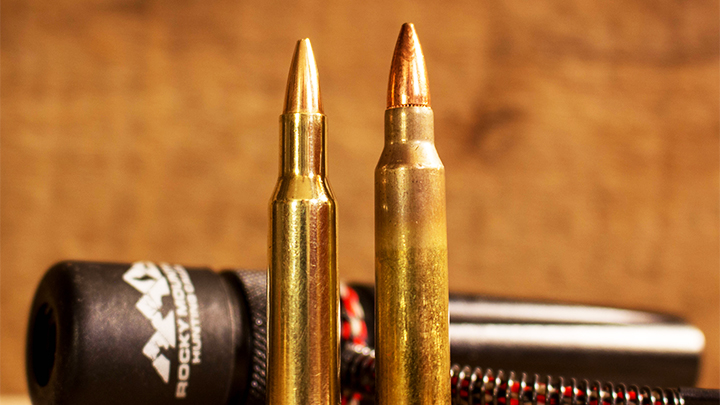
Undoubtedly, the younger cartridge—assuredly due to its military status—is the more popular of the two, yet the older cartridge was the cool kid, holding a good number of accuracy records. Frankly, I was surprised that Sauer went through the trouble of chambering their rifle for the Triple Deuce, until I was informed that there is a portion of the European market which cannot use military cartridges for private use. Nonetheless, I was more than happy to have the chance to wring them both out. Let’s compare the two, to see what makes them tick and which will better serve your needs.
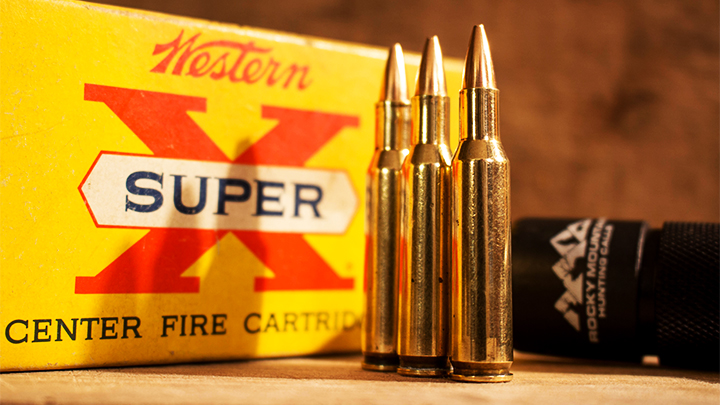
The .222 Remington was released to the shooting public in 1950 in the Model 722 bolt-action rifle, and made quite a splash. Considerably faster than the .22 Hornet, the .222 Remington would extend the range of that classic cartridge, not to mention showing an unprecedented capability for accuracy. And, while not as fast as the smoking .220 Swift, it is considerably easier on the barrel and especially the throat. Remington’s Triple Deuce was a unique design, having no parent cartridge, yet would go on to sire some very famous children.
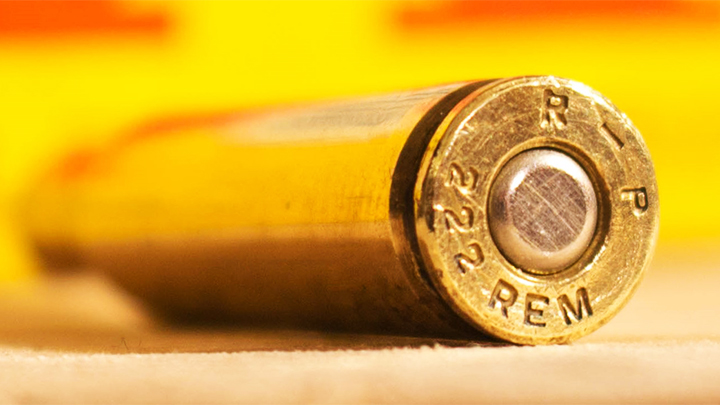
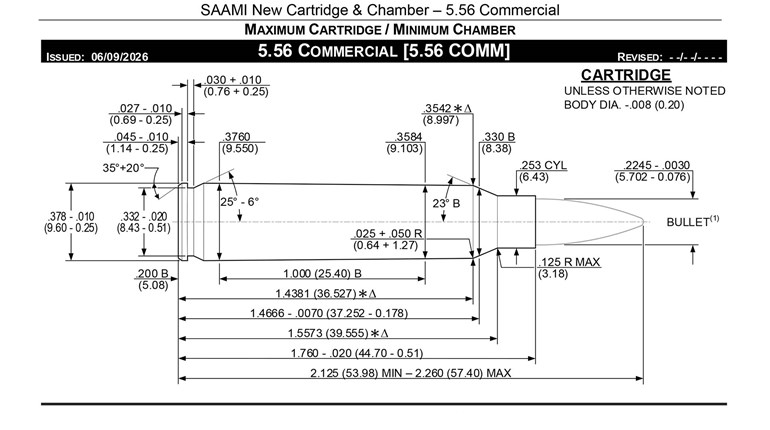
It is a rimless case, headspacing off the 23-degree shoulder. The base diameter is .378 inches, tapering down to .357 inches at the shoulder. The .222 Remington has a good, long neck measuring .313 inches, giving all the neck tension you could ever need. The cartridge overall length is set at a maximum of 2.130 inches. With a 1:14” twist rate, the .222 can stabilize bullets weighing up to 55 grains, or perhaps 60 grains if the bullet profile is correct. Looking at the modern ammunition options, the 50-grain bullet seems to be the most popular, and that bullet is usually travelling at a muzzle velocity of 3150 fps or so (until you get to the Hornady Superformance load, where you’ll see almost 3400 fps). The .222 was the darling of the shooters competing in the newly-developed benchrest competition, holding many records, until the 6mm PPC came along and shocked the industry.
In an effort to develop a new cartridge for the U.S. Army, the .222 case was the platform used to obtain the ballistics the Army defined: a .22 caliber bullet, maintaining supersonic flight out to 500 yards, capable of penetrating a 0.135-inch steel plate at that same distance, with accuracy and ballistics equal to that of the M2 Ball ammo for the Garand rifle. To be brief, the case was lengthened, the shoulder moved forward, and more than a few iterations were rigorously tested before coming to what we know as the .223 Remington. Driving a 55-grain bullet to a muzzle velocity of 3250 fps, the cartridge would check all the boxes, and go on to lead a dual-life, as the ‘Cartridge, 5.56mm ball, M193.’ With a 23-degree shoulder, and a case length of 1.760 inches, the .223 has a cartridge overall length of 2.260 inches, a tad longer than the .222 Remington.
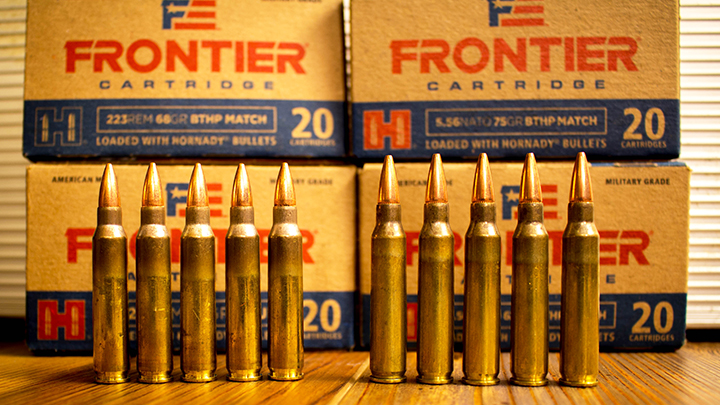
There are many twist rates available for the .223 Remington, from the early 1:14” twist—perfect for the lighter bullets from 35 grains to 55 grains—to the more modern 1:9”, 1:8” and 1:7” twist rates which handle the heavy-for caliber bullets, namely those weighing as much as 77 grains. Ammunition availability, as I mentioned earlier, heavily favors the .223 Remington, as is to be expected.
It was an eye-opening experience using both cartridges back-to-back on that prairie dog hunt. Inside of 300 yards, the .222 Remington held its own ground, creating red mist and sending a good number of the little buggers to the great dog town in the sky. Outside of that range and holdover posed an issue, especially in comparison to the .223 with heavier bullets. The .223 Remington was equally accurate inside 300 yards (I guess you’d call that minute-of-prairie dog) but certainly showed the velocity advantage at the 400-, 500- and 600-yard ranges. It was on that hunt that American Rifleman’s Christopher Olsen and I made back-to-back 800-yard shots on prairie dogs with the .223 Remington; while I wouldn’t want to replicate the scenario, it was rather exciting, and I know I’ll never forget it.
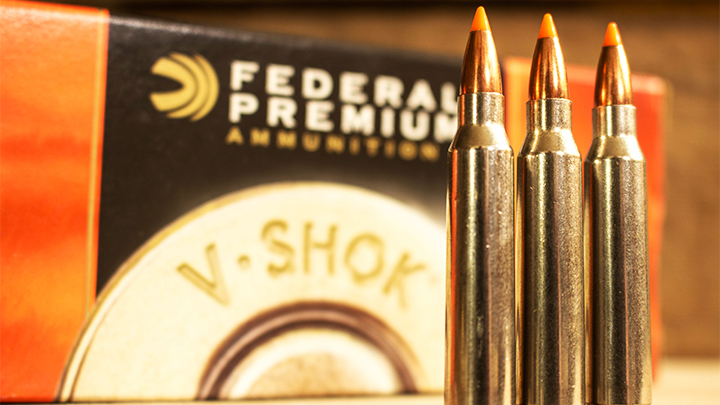
In this comparison, though the .222’s history is certainly respectable, the practical side of me must give the nod to the .223 Remington. There are so many more factory ammunition options for the Two-Two-Three, compared to the Triple Deuce, that it settles the argument with that simple fact. That said, if you are the casual varmint/predator hunter who spends the majority of his or her time inside 300 yards (a shot on the longer side for those of us in the Northeast) there is nothing wrong with owning or buying a good rifle chambered the .222 Remington cartridge. But, for a new shooter shopping for a rifle, or for the hunter shopping for a varmint rifle, it is hard to argue with the choice of a .223 Remington, especially in this era of limited ammunition availability.
Looking for previous installments of our "Head to Head" series? We've got you covered.
• .270 WSM vs. 7mm Rem. Mag.
• .22-250 Remington vs. .204 Ruger
• .25-06 Remington vs. 6.5 Creedmoor
• .444 Marlin vs. .45-70 Government
• 7x57mm Mauser vs. .280 Remington
• .300 Win. Mag. vs. .300 Wby. Mag.
• .375 Ruger vs. .375 H&H Magnum
• 7mm-08 Remington vs. .280 Remington
• .280 Remington vs. .280 Ackley Improved
• 7mm vs. .30 Caliber
• 6.5 Weatherby RPM vs. 6.5 PRC
• .338 Win. Mag. vs. .340 Wby. Mag.
• .300 RSAUM vs. .300 WSM
• .500 Jeffrey vs. .505 Gibbs
• 7mm RUM vs. .300 RUM
• .308 Winchester vs. 7mm-08 Remington
• 6.5 Creedmoor vs. .260 Remington
• .303 British vs. 8x57 Mauser
• .30-06 Springfield vs. All Other .30s
• .17 HMR vs. .17 WSM
• .450 Nitro Express vs. .470 Nitro Express
• 350 Legend vs. .35 Remington
• .280 Ackley Improved vs. 7mm Rem. Mag.
• .404 Jeffery vs. .416 Rigby
• .243 Winchester vs. 6mm Creedmoor
• .300 PRC vs. .300 Win. Mag.
• .30-06 Springfield vs. .270 Winchester
• 6.5 Creedmoor vs. 7mm-08 Remington
• 8x57 Mauser vs. .318 Westley Richards
• .358 Winchester vs. .350 Remington Magnum
• .22-250 Remington vs. .220 Swift
• .270 Winchester vs. .270 WSM
• .26 Nosler vs. 6.5-300 Weatherby Magnum
• .458 Win. Mag. vs. .458 Lott
• 7mm Rem. Mag. vs. .300 Win. Mag.
• .243 Winchester vs. 6mm Remington
• 7x57mm Mauser vs. 7mm-08 Remington
• .25-06 Remington vs. .257 Weatherby Magnum
• .338 Winchester vs. .375 H&H Magnum
• .30-30 Winchester vs. .35 Remington
• .257 Roberts vs. .250-3000 Savage
• .270 Winchester vs. .280 Remington
• .35 Whelen vs. 9.3x62mm Mauser
• .416 Rigby vs. .416 Remington Magnum
• .308 Winchester vs. .30-06 Springfield
• .22 Nosler vs. .224 Valkyrie
• .300 Win. Mag. vs. .300 WSM
• .223 Remington vs. .22-250 Remington