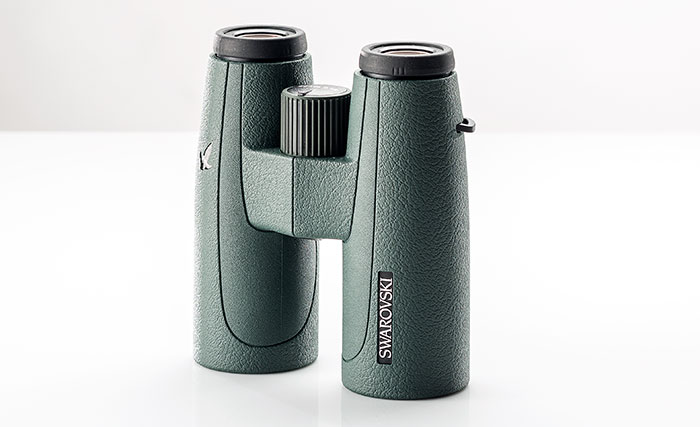
If you're really serious about glassing for big game, it's never a mistake to use Swarovski binoculars. They're as sharp and bright as anything made, especially during those critical twilight hours when big bucks and bulls tend to be most active.
I first started using Swarovski SLC binoculars, the company's lower-priced line, more than 20 years ago, but as with everything else in optics, major improvements have taken place over the past two decades. The optics of the first SLC models were very good but not great, and they weren't exceptionally rugged or waterproof. The latest SLC models, such as the 10x42mm version sent for testing, are almost a completely different binocular.
My standard "test binocular" for comparison to anything in the 10x40 class is a Swarovski 10x42 EL from the maker's higher-priced line. Mine's a few years old, made before the advent of all the latest optical improvements, but while there's a difference between its optics and the latest EL's, it's very slight. It would be a good comparison-test for the latest SLC.
The Swarovski website lists the 10x42 EL at $2,866 and the 10x42 SLC at $1,999. Just exactly what do we give up by saving $867? To find out, I stacked the binoculars on top of each other (the non-technical method used by many optics addicts) so I could quickly compare views. The new SLC actually proved to be a little brighter than my EL, and the two binoculars appeared equally accurate in color rendition.
Because men's eyes typically differ somewhat in color perception from women's, I also asked my wife, Eileen (a very experienced hunter and glasser), to provide her opinion, and I didn't reveal exactly which models we were testing. She also thought colors were very accurate in both binoculars, but to her the colors rendered by the SLC seemed to "pop" a little more. (Neither of us uses much technical jargon, though we can be forced to when talking with an optical engineer.)
The new SLC includes the Swaroclean anti-moisture coating on exterior lens surfaces. I tested this by filling the objective lens cavities with water, then turning the binocular so the water flowed out. Only a few tiny water droplets remained, too small to interfere with the view. The coating also doesn't allow dust to settle as easily and makes the lenses far easier to clean.
One great feature of Swarovski binoculars for eyeglass wearers, like me, is the full field of view (FOV) remains visible thanks to generous eye relief. This was true of the SLC, though overall FOV was a little wider in the 10x42 EL. The SLC had slightly more "fuzz" along the edges of the FOV than the EL, but this wasn't noticeable until I looked for it.
The only really substantial optical difference between the two glasses turned out to be close-focus distance. The listed minimum focus for the EL is 4.9 feet, while the minimum for the SLC is 10.5 feet. These checked out when comparing the two binoculars, but the extremely short focus in the EL is primarily designed for bird watchers. Hunters are far more concerned about glassing animals at 490 yards than 4.9 feet.
It was a little surprising to find the SLC about 1.5 ounces lighter than the EL, since SLC models used to be heavier. This is due to the lack of the extra view-flattening lens found in the EL, and it's also why the SLC's view is slightly brighter. I don't mind a little weight in 10X binoculars, finding it helps steady the view, especially when seriously glassing for long periods, but I also don't want a boat anchor around my neck all day. The 28-ounce 10x42 SLC is a very good compromise.
All the adjustments worked easily yet firmly, with no slack. Once the focus and distance between the barrels were set, they never needed readjusting after walking around for a while. This sometimes happens with a binocular and can be really annoying when you raise the optic to your eyes again.
Finally, the SLC went into a chest freezer overnight, at a temperature of minus 10 degrees. Swarovski lists the "functional" temperature range as minus 13-158 degrees, so this pushed the lower limit, but the adjustments still worked fine. Taking the SLC from the freezer, I almost immediately submerged the binocular in a sink of 100-degree water and left it for several minutes, long enough to reveal any leaks through expansion of the interior nitrogen. No bubbles escaped, and while the inside of the lenses fogged slightly (it's impossible to keep all moisture from entering an optic even after nitrogen purging), the fog disappeared entirely within a couple of minutes.
Swarovski has made noticeable improvements to the SLC. If you're a hunter willing to pay for the advantages of Swarovski optics, but also like to save money, the new SLC is a really good deal.
Technical Specifications:
Type: roof-prism binocular
Magnification: 8X, 10X (tested)
Objective Lens Diameter: 42mm
Focusing Range: 10.5'-infinity
Eye Relief: 16mm
Exit Pupil: 4.2mm
Field of View @ 1,000 Yds: 330'
Coatings: fully multi-coated lenses and prisms with Swarobright, Swarodur and Swarotop; Swaroclean anti-moisture and dust protection coating on exterior lens surfaces
Length: 5.7"
Width: 4.7"
Weight: 28 ozs.
Construction: rubber-coated magnesium frame
Accessories: field bag, eyepiece cover, objective cover, carrying strap
MSRP: $1,999