I stopped by the Barnes booth during the 2017 Safari Club International show in Las Vegas to say hello to Jessica Brooks-Stevens, the company’s senior marketing manager and daughter of Barnes pioneer Randy Brooks. At least that was my cover. My knees were hurting, and I wanted a place to sit down. Before I could find a chair, Jessica dragged me over to one of the Barnes engineers for a first look at a new project.
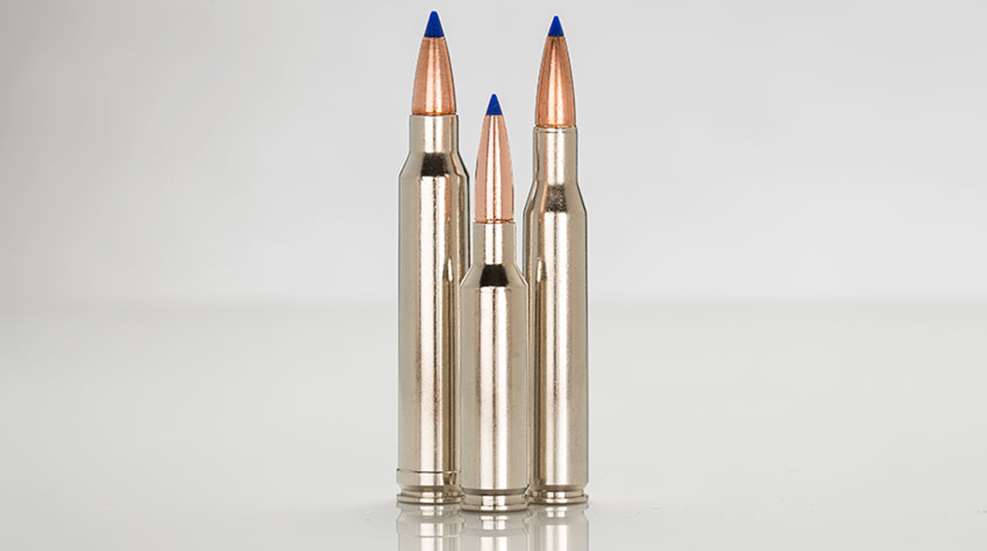
It was pretty much just a concept at the time, but the idea was to take the excellent Barnes LRX long-range hunting bullets, match their weights and performance to select cartridges, and then load them into ammunition with extreme care and precision. That was my introduction to what would become Barnes Vor-Tx LR ammo.
To understand the development of the new Vor-Tx LR loads, it helps to look back at some Barnes history. The Barnes TSX is the mono-metal hunting bullet that so many other bullet makers have imitated. It’s the apex of the X-Bullet design that Randy Brooks developed 33 years ago. That all-copper bullet turned the hunting world upside down. In many places where bullet performance is critical—Africa, Alaska, Australia—many outfitters and professional hunters recommend and often demand that hunters use this bullet.
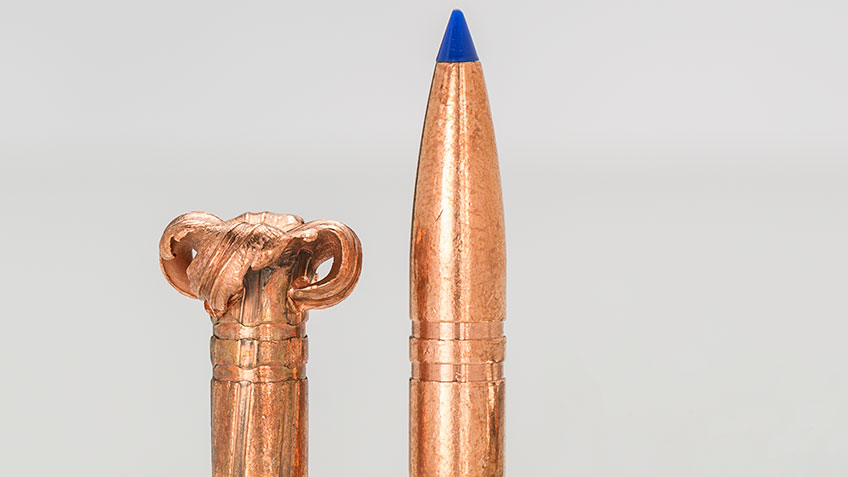
Throughout the years the X-Bullet was tweaked and refined to improve its performance and address some of its issues. The first X-Bullets could be finicky about accuracy, but today the TSX, with grooves in its shank, is usually the most accurate hunting bullet I see during ammo testing. Often its accuracy rivals match bullets.
The all-copper LRX bullet was the next step in development and was introduced for the long-range hunter who understands that bullet performance is perhaps the most important aspect when shooting game. It has a long profile with a sleek ogive, a polymer tip and a boattail base. This results in a high ballistic coefficient for more retained energy downrange and flatter trajectory. Barnes publishes ballistic coefficients for its bullets that are scientifically measured with Doppler radar, rather than using a good guess, which was often the accepted norm in the past.
I have handloaded the LRX bullet quite a bit in several cartridges. Most recently I developed loads for the 139-grain LRX in my .280 Ackley Improved and the 127-grain LRX in my 6.5x284. Both bullets proved to be extremely accurate in those rifles.
For the new Vor-Tx LR ammo line, Barnes engineered each LRX bullet specifically for its cartridge, focusing on both external ballistics and terminal ballistics. The goal for each load was to have a flat-shooting, accurate bullet that would reliably expand on game out to as far as 700 yards, but still hold together and penetrate on close-range impacts. Barnes met that goal with most cartridges in the Vor-Tx LR line but not all: the 6mm Creedmoor and .375 RUM are rated for reliable expansion to 500 yards, and the 6.5 Creedmoor to 600 yards.
Still, the result is factory ammo that offers optimum performance over a wider range of impact velocity than perhaps any other hunting load on the market. It is incredibly important for a long-range hunting bullet to expand on game at the low velocities associated with impacts at extended ranges. It is difficult to make a bullet that will expand at an impact velocity as low as 1700 fps and still be tough enough for a close-range impact at a velocity approaching 3000 fps. The engineers refined the design, namely in the scored nose cavity behind the polymer tip, and met that objective with the LRX bullets used in Vor-Tx LR ammo.
Barnes built its reputation on reliable expansion with high weight retention. The company tests its bullets extensively. I have spent some time in the Barnes ballistic lab and have always been impressed with how thoroughly the engineers test each bullet design. The LRX bullet is no exception.
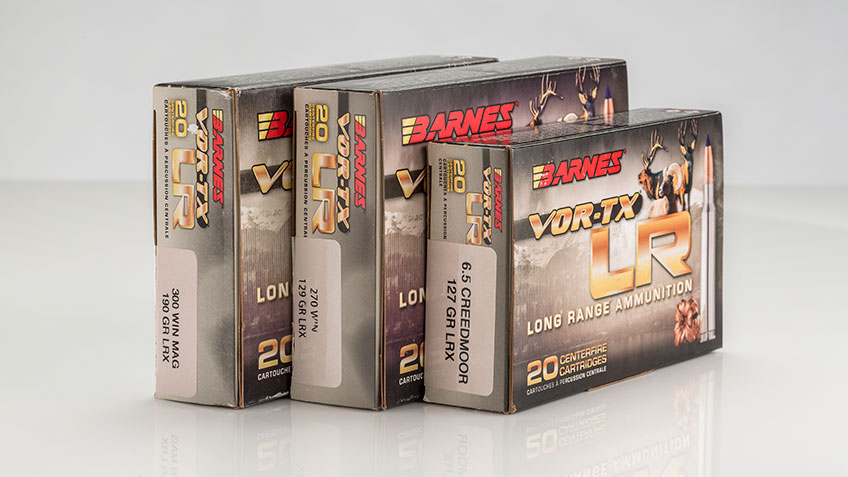
Currently the Vor-Tx LR line includes 6mm Creedmoor 95-grain, 6.5 Creedmoor 127-grain, .270 Win. 129-grain, 7mm Rem. Mag. 139-grain, 7mm RUM 145-grain, .300 Win. Mag. 190-grain, .300 RUM 190-grain, .338 RUM 250-grain and .375 RUM 270-grain loads, but more are coming soon. For those hunters who insist on shooting big, tough game like elk at long range, the larger cartridges provide optimum ballistics and enough retained bullet energy for clean kills.
Vor-Tx LR ammo comes in rather elaborate packaging. Included on the coffee-table-quality box is the bullet’s G1 ballistic coefficient. There is also a full ballistics chart with velocity, trajectory and energy data out to 700 yards, both at sea level and 5,000 feet.
I used the 6.5 Creedmoor load during a recent California blacktail deer hunt. While the possibility for a long shot was there, I shot my buck at about 35 yards. He was bedded and facing me. I shot him high in the chest and recovered the bullet under the skin on the back of his offside leg. It penetrated the entire length of the deer, looked catalog-perfect in expansion and appeared to have nearly 100 percent weight retention. (I wish I could have weighed it, but apparently the TSA thought it was too dangerous to travel in my checked bag.) Considering the 6.5 Creedmoor is a pretty mild big-game cartridge, that’s impressive penetration.
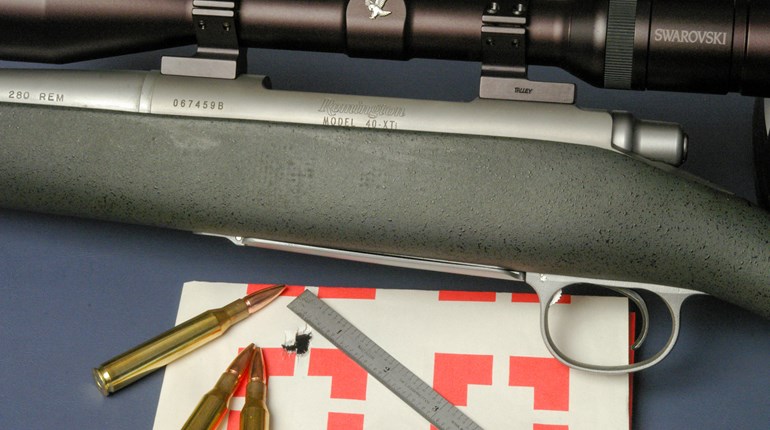
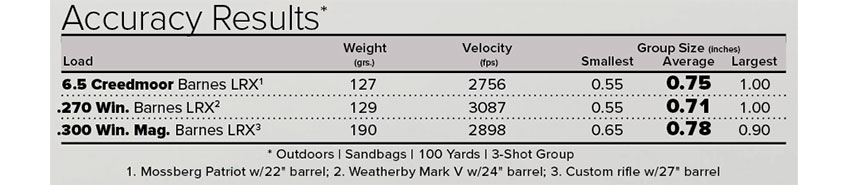
More recently, I tested the accuracy of three loads that I picked to give me a sample of popular cartridges in short, standard and magnum case sizes: 6.5 Creedmoor, .270 Win. and .300 Win. Mag. At 100 yards, all three Vor-Tx loads produced sub-MOA group averages.
While accuracy testing at 100 yards is pretty standard, I also had paper targets at 200 and 300 yards. Once the formal testing was complete, I turned the .300 Win. Mag. loose on them. At 200 yards my group was 1.6 inches with two of the bullets touching. To be honest, I think the flyer was my fault. That is consistent with what I saw at 300 yards. I shot two groups: One was 1.7 inches and the second measured 1.9 inches. I had the rifle zeroed an inch high at 100 yards, and the impact at 300 yards was just 6.5 inches below point of aim. Even after I adjust for the upward slope of my range, the load is a bit flatter shooting than my computer program indicates, which illustrates why it’s so important to prove your data by shooting.
Just as I finished shooting the last group a black bear ran across my range at about 250 yards and stopped to look at me for a few seconds. I was watching him in my scope, the season was open, the rifle was loaded, and I had a bear tag. I let him walk. I was tired and not interested in spending half the night skinning a bear. Still, I have no doubt at all the Barnes Vor-Tx LR ammo would have done its job.
Technical Specifications
• Caliber: 6.5 Creedmoor, .270 Win., .300 Win. Mag. (all tested)
• Bullet: monolithic-copper, polymer-tipped Barnes LRX
• Ballistic Coefficient: .468 (6.5 Creedmoor), .463 (.270 Win.), .499 (.300 Win. Mag.)
• Muzzle Velocity (advertised fps): 2825 (6.5 Creedmoor), 3140 (.270 Win.), 2880 (.300 Win. Mag.)
• Muzzle Energy (advertised ft.-lbs.): 2,251 (6.5 Creedmoor), 2,825 (.270 Win.), 3,500 (.300 Win. Mag.)
• MSRP: $38.10-$43.74 per 20-rnd. box; barnesbullets.com