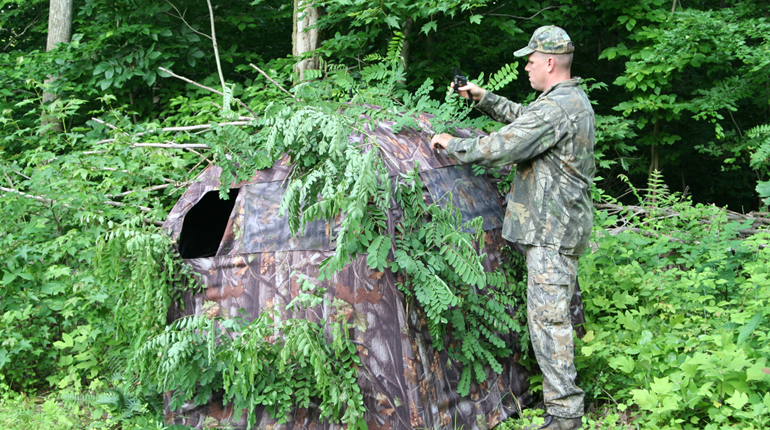
Until manufacturers make clothing and laundry soaps that eliminate human movements, deer hunters should realize they face bigger worries than which camo or blaze-orange clothing hides them best.
In fact, fretting over colors and camo patterns nearly misses the point. It’s like bowhunters debating three- and four-blade broadheads: Both have their charms, but what matters more is blade sharpness. Likewise, no matter the color, the patterns, the lighting or the habitat, what matters most is how well you imitate a woodland statue.
“Whether it’s hype about blaze orange or ultraviolet colors, those are minor issues compared to the deer’s ability to detect movements,” said professor Karl Miller, who has studied whitetail vision with graduate-school researchers at the University of Georgia for much of the past 25 years.
One of Miller’s recent students, Bradley Cohen, recently found that whitetails can see a bit further into the red and blue—and possibly ultraviolet—spectrums than previous physiological research indicated. Therefore, they recommend that “clothing worn by hunters and wildlife viewers should not be washed with laundry detergents containing brightening agents.”
Does that mean UV-brightened clothes regularly ruin hunts? No comment. Researchers don’t speculate about things they can’t measure.
“A hunter’s No. 1 concern is making sure you’re not moving when deer can see you,” Cohen said.
What else can researchers say about their studies into the whitetail’s visual capabilities? Studies at U-Georgia a generation ago concluded that a deer’s color vision is probably limited to the shorter blue and green wavelength colors. Human eyes, however, see those colors as well as the longer-wavelength red colors.
This means deer likely distinguish blue from red, but not green from red, or orange from red. The researchers reported that whitetails probably see blaze orange as a shade of gray or brown. “It appears hunters would be equally suited wearing green, red or orange clothing, but perhaps be slightly disadvantaged wearing blue,” they wrote.
Recent research confirmed those early assessments, but defined them more precisely. Yes, humans can see reds (including orange) better than deer can, but deer see blues far better than humans can. More specifically, deer see further into the dark end of the blue spectrum, and perhaps further into the UV range, than researchers once thought.
Still, they probably don’t see UV colors as something glowing under black lights. “It just means deer can see darker blues than we can see, and our eyes see further into the red spectrum than deer can see,” Miller said. “That’s why we can see blaze orange, but we can’t see all the way into the infrared spectrum.”
Here are some other insights and conclusions from Cohen and Miller:
Deer do not need to see their world’s fine detail. It’s more important that they quickly detect movement, near and far. For instance, U-Georgia research in 2007 estimated a deer’s daylight vision to be about 20/100. Miller said subsequent research puts the estimate closer to 2/60, still three times worse than normal human visual acuity of 20/20.
“When you see those fine-detailed camo prints with leaves and twigs, that’s not important to deer,” Miller said. “You’d probably do as well with a blurry camo. That’s why a stationary object isn’t easy for deer to see, but moving objects are very easy for them to see. Their eye catches movements much better than our eye can.”
Deer likely see the blue color spectrum 20 times better than humans do. The human eye has relatively few blue cones, and they’re in the central 2 degrees of our retina. Deer have far more blue cones, and they’re all across the retina, not just its center. Therefore, deer see blues across their entire 300-degree field of view.
“Deer see blue better than we see orange, but they don’t see bright orange as bright blue,” Miller said. “Those colors are not in the same spectrum.”
Deer see blue colors extremely well because their eyes don’t have a yellow filter to block UV light. In contrast, yellow pigments in the human retina filter out UV light, as do “macular” pigments—another set of yellow filters—which block even more blue light. To understand how that affects human vision, consider what happens when using yellow shooting glasses. Yellow lenses heighten clarity by blocking blue color waves. Because deer lack yellow filters, blues pour into their eyes and decrease visual clarity.
But although all that blue hurts a whitetail’s visual acuity, it enhances its ability to detect danger at twilight.
“The light most available at dawn and dusk are all those blues in the short-wavelength spectrum,” Cohen said. “Deer eyes are most sensitive to light that’s most available when they’re most active. This is an animal that sees best when it’s moving the most. Their vision system makes them a highly specialized anti-predation machine.”
That might also explain the deer’s most defining feature: its white tail. The greatest amount of light reflected by a deer’s white tail is in the short-wavelength blue spectrum. When deer flee with their white tail waving, it’s a loud visual signal to other deer.
“If you’re running through the woods being chased by a predator, you want to see your mama’s or buddy’s tail,” Cohen said. “You want to stick close and get one step ahead of your buddy before the predator catches up.”
The researchers suggest hunters choose clothes and camo patterns with darker backgrounds. Their studies suggest deer detect grays and light tans better than they do reds, oranges, browns and greens.
Meanwhile, Miller hopes to learn even more about the whitetail’s visual powers. How, for instance, can deer run through the woods and not poke out their eyes on sticks? Perhaps their ability to quickly detect motion near and far also helps them avoid pointy hazards in split seconds.
“Maybe they’re able to process what they see a lot faster than we can,” Miller said. “Finding that would increase our understanding of many aspects of the whitetail’s vision and behavior.”

Most Popular