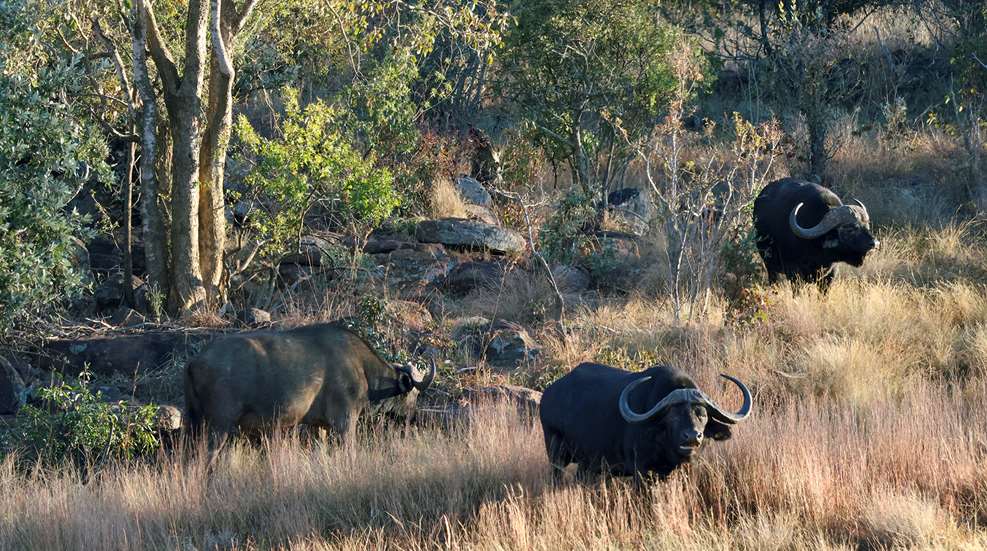
Three buffalo bulls fed in some low sawgrass on the far side of a muddy waterhole. Bachelors, dagga boys, mud bulls, slathered with wet, shiny mud. One was wide-horned and perfect. Another was bigger-bodied and heavier, with massive bosses. The third was just okay, still a hard-bossed mature bull.
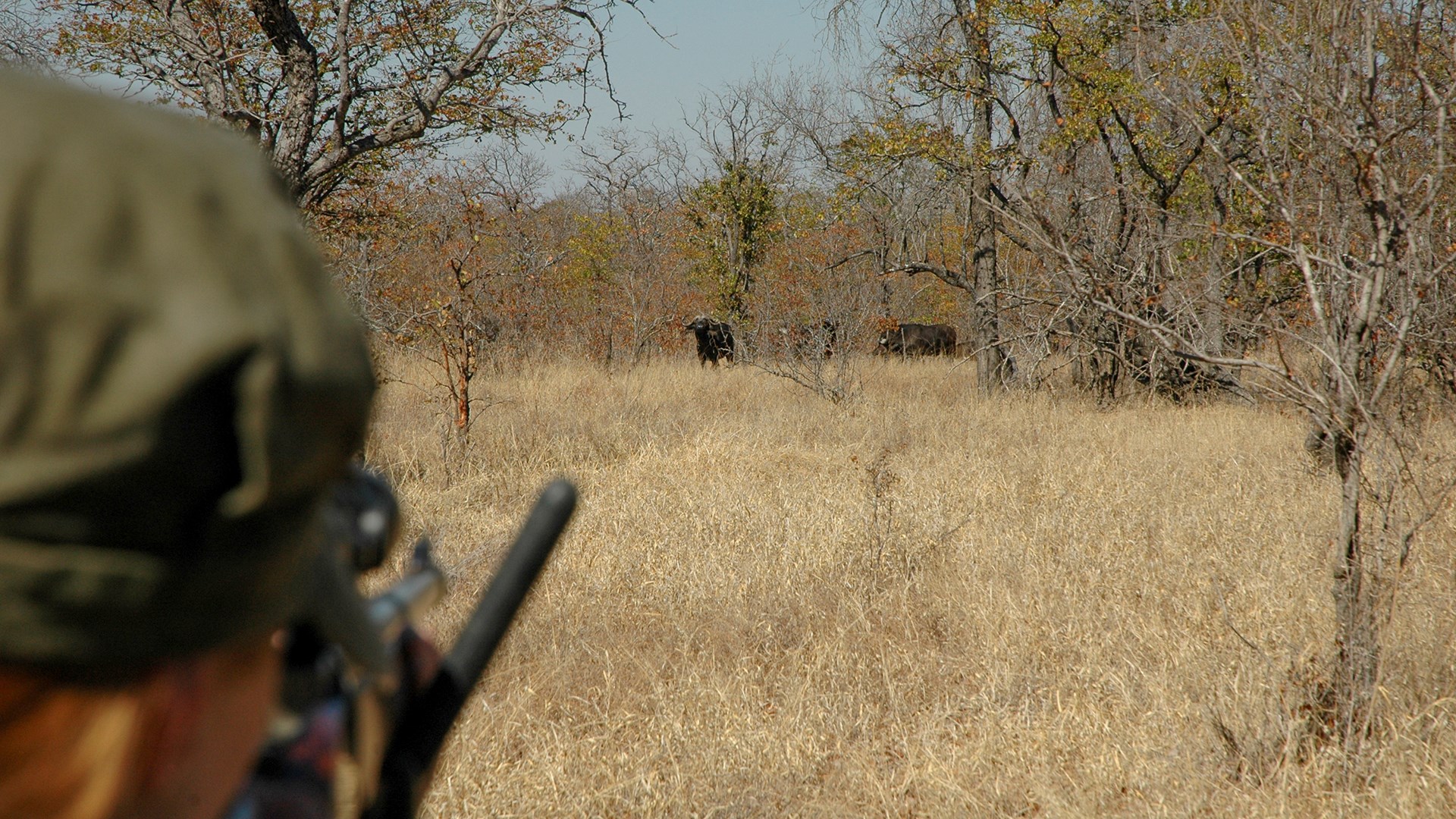
Perfect situation, ours to take advantage of … or mess up. Professional Hunter (PH) Poen van Zyl and his trackers studied the ground and checked the wind. Then we ducked back into the forest and made a big half-circle. We hoped to get ahead, but they changed direction and we came in from the side. Almost as good. After some creeping and crawling on a hot November day in coastal Mozambique, a stand of taller grass offered cover and we pitched up within range.
They were feeding in open echelon, the smallest bull 40 yards, the big, heavy bull at 60, the wide-horned prize at 90. I chose the middle bull. When he quartered away I shot him behind the shoulder. He almost went down, then he recovered and lumbered hard to the right. I hit him running, also missed him. Then he stopped and I dropped him with a final shot. Massive bosses, wider horns than we’d thought because his body was huge. Scarred face, tattered ears, a fine old bull.
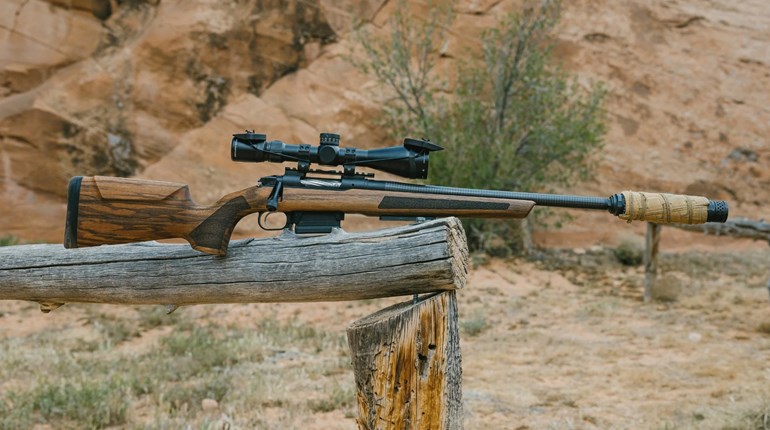
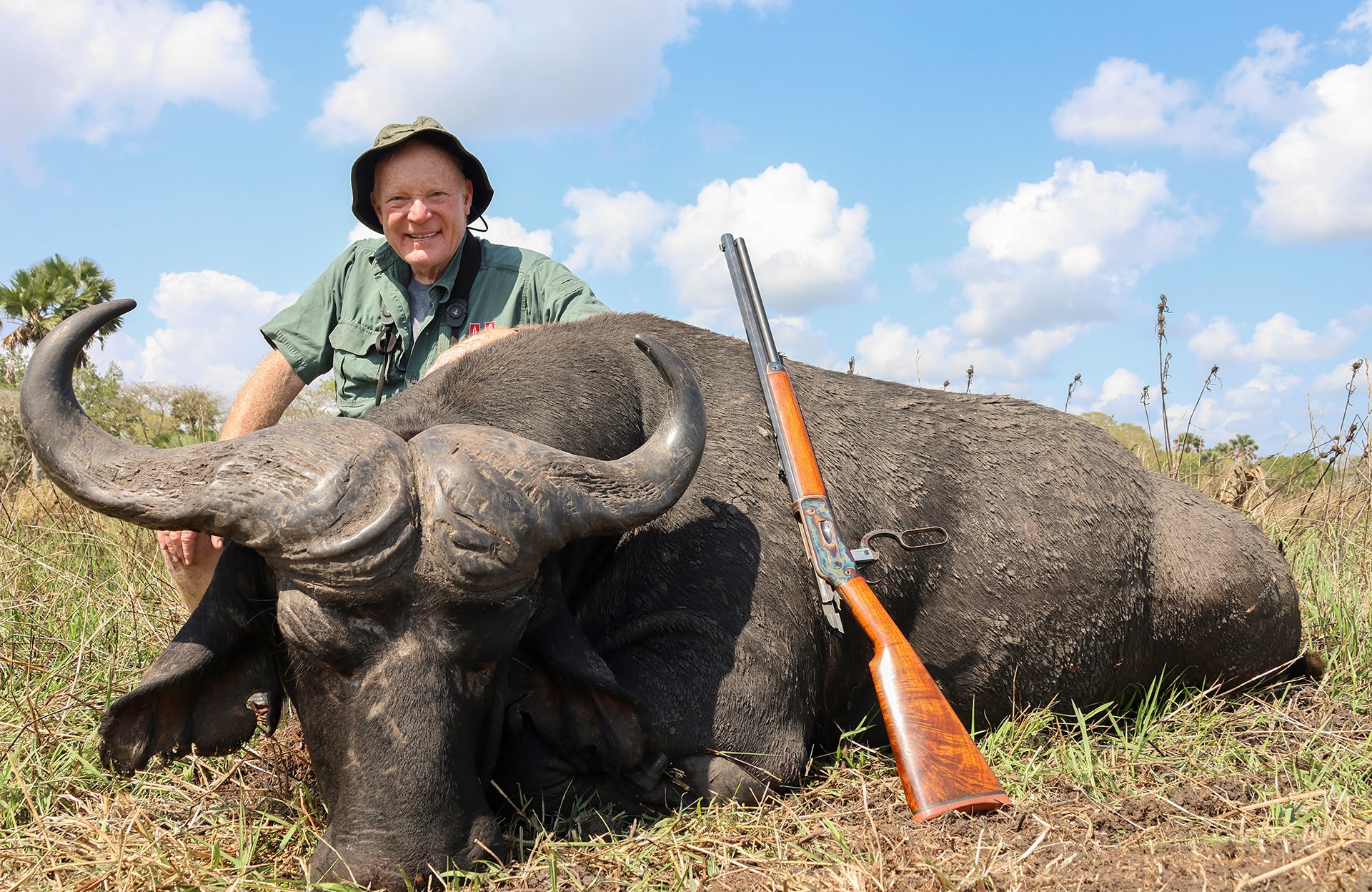 Last November, the author used a Browning 1886 in .475 Turnbull to take a huge-bodied old bull at 60 yards in coastal Mozambique.
Ways and Means
I don’t know if the first shot would have done the trick. It felt good and looked good. No way to know. First shot or last, he was down within sight, no drama.
Now let me tell you what really happened. I was shooting a Browning 1886 in .475 Turnbull, 400-grain Barnes at 2150 fps, 4,000 ft.-lbs. of energy, plenty of gun. That rifle is unusually accurate for a lever-action, but it wears open sights, buckhorn rear and a bold white front bead. At 50 yards, it groups in a ragged hole. In the field, it has limitations. So do I.
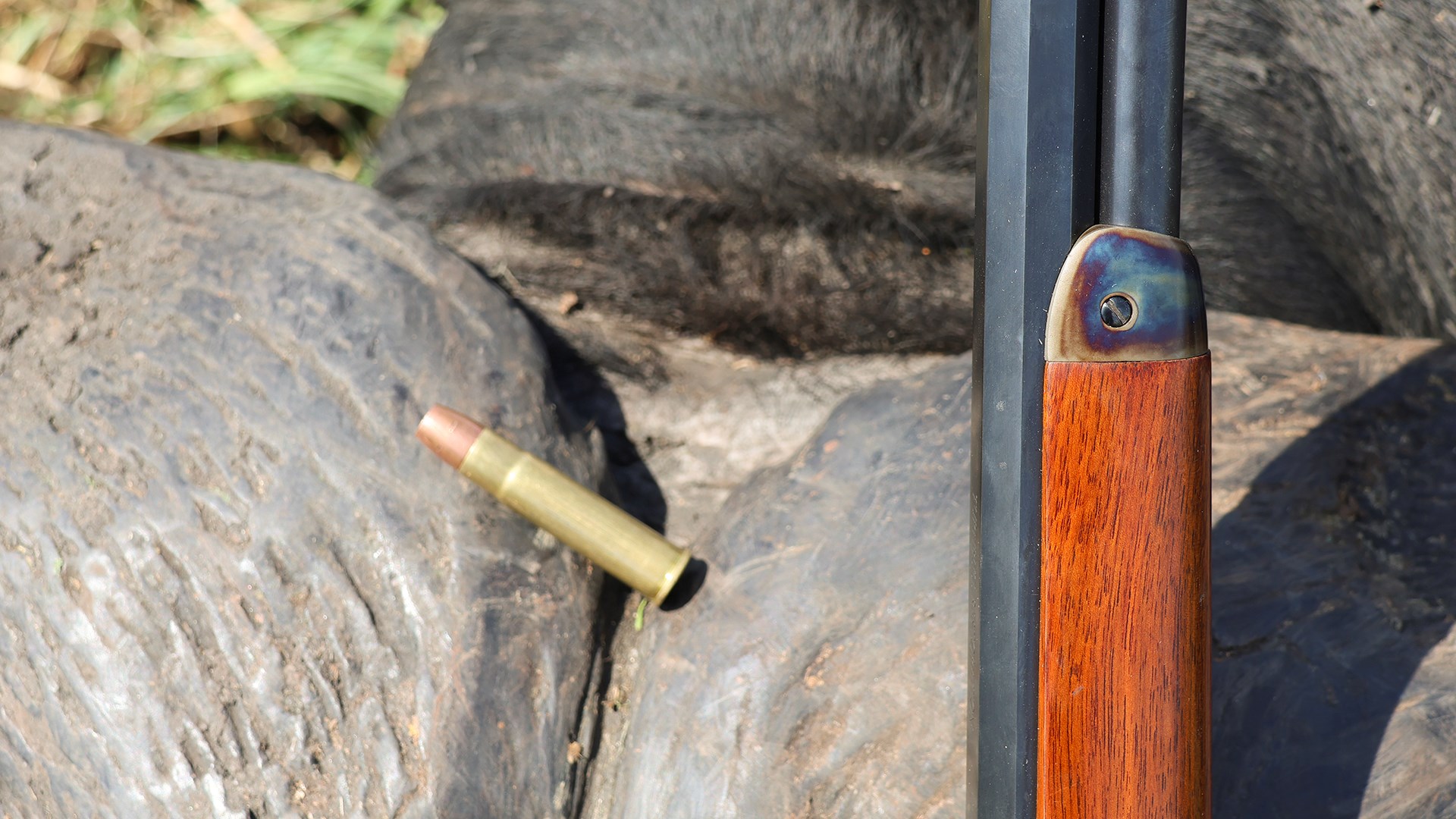
Of the three bulls, the wide bull was the one to take. When we got in on them, Poen instantly pointed him out, the most distant. I said no, too far to be certain. At 90 yards, that bold white bead covers a lot of buffalo. Well, you are you, and I’m me. I’ve shot big buffaloes. Better to leave that wide bull for someone who will cherish him. I defaulted to the big-bodied, heavy horned bull at 60 yards, a more certain shot. We let an awesome trophy bull walk.
I’m often asked about “favorite game animals.” Like most Americans, I love my whitetails. Like most who hunt Africa, I love Cape buffalo. They have much in common: Cover-loving, wary, blessed with keen eyes, sharp hearing and marvelous sense of smell. Both species are tough and tenacious of life. However, the buffalo carries a lot more pounds. If you mess up on a buffalo he may kill you.
Among Africa’s Big Nasties, the buffalo is the most plentiful and the most available. I don’t consider him the most dangerous; I rate him fourth after lion, elephant and leopard. However, across Africa there are more buffaloes taken than the rest of the Big Five put together, so there is more written about buffalo today … and there are more incidents. Therefore, there is much romance surrounding hunting the African buffalo.
This translates to expectations. It doesn’t matter whether you’re going in on buffalo for the first time or the hundredth. Few things in life are more exciting than getting up close, smelling the cattle smell, seeing the black mass shifting and milling, sorting through the group. If you’re not just a little scared, then you have malfunctioning adrenal glands or no imagination.
The encounter will be amazing, but it may not play out as you expected. Years ago, I was in buffalo camp in the Zambezi Valley. One gent gravely announced, “The only proper way to take a buffalo is with iron sights at 40 yards.” I won’t bore you with how that worked out. Not well.
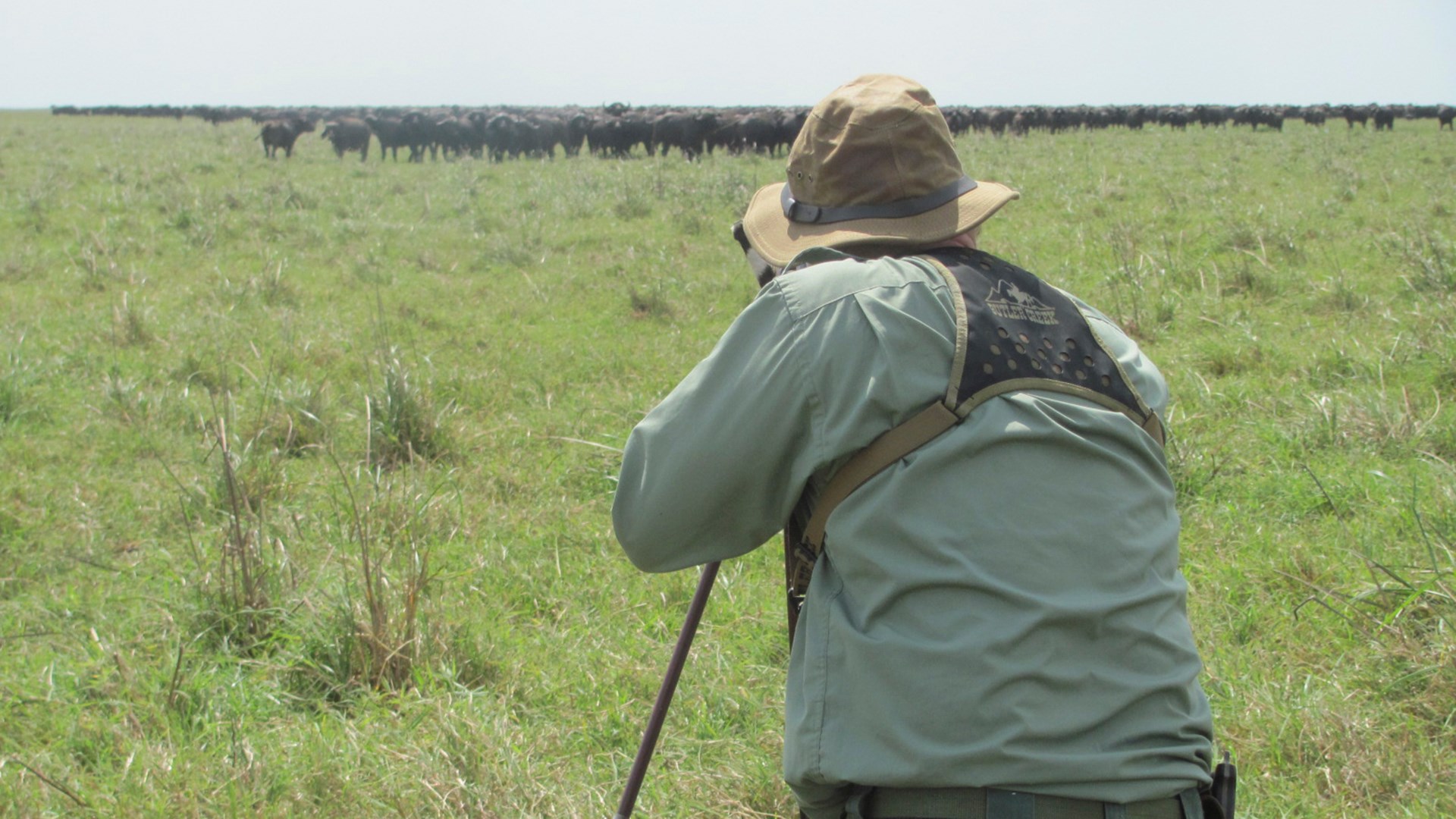
His was a nice thought, perhaps shared by many who have dreamed too long … and read too much and seen too much video. The close encounter isn’t often reality with buffalo. Most are taken by spot-and-stalk, whether following tracks or seeing buffalo and then closing. In any stalking situation, how close you can get is determined by terrain and vegetation, and by the animals themselves.
Buffalo are herd animals, small groups up to the hundreds. With safety in numbers and lions their hereditary dread, even bachelor bulls rarely wander alone. There were three in that group in November 2025. I’ve seen bachelor groups into the dozen. To get close, multiple eyes, ears and noses to defeat. Then you must winnow out the right bull.
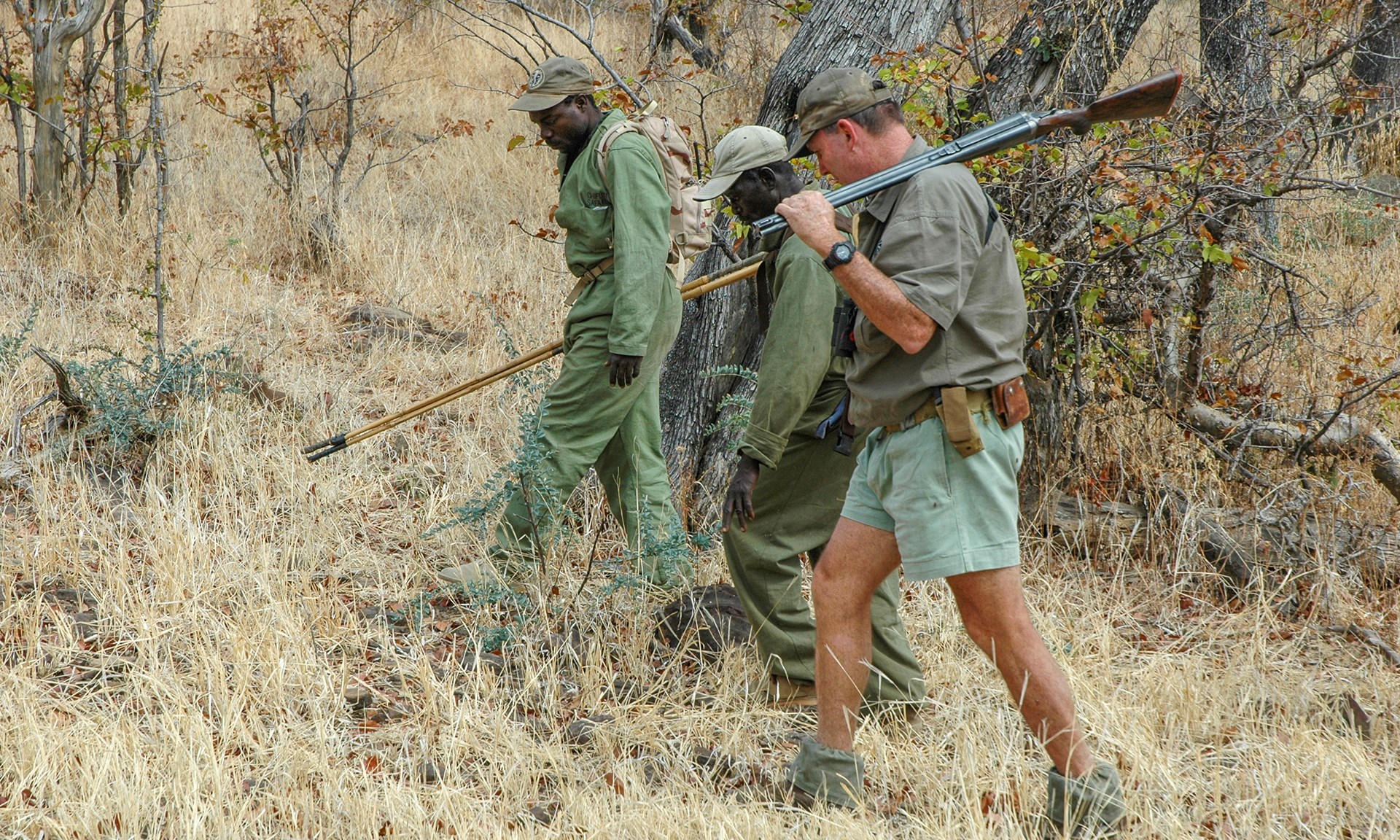
In the early 2000s, I did a lot of buffalo hunting in Zimbabwe’s Lower Zambezi with PH Andrew Dawson. There, at that time, there were a lot of bachelor bulls along the sand rivers. Singles, twos, threes, up to a half-dozen. Typically, we wouldn’t bother tracking a lone bull. Good chance of closing, but poor odds for good horns. We’d try to find tracks of multiple bulls to follow, increasing chances for a shooter … and reducing likelihood of losing the track.
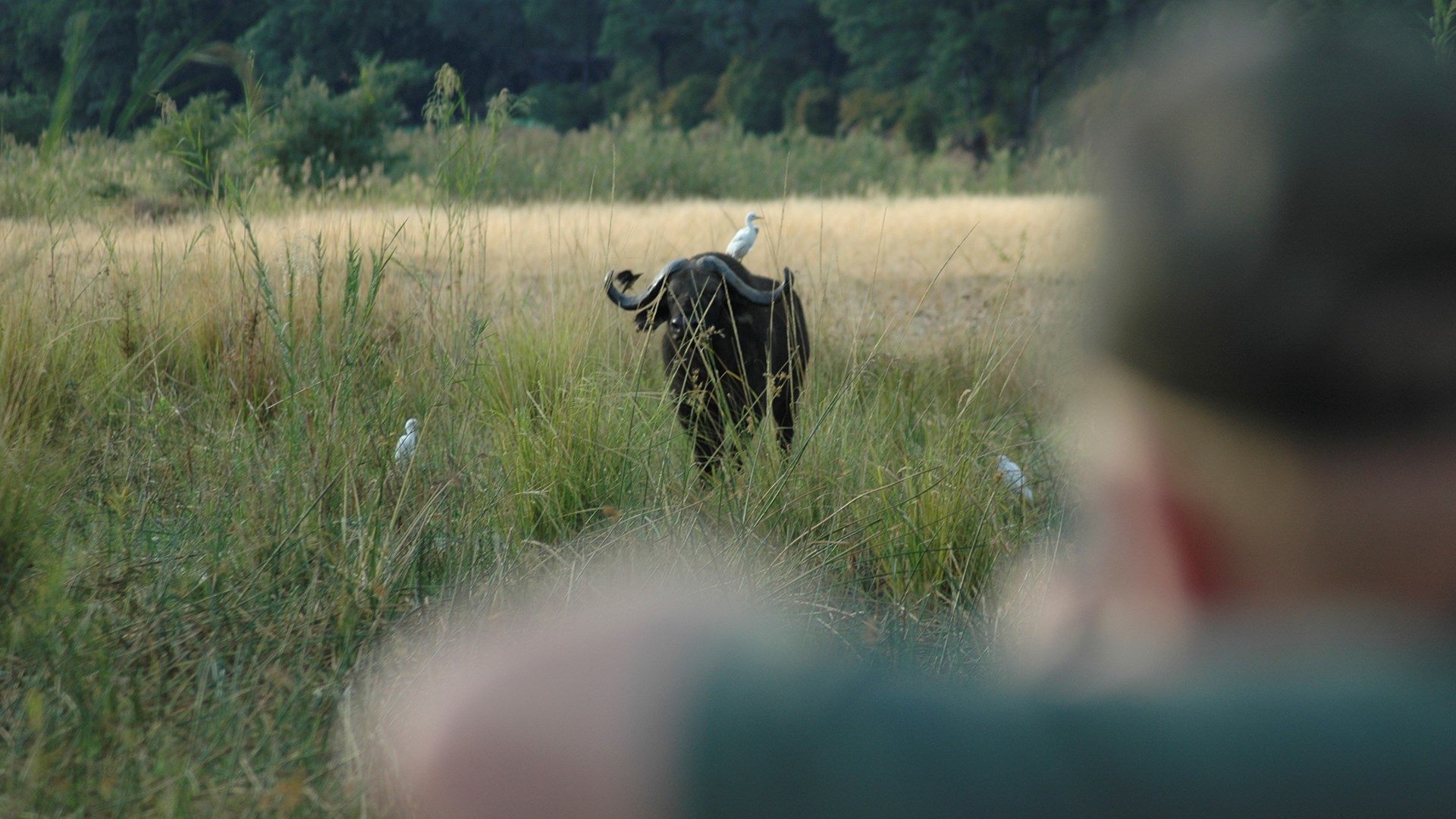
It wasn’t easy. In that hard, rocky soil, even the greatest trackers lose tracks. More frequently, just as we were closing, the wind would swirl and that was that. Because of that romantic notion, clients often brought iron-sighted big-bores. Awesome when they work, but it’s tough to get close enough. Better chance with small bachelor groups, increasingly unlikely when working herds. At one point, Dawson put a number on it: “If hunters insist on iron sights on buffalo, they need to understand they’re giving up 60 percent of shooting opportunities.” This in an area of thick bush, in a time when bachelor bulls were plentiful.
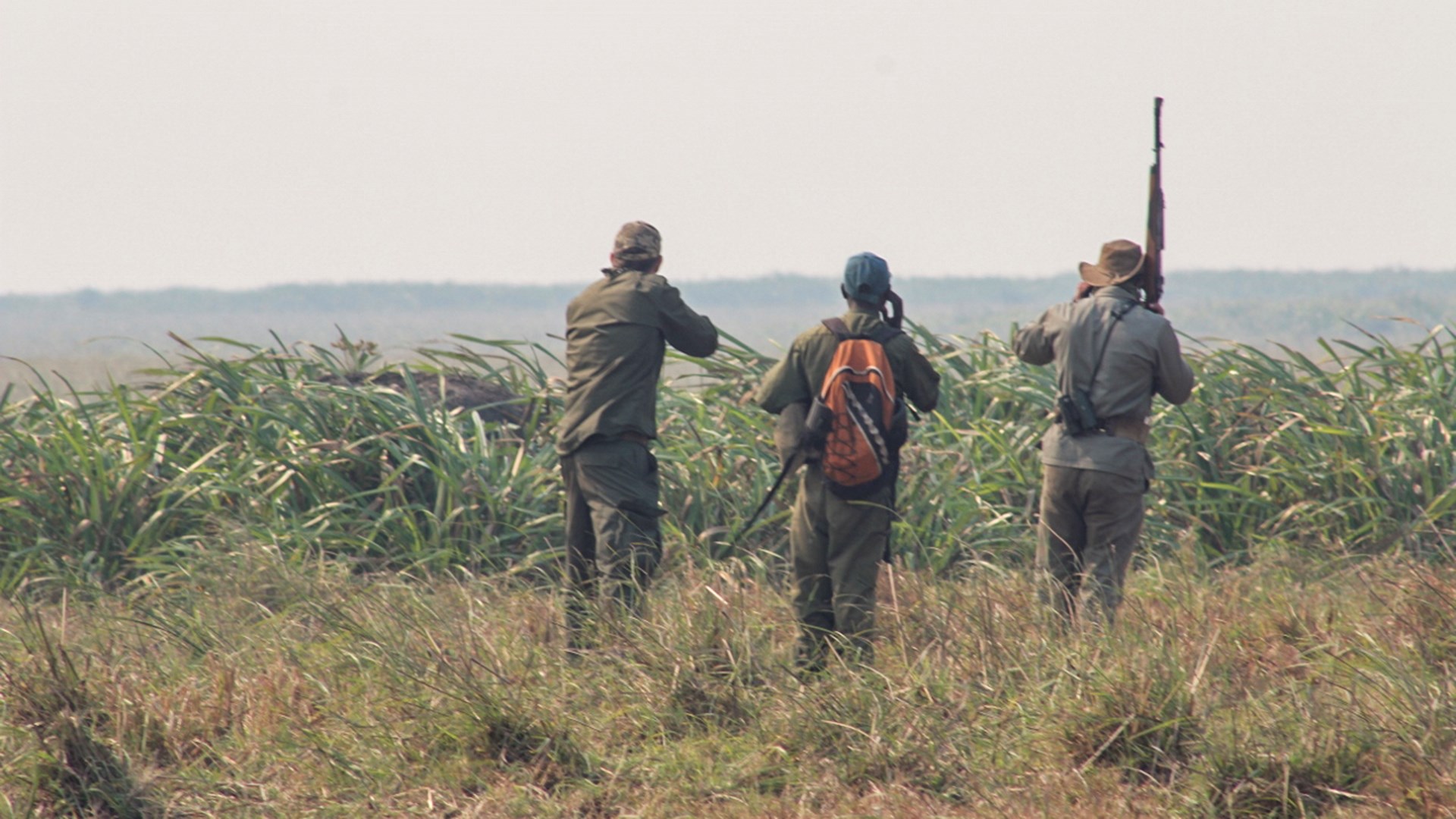
The last 20 years I’ve done most of my buffalo hunting in coastal Mozambique with Zambeze Delta Safaris, where Poen and I were. Totally different situation. Huge concentration of buffalo, mostly in big herds out in papyrus swamp and sawgrass flats interspersed with short-grass savannas. There, perhaps because of soft living in ideal habitat, bachelor groups are uncommon, and most herds contain mature bulls. The more eyes and ears, the more difficult to get close. In the shadeless swamps we wear long trousers and long sleeves against unrelenting sun, and leeches. Gloves against sawgrass that cuts like razors. And kneepads for crawling over hard-baked ground.
You can get close, but it’s a matter of how close. There, I would say the normal shot at buffalo is past 75 yards. It is not iron-sight country. With practice and good vision, 75 yards is fine. What about 100 yards? Using scoped .375s or .40-somethings, I’ve taken buffaloes all over Africa at 100 yards. That’s not the limit, but nobody takes a long shot at a buffalo.
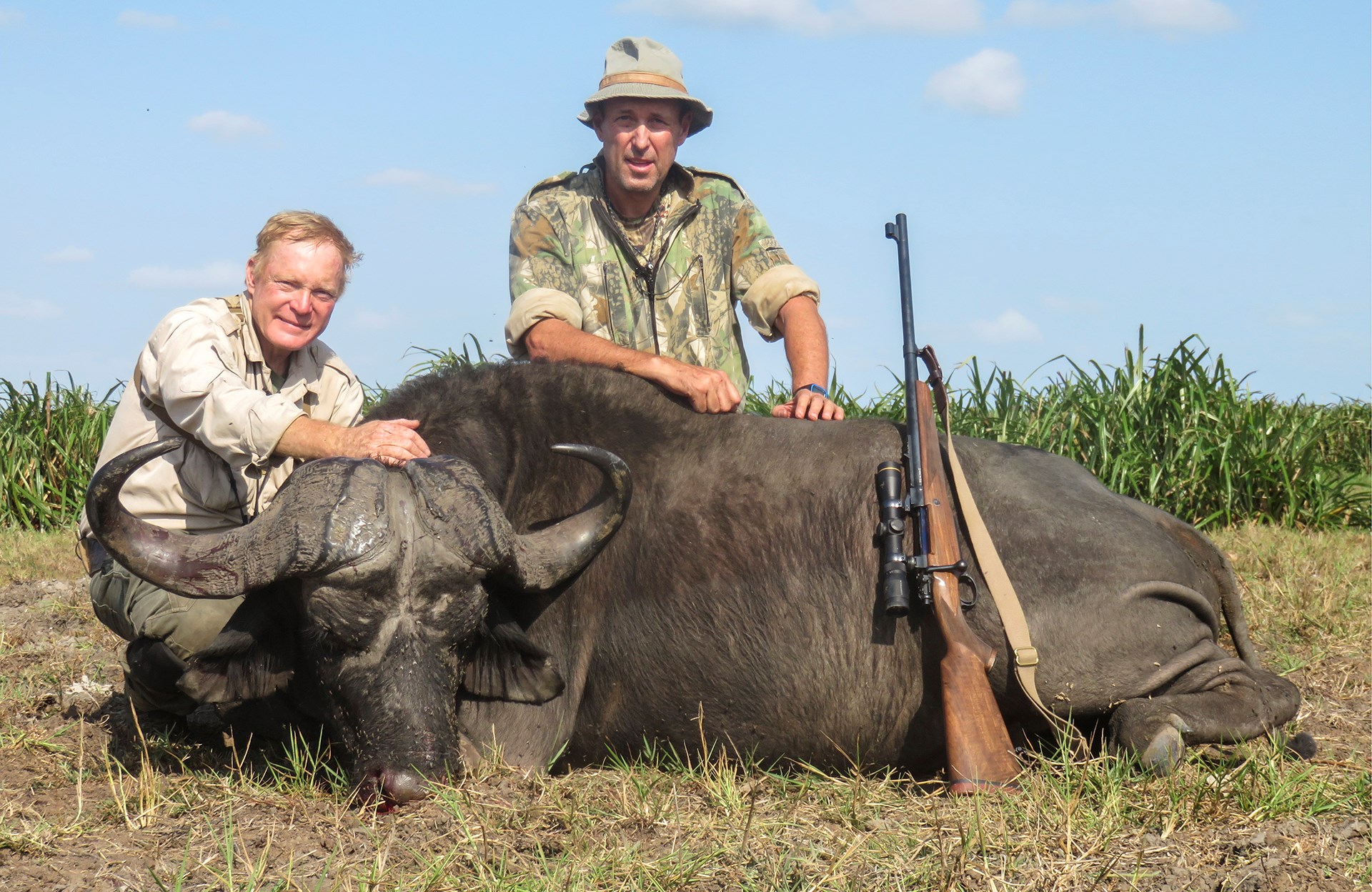 Hunting with PH Mark Haldane, Boddington took his longest shot ever on a bull in a swamp: 165 yards.
It was out in the Mozambique swamps that I took my longest-ever shot at a buffalo. PH Mark Haldane and I stalked a nice herd, 100 or more. We caught them spread out in a small savanna, cows and calves within 40 yards, but the big bull was on the far side of the herd. Somehow, he always is 165 yards—take it or leave it. Impossible with iron sights. I was shooting a well-scoped .416 Rigby. Sitting, sticks spread low, dead-steady. At the shot we lost him in the press. When the herd and their dust cleared, he was right there, all four feet in the air.
It’s true that iron sights and traditional big-bores give special satisfaction. I have an old .470 that I love and I use it. With caution. Last November, I carried my .475 Turnbull because I wanted to take one more buffalo with it. But that’s me. I understand the risk, and I’m happy to walk away if I can’t get close enough. Had it been my first buffalo, I would have wanted that wide, beautiful bull … standing just a bit too far. Romantic notions aside, wherever we hunt, we will all take more and bigger buffaloes with scoped rifles of adequate power.
The Danger Factor
Incidents occur. In August 2025, a well-known Texas hunter was killed by a buffalo. Over the years I’ve lost other friends to buffalo. Although rare, it happens. What was highly unusual about this sad incident: They were hunting buffalo, but not that buffalo. It was unwounded, charged out of nowhere.
Part of the romance: Because of too many sensational stories and videos, some hunters go buffalo hunting secretly (or openly) hoping to stand a charge. Uh, no, you really don’t want that. Because not all charges can be stopped. The buffalo that killed veteran Zimbabwe PH Owain Lewis was wounded and tracked for three days. Difficult, determined tracking, spoor utterly lost several times. Better it had been declared lost, but Owain wouldn’t give up. According to witnesses, 18 shots were fired in the final encounter. An average buffalo bull weighs 1,500 pounds, and I know of no tougher animal when pumped with adrenaline.
Whether you welcome it or dread it, actual buffalo charges are rare. I hunted buffalo for 30 years before I saw a genuine charge. And that first one was another unprovoked charge, almost unheard of. I was hunting in the Valley with PH Mike Payne and hunter Chad Allen, me along for the ride. We got into a herd, lost them, circled to pick up tracks, figured they must have held up in dense bush across a sand river.
No tracks, no known buffalo nearby, we strolled across the river toward three tall palm trees. A lone buffalo bull rose from the shade of the nearest, 30 yards away, shook his head once and came in a full-out charge.
The unarmed tracker wisely exited stage right. Chad stepped up beside Mike and raised his double. The buffalo now within 20 yards, Mike said clearly, calmly and firmly, “Chad, take him now.” Their .470s went off at the same time, slewed the buffalo sideways, then he went down as their second barrels sounded together—20,000 ft.-lbs. in a half-second.
Behind them and blocked, all I could do was watch the wonderful show. The buffalo came straight in, head high, magnificent, seeming to fly over the ground as the distance closed. At the last, he would have dropped his head to hook, but he was down before he got that close. You may think you want to see that. You really don’t.
Uncharacteristic buffalo behavior … until we examined him. He’d had a bad encounter with a lion, deep gouges in private places, infected and stinking. I’d have been in a bad mood, too.
Such events are highly unusual. Most of the time, you don’t get in trouble with dangerous animals unless and until mistakes are made. Most commonly, not shooting well enough in the first encounter.
Until that event with Mike Payne and Chad Allen, I was starting to feel cheated. Mind you, I’m not perfect. I’ve wounded buffalo, paid with terrifying follow-ups, just had never seen a genuine charge. Since then, I’ve sort of caught up, seen several. Hope I never see another.
There is a well-known hunter who has had a successful career producing videos full of hair-raising charges. I know him, knowledgeable PH, great shot, ice-water in his veins, but actual charges are so uncommon that I always wondered how he did it. I finally figured it out. He discourages use of scopes and shooting sticks. In his videos, a lot of initial shots are like everyone’s, maybe 75 yards. Try that unsupported with iron sights and you will have plenty of wounded buffaloes to follow. The Law of Averages kicks in.
It is not true that the Cape buffalo is a vengeful satanic beast, prone to circle and lie in wait. Some do, but that seems as rare as unprovoked charges. The scariest follow-up I ever did was on a bull I shot poorly in the Zambezi Valley. We jumped him at dusk, realized we were no longer tracking a dead buffalo.
Long night, took the tracks at daylight. Hours winding through thick gray jess, some of the thickest cover in Southern Africa. When we finally caught up he was on his feet, circling to get our wind. I dropped him with a double .500 borrowed from Russ Broom. Luckily, we were in slightly more open mopane forest. In that awful jess, that could have been an unstoppable charge.
Keep Shooting
My initial shot was with a scoped .416, not far. The hit was way too far back. No excuse. Worse, only the one shot was fired. A few hours into a tracking job like that, you’ll be hoping for a charge just to get it over with. It may not happen.
The African buffalo is so strong—and strong-willed—that my experience is a poorly hit buffalo is likely to cover a lot of ground. It may lie down and succumb or, if hit non-fatally, jump up and run again when you approach, and we can hope it offers another shot. Or it may just keep going until the wound closes and blood spoor is gone. Rather than a charge, my experience with poorly hit buffalo: That buffalo will likely never be seen again.
Twenty years ago in the Zambezi Valley, Chifuti Safaris had an annual quota exceeding 100 buffaloes. It seems like we were losing about one in 10. Sounds high, but it’s hard ground, few roads, no choice but to follow as long as you can. In that same period, maybe one genuine charge per season, which supports my theory that a wounded buffalo is most likely to just keep going.
I have an alternate theory. In 49 years of hunting African buffalo, I have seen only one lost that was hit more than once in the first encounter. In that anomaly, video suggested both were peripheral hits. We followed blood until there was none, circled and recircled, and then we were out of Schlitz. We Americans have a bad habit of firing a careful first shot, then standing with our thumbs (never mind), watching to see what happened. African PHs call it “admiring the shot.” The first shot is all-important. Subsequent shots will be less steady, probably at a moving animal. But if the animal is still on its feet—and the shot is clear—extra bullets can save the day.
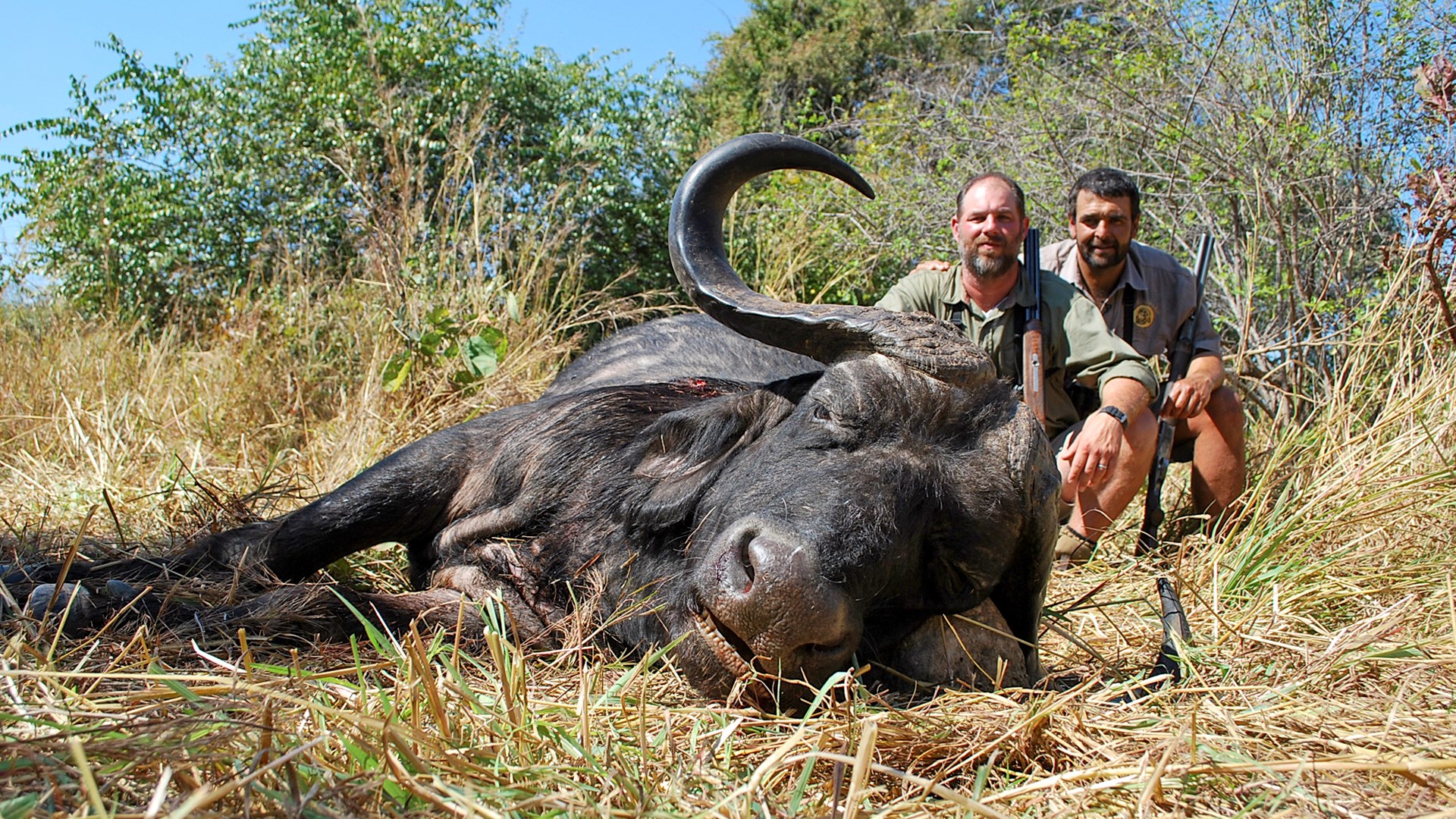 Chad Allen, with PH Mike Payne, took a Zambezi Valley bull in a rare, unprovoked charge at close range.
Even if non-fatal, extra bullets produce more damage, more spoor to follow. On such a large, strong and dangerous animal, it’s unwise to bank on that first shot if you have a choice. It may not be as perfect as you think, and you can’t know how the bullet performed. In 1977 I lost my first buffalo high on the slopes of Mount Kenya, where hardwood forest surrenders to impenetrable bamboo. I can still see my crosshairs on the broad bum of that bull as the bamboo closed around him. And that was the last we saw of him.
In those days, expanding bullets were still mistrusted. I was shooting a .375 with 300-grain solids. I should have fired, don’t know why I didn’t. I suppose youth and inexperience. For sure, I was “admiring” my first shot … which wasn’t as good as I’d thought. Since then, I have never spared additional shots when possible. Things happen fast. Other buffaloes and vegetation get in the way, and you can’t shoot again unless you’re certain which buffalo and the shot is clear. If you’re sure and you can, you should, no matter how you feel about that first shot.
Sometimes it’s not necessary. I’ve had one-shot kills with lots of cartridges, from .338 and 9.3mm, .375, .40, up to big bores. Probably more with .375s than anything else … because I’ve shot more buffalo with .375s than anything else. However, since my Kenya debacle, one-shot kills have occurred only because I couldn’t safely fire again. Or, rarely, the buffalo was down on the spot. Then I’ve stood ready to make sure it stayed down. Practicing working the action or using the second barrel of a double is as important as practicing for that first perfect shot. Do a lot of that practice off sticks but practice offhand as well. If you do get close, there often isn’t time or you can’t risk the movement to set up sticks.
On my November 2025 buffalo—which I hope isn’t my last—I followed my rule. I placed the first shot as well as I could, felt good about it. Then, my bull clear and moving, I kept shooting. The ’86 lever-action was smooth and fast, but after the first shot I was pushing my limit with open sights. Two were okay, one a clean miss. It doesn’t matter. The bull was down in sight, ideal conclusion to a perfect buffalo hunt.