“That damned Yankee rifle that can be loaded on Sunday and fired all week.” Those are the words of Confederate Col. John Mosby referencing one of the first two practical repeating rifles to be placed in U.S. military use; the Henry rifle, built by the New Haven Arms Company.
Introduced in 1860, the Henry overmatched the rival Spencer in capacity (15 rounds vs. seven), reliability, and practical rate of fire, thanks to cocking integrated into the reloading cycle. Originally chambered for a .44 rimfire cartridge, the Henry threw a 200-grain bullet at around 1125 fps. While weaker than the .56-50 Spencer, it was sufficient for cavalry and close-range infantry use.
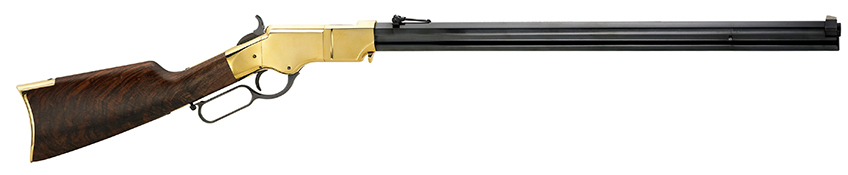
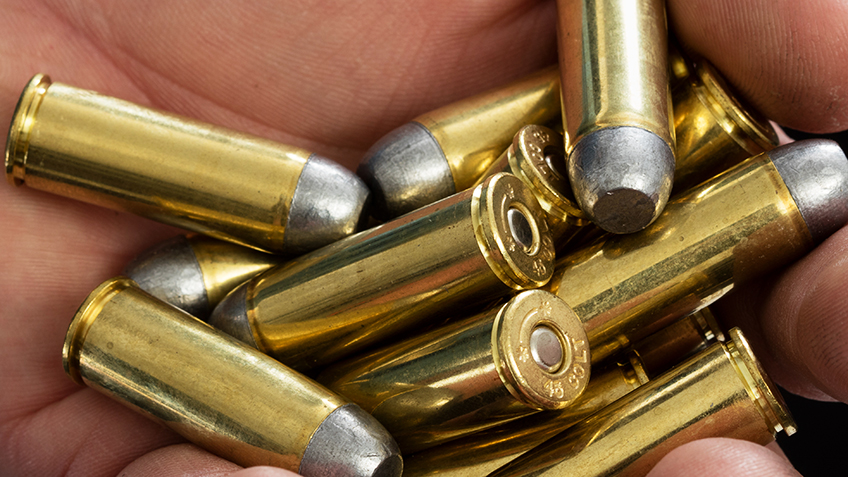
In production only until 1866, the original Henry toggle lock and tubular magazine lived on through the Winchester 1866 lever-action rifle. Recently, the Henry Repeating Arms Company (no affiliation or lineage to Benjamin Tyler Henry or to the New Haven Arms Company), introduced their version of the classic Henry rifle in several variants, including .45 Colt and .44-40 Win. models, featuring a brass receiver similar to the original, and a .44-40 Win. version with a case-hardened steel receiver. The differences between the New Original Henry rifles and those made by the New Haven Arms Company are minor and include the addition of a drop safety and the reduction of capacity to 13 cartridges. The fit and finish on the New Original Henry is far ahead of the original. The New Original Henry rifles are almost like jewelry—jewelry that shoots bullets.
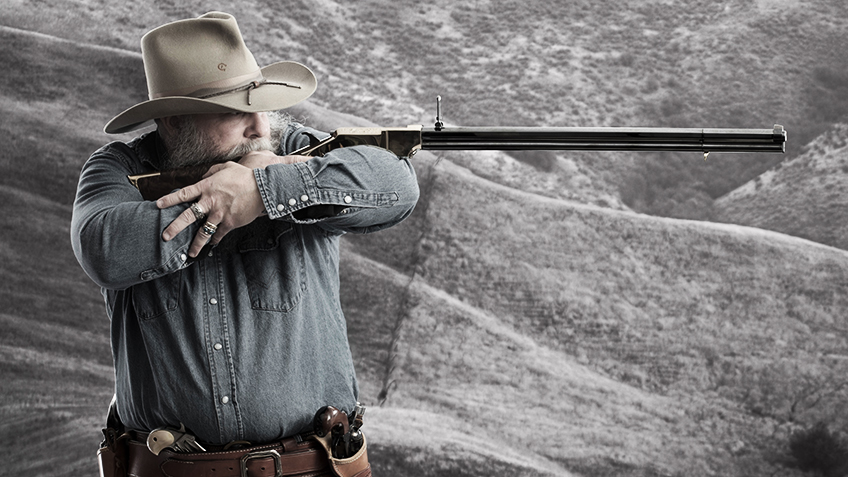
While the 24-inch octagonal barrel is not strictly necessary for either the .45 Colt or .44-40 Win. cartridges, it does give them a little extra pep. Cowboy loads nominally rated at 800 fps were pushed around 980 fps from the longer tube. The increased sight radius also helps, and the forward balance reduces muzzle rise on firing. This reduction is quite helpful, as the 1860 Classic is also distinctive in its lack of any forend whatsoever. This means that the support hand usually rests underneath the receiver, both to avoid burning hands on a hot barrel and to keep from interfering with the magazine follower that moves from front to back under the magazine tube as the ammunition is depleted.
This unconventional design led to a number of equally unconventional shooting stances, including cradling the rifle in crossed arms for stability. Overheating is less of an issue now than in the past, as smokeless loads use somewhere between 1/7 and ½ of the powder charge compared to the black powder loads. Also, outside of dirty and dusty environments, reloading the tube magazine with the bolt open cools the barrel through air convection.
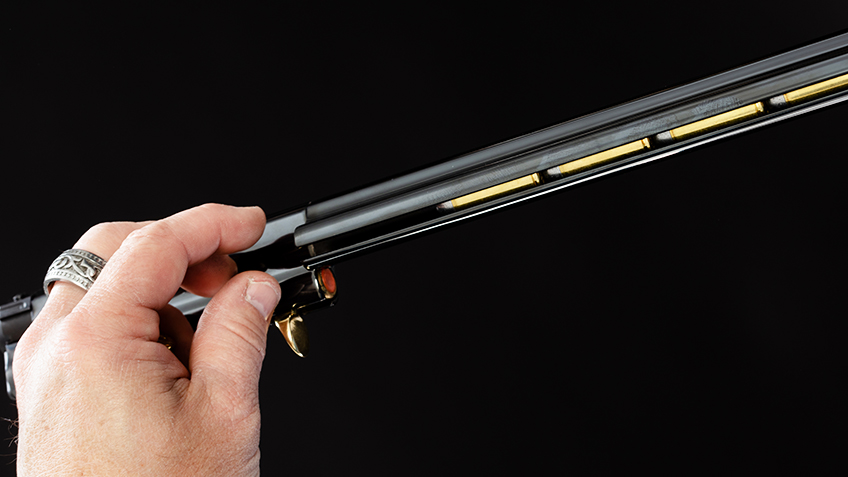
Loading the New Original Henry rifle is unconventional by our standards: it involves pulling the follower to compress the magazine spring, then turning the separate front segment of the magazine tube to trap the follower in it. Individual cartridges slide into the magazine from the front. Care must be taken to hold onto the follower as it is returned in line with the cartridges, else it will slam into the bullet of the front round. This loading method seems awkward compared to a side loading gate.
Both the .44-40 and .45 Long Colt are represented in two tiers of power. Cowboy generate minimal muzzle blast and no perceptible recoil. Although loaded with smokeless powder, they produce some smoke from the burning lubrication. It’s also very evident, especially with straight wall .45 Long Colt cases, that the obturation is lacking and some gas escape around the breechface. This is why eye protection is crucial even for historic reenactors. This issue goes away with full power ammunition in either caliber.
In .44-40, the 200-grain Hornady XTP yields little smoke at either end, while reaching nearly 1950 fps with a correspondingly stout kick. Even with the 9-pound rifle, the curved buttplate makes it quite clear that a shot went off. The .45 Colt gains less, but 1300 fps is typical of full power ammunition. Effective range depends mainly on the sights and user proficiency. The rear notch flips up to reveal a ladder sight graduated from 300-800 yards for the .44-40. With the best accuracy hovering around 3 MOA, the longer distance markings are more for area targets like enemy columns or cannon crews, both conspicuously missing in today's world.
While the toggle action is too complicated for routine disassembly, the long, skinny bolt has the advantage of keeping power residue away from the rest of the action. The Henry manual recommends limiting cleaning to a pull-through bore cleaner and oiling the outside of the gun. The New Original Henry rifle requires minimal actual maintenance: it was designed to withstand the fouling and the corrosion of black powder and mercuric primers after all, so clean non-corrosive modern ammunition gunks it up less than expected. Compared to its contemporaries, the New Original Henry handles much more like a modern firearm. It isn't the most practical hunting rifle ever made, but it's entirely adequate for medium-sized game, so long as the range is kept short in deference to the open sights. Unlike the 1860 design, the new Henry may be safely carried on half-cock.
Compared to stronger modern lever-actions, the New Original Henry offers certain handling advantages. Energetic top ejection is left-hand friendly, and loading is the same for left- and right-hand shooters. The short bolt protrusion permits maintaining the sight picture while working the lever. Open sights, though not conducive to long-range precision, work well for following moving targets. Meant primarily for Cowboy Action and reenactments, the New Original Henry rifles are practical enough to provide venison in any brush hunting area—with an abundance of style!
Technical Specifications
• Type: Lever-Action
• Caliber: 44-40 Win., .45 Colt
• Barrel Length: 24.5″
• Barrel Type: Octagon Blued Steel
• Rate of Twist: 1:16″
• Overall Length: 43″
• Weight: 9 lbs.
• Receiver Finish: Polished Brass
• Rear Sight: Folding Ladder
• Front Sight: Blade
• Stock: Fancy American Walnut
• Buttplate/Pad: Brass
• Length of Pull: 14″
• Safety: Half Cock
• MSRP: $2,415; henryusa.com