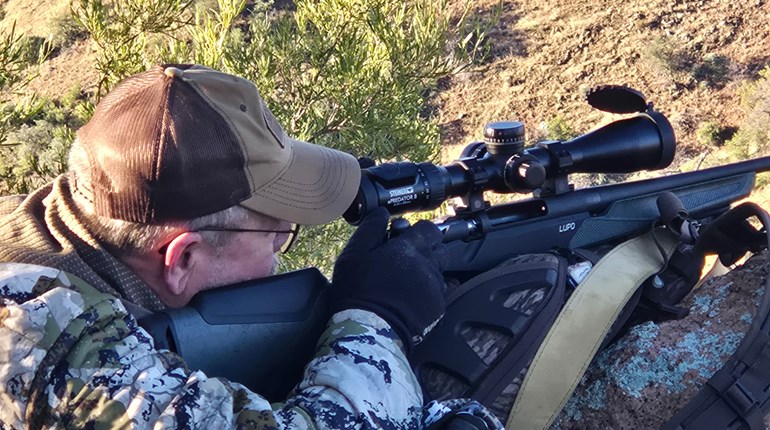
The .30-06 Springfield case has been the impetus for a good number of very useful wildcat and commercial derivative cartridges. From the .270 Winchester to the .35 Whelen, and the Remington pair of .25-06 and .280, the cartridge dimensions offer a useable blend of powder capacity and shooter-friendly levels of recoil. But, I may have to vote for the least known of the offspring for the coolest of the lot—the .338-06 A-Square.
 First, let’s take a look at the bullet diameter. The .33 Winchester was a fat, rimmed cartridge designed for the Model 1886 lever-action rifle, and it was built around a 200-grain flat-point bullet of .338-inch diameter. While moderately successful, the cartridge was retired when Winchester discontinued the ’86 in favor of the more powerful .348 Winchester in the Model 71. Elmer Keith, along with a couple of buddies, worked on some wildcat cartridges using the .30-06 case and a shortened version of the .300 H&H case, both mated with the heavier bullets of the nominal .333 Jeffery. While these wildcats worked just fine, wildcats they were.
Winchester saw the wisdom of the design, and in 1958, released the .338 Winchester Magnum, using a belted case (from the .375 & .300 H&H Magnums) shortened to 2.500 inches, and—presumably—using a bullet diameter that Winchester had been geared up for. The spitzer bullets showed their advantage over the flat points used in the .33 Winchester, and the .338 Winchester Magnum was an overnight success, being a perfect choice for elk, moose and the big northern bears. But, with the additional velocity comes increased recoil.
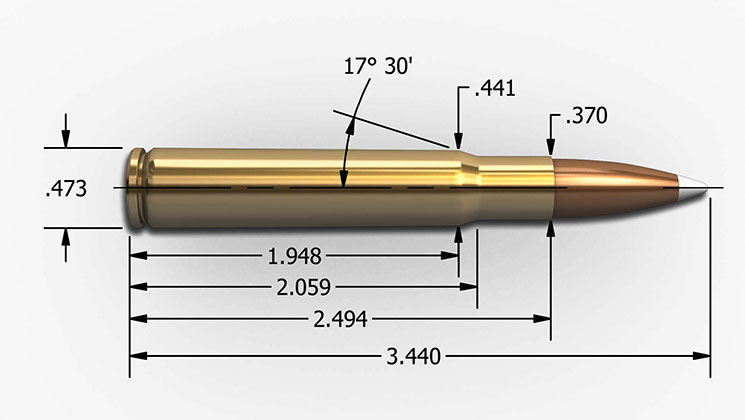
When a new cartridge or bullet diameter is released, the wildcatters immediately start buzzing like a nest of disturbed hornets. Some designs work well, and may make their way to the Big Show, while others stay in the minor leagues for quite a while; the .35 Whelen is a classic example of a long-term wildcat becoming commercially accepted. The .30-06 case has been reworked to hold bullets from .22 caliber all the way up to .416 caliber, with varying degrees of success, but it seems that the .338-inch bullet diameter fits the case nearly as well as any other. While it was around as a wildcat cartridge for a number of years, it was Col. Arthur B. Alphin’s A-Square company who legitimized the design, receiving SAAMI approval in 1998, with Weatherby chambering rifles for the cartridges. It utilizes the 17.5 degree shoulder and the same case length as its parent—2.494 inches—so the conversion from an existing .30-06 Springfield rifle is not a serious thinking job for a competent gunsmith.
For a hunter who routinely pursues the bigger beasts, it makes a whole lot sense, for a number of reasons. The .338-inch diameter is typically offered with bullets between 200 and 250 grains, but the modern—and some of the older—bullet developments have changed all that. Yes, the 200, 225 and 250s work just perfectly in the .338-06, but there is more to offer for a hunter who wishes to utilize the cartridge to its full potential. On the heavier end of the spectrum, Swift offers their A-Frame at 275 grains for serious bone-smashing power, and on the lighter end, there are bullets like the Nosler AccuBond available at 180 grains. This, combined with the traditional bullets, gives the hunter a cartridge that is very versatile, yet easier on the shoulder than the .338 Winchester Magnum, though the velocities run only 150 fps or so behind the larger case.
The 250-grain bullets will leave the muzzle at 2,500 fps or so, compared to the .338 Winchester’s 2,650 fps. That slight reduction in velocity translates to a very noticeable difference in felt recoil, yet within normal field ranges, the differences are diminished. Not that there is anything wrong with the .338 Winchester Magnum, but I personally find it to be the tipping point for ‘snotty recoil’—I’ve had some .338 Win. Mag. rifles deliver a serious beating to the shoulder, especially off the bench. The .338-06 tends to be gentler, and therefore easier to shoot. When there’s a big bear on the other end of the line, that fact may become an important consideration.
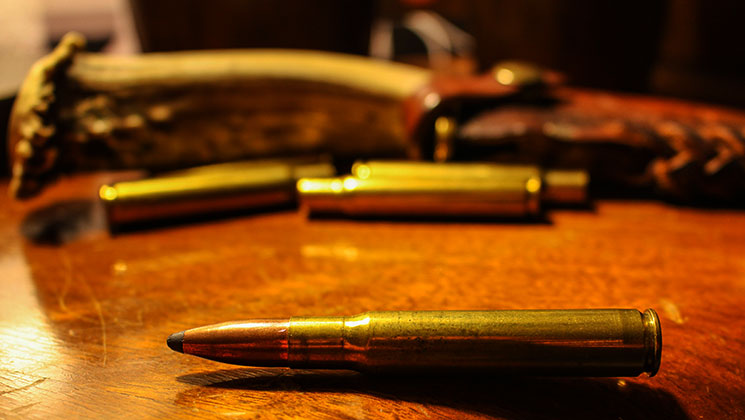
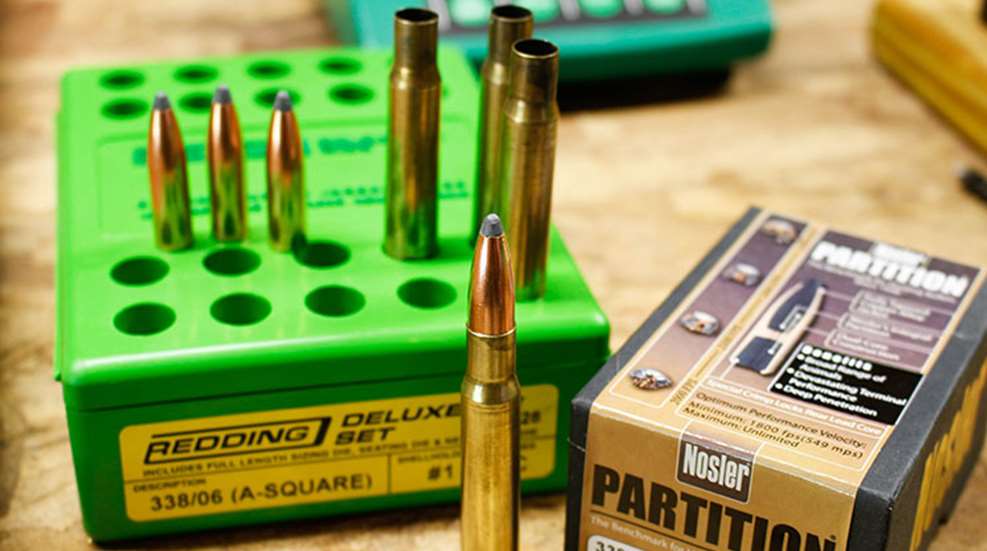
If the cartridge intrigues you, as it does me, ammunition can be handloaded rather easily. Cases can be made from the readily available .30-06 Springfield brass, using a set of .338-06 resizing dies with a good tapered expander ball. One careful pass through the die, and you should be set, though the cases may come out a bit shorter than the desired length from the resizing process. Other than that, it’s a straight-forward process, with the .338-06 running well on the medium to medium-slow burning powders like Hodgdon’s H380, IMR4064, and Alliant’s Reloder15 and IMR4350. Sparked by a standard large rifle primer, the .338-06 is efficient with regards to powder consumption.
If you’re looking for something out of the norm, which can be housed in a handy rifle that hits hard, give the .338-06 a look; if you spend a bit of time with it I believe you’ll become a fan rather quickly.
Looking for previous installments of Behind the Bullet? We've got you covered.
• 9.3x62mm Mauser
• .257 Weatherby Magnum
• .45-70 Government
• .300 H&H Magnum
• .25-06 Remington
• .30-06 Springfield
• 6.5 Creedmoor
• .300 Remington Ultra Magnum
• 7mm Remington Magnum
• .470 Nitro Express
• .280 Remington
• .300 Winchester Magnum
• .270 Winchester
• .222 Remington
• .45 ACP
• .404 Jeffery
• .44 Remington Magnum
• .41 Remington Magnum
• .243 Winchester
• .338 Winchester Magnum
• .357 S&W Magnum
• 6.5-284 Norma
• 8x57 Mauser
• .38 Smith & Wesson Special
• 7x57mm Mauser
• 9 mm Luger
• .35 Whelen
• .454 Casull
• .375 H&H Magnum
• .45 Colt
• .22-250 Remington
• 10mm Auto
• .308 Winchester