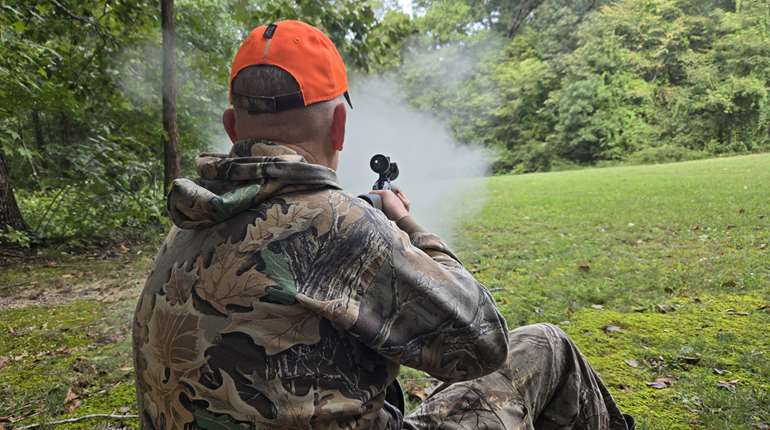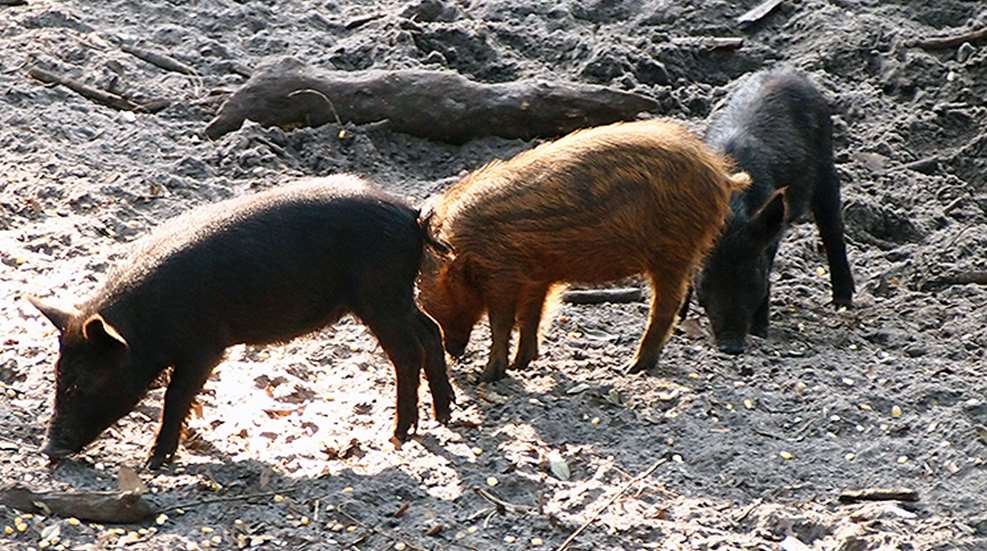
During Missouri’s 2015 deer rifle season, Carla Brown Beck hunted a portion of the Mark Twain National Forest in Washington County. During her hunt, she saw over 100 wild, feral hogs, bagged a couple, and processed the meat for use. If the Missouri Department of Conservation (MDOC) has its way, however, Brown and other Missouri hunters won’t be any more taking feral hogs on public lands MDOC manages—and there’s a good chance the federal government will follow suit on Missouri’s national forest lands, too.
In January, MDOC proposed banning hog hunting on the approximately 1 million acres of public lands it either owns, leases or manages. MDOC’s argument is that hog hunting gets in the way of state and federal attempts to eradicate a surging population of feral hogs.
Odds are, the hunter who comes upon a sounder of hogs will kill one or two of the wild swine, says Alan Leary, MDOC’s Wildlife Management Coordinator. The problem, the state contends, is that such an event leaves the other hogs not only alive, but scattered and more wary of humans.
"We believe trapping is the best means to eradicate hogs," Leary said. "But you have to trap whole sounders at a time—or as much of a sounder as you can—and hunters make that harder for us to do this because they tend to disperse hogs."
MDOC also worries that the establishment of a hog hunting “culture” will result in people illegally transplanting hogs to new areas to create more hunting opportunities. Leary notes there have been several cases where new hog populations have suddenly appeared in previously hog-free areas of Missouri, even though no hogs were found between known populations and the new sounders. “We had one case where new groups of hogs popped up a couple hundred miles from established populations,” says Leary. "We don’t think they got there on their own."
Eradication efforts by MDOC and federal agencies resulted in 3,500 hogs killed in 2015, most of it via trapping. In 2015, the U.S. Department of Agriculture had four full-time trappers working Missouri, and for 2016 will hire a fifth trapper. Currently, people can kill hogs on Missouri’s public lands while hunting legal game species in their seasons. Still, MDOC encourages hunters to “Report feral hogs—don’t shoot them.”
If MDOC gets its way, there’s a very good chance the Mark Twain National Forest (MTNF)—where Brown and many others pursue hogs and other game—will follow suit.
"MTNF is supportive of the state’s management and is aware of the proposed amendment to Missouri’s Wildlife Code,” says Bill Nightingale, supervisor of the MTNF. “If the Wildlife Code of Missouri is amended, MTNF would likely follow suit."
That would add another 1.5 million acres of public lands off-limits to hog hunting—at a time when everyone agrees hog numbers are taking off exponentially in Missouri, though no one, including MDOC, will put a number to the state’s pig population.
"It's a terrible idea," says Missouri hog hunter Eric Robbins, who also administers the Facebook group, Missouri Feral Hog Hunters. "We’re being over-run by hogs. The majority of hunters either use the meat or donate to those who have little money and would love some quality meat. But MDOC cuts out parts of the hogs for their studies and leaves the rest to rot. Let the hunters hunt."
Robbins is not opposed to MDOC’s eradication efforts. But he believes that hunters—who are actually on the land and have a big stake in wildlife conservation—should be included in efforts to curb hog populations.
"We wish MDOC would work with us instead of telling us to go away," says Robbins. "Heck, why not have competitions like they do with coyote hunt contests? I bet you’d see hog populations drop then."