The story has been told countless times. In 1946 John Nosler shot a Canadian moose with a conventional bullet. It failed, so he designed his own. John knew the key to killing was finding a balance between expansion and penetration. His solution was a bullet with two cores; one in front that would deform and damage lots of tissue and one in the rear that would maintain its integrity and penetrate deep.
The first Partitions were built on screw machines in John's garage and the first moose to meet one died with one shot. A company was built around one bullet and the rest, as they say, is history. The Nosler Partition was the first serious step forward with regard to premium hunting projectiles. 69 years later it remains the hunting bullet by which all others are judged.
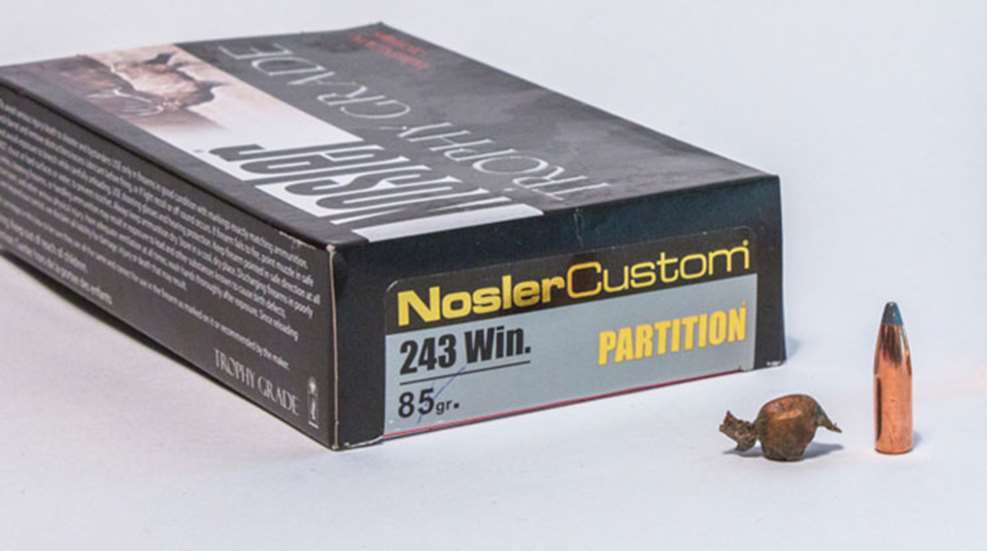
The dual lead core separated by a gilding metal barrier is where the partition gets it name, and is what makes it so effective. When the bullet strikes an animal, the front rapidly deforms. The gilding metal jacket peels back and the lead core flattens and wears away. This creates wide wound cavities; it’s a violent occurrence. After the bullet slows to about 1800 fps—inside the animal—deformation stops. But the rear lead core, protected by the partition, is still in tact. By retaining about 70 percent to 80 percent of its weight, the Partition continues to penetrate.
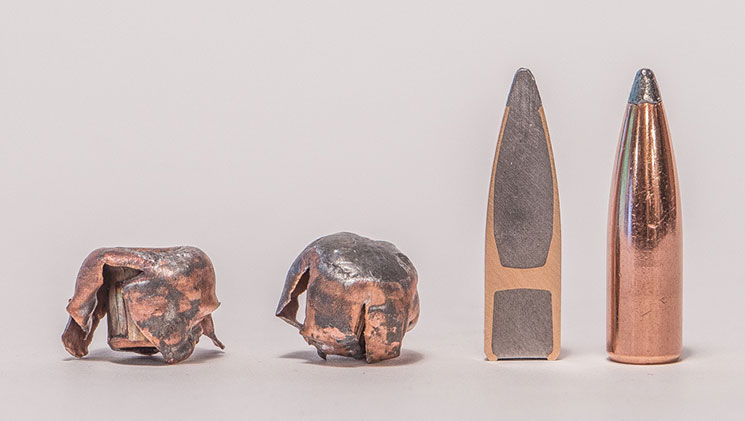
Since 1946 Nosler has continued to tune the Partition. The company has tweaked jacket thickness and hardness and massaged the content of the core. It has been refined to the point of perfection—but they are not cheap to make. A Partition bullet goes through many stages of formation and multiple heat-treating operations. No screw machines anymore—modern Partitions are pounded out on extrusion presses the size of a '64 Lincoln. It’s arguably the best big game bullet for killing critters ever invented. If it has a flaw, other than price, it’s that it sometimes might not shoot bug hole groups. That does not mean the Partition isn't accurate, it's just not a match bullet.
I’ve seen Partitions do amazing things. Most recently, in South Africa, an 85-grain Partition from my wife’s .243 Winchester pounded a big blue wildebeest to the ground with one shot through the heart. Two days before, another 85-grain Partition did the same thing to a gemsbok. I used a 165-grain Partition to take my best mule deer at a 318 yards and I’ve put numerous whitetails in my freezer with the littlest Partition; a 60 grainer out of a .223 Remington.
It might be hard to accept that a 70-year-old hunting bullet is still king of the hill, but look at it this way: the Reese's Cup has been with us for 87 years for the same reasons. That little candy cup perfectly balances the flavors of chocolate and peanut butter like the Partition balances expansion and penetration. They’re both about as close to perfection as you can get.